

A kind of plant haploid doubling method
A haploid and plant technology, applied in the biological field, can solve problems such as the inability to realize large-scale haploid breeding of corn, low doubling rate, and complicated operation, so as to promote the large-scale process, high safety for people and the environment, and easy operation simple effect
- Summary
- Abstract
- Description
- Claims
- Application Information
AI Technical Summary
Problems solved by technology
Method used
Image

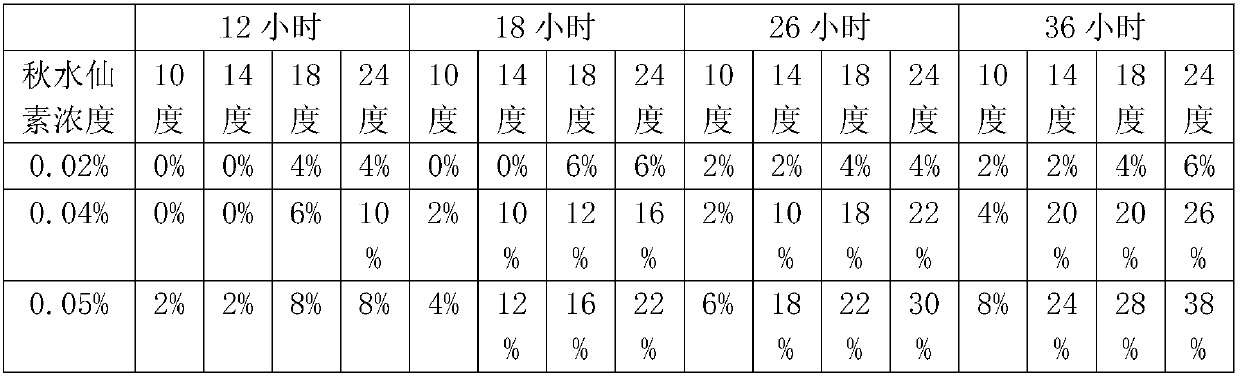
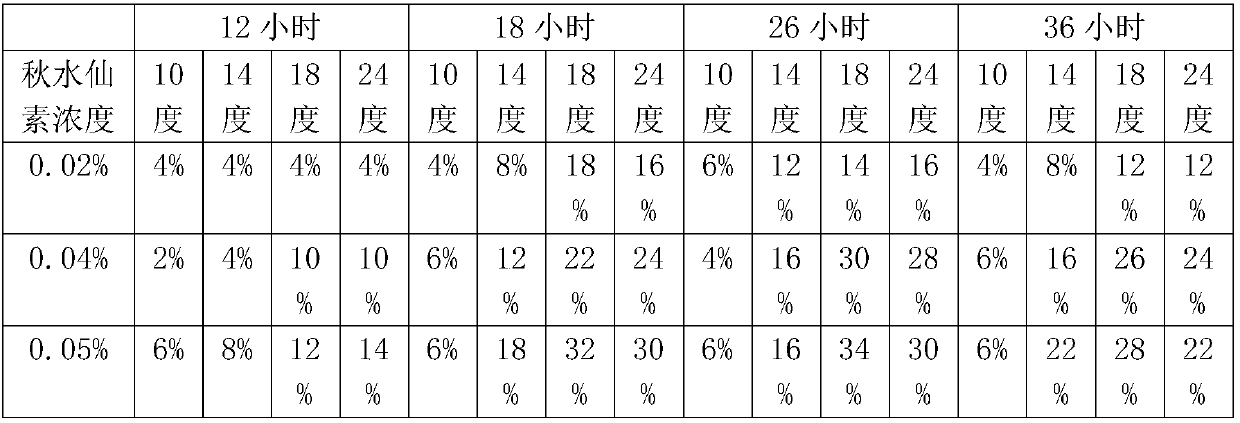
Examples
Embodiment 1
[0019] Present embodiment provides a kind of corn haploid doubling method, comprises the following steps:
[0020] 1) Disinfect the haploid corn kernels and place them in fine sand at 26-30°C to moisturize and accelerate germination;
[0021] 2) When the radicle length is 1-1.5cm, the young shoots are taken out, and placed at 4°C for 8-12 hours in the dark;
[0022] When the root tip length of corn is 1-1.5cm, its mitosis is in the most active period. Roots less than 1cm or greater than 1.5cm can also be used, but the effect is second. Therefore, the present embodiment selects the radicle length as 1-1.5cm.
[0023] The main function of this step is to reduce the cell division speed of the corn root tip, so that most of the cells are in the metaphase of mitosis, so that more diploid cells can be obtained in the subsequent colchicine treatment, and the doubling rate can be increased.
[0024] 4℃ is the critical temperature for maize radicle growth and meristematic zone mitosi...
Embodiment 2
[0035] 1) Germination of corn haploid seeds: sterilize the haploid seeds and soak them in distilled water for 10 hours; insert the soaked seeds evenly into a germination tray filled with sand with a humidity of about 75% (thickness of the sand tray is more than 10cm) , spread a wet towel, and place it in an incubator at 26°C for 2 days in the dark, and replenish water in time.
[0036] Excision of the top of the radicle: when the haploid radicle of the corn grows to about 1.5 cm, cut off the top 1-2 mm of the radicle of the haploid young germ of the corn, and then cut 1-2 mm longitudinally along the direction of the radicle.
[0037] 2) Colchicine solution preparation: prepare colchicine solutions with 3 different concentrations (mass percentage): 0.02% colchicine+2% dimethyl sulfoxide; 0.04% colchicine+2% dimethyl sulfoxide Sulfone; 0.049% colchicine + 2% dimethyl sulfoxide; 0.05% colchicine + 2% dimethyl sulfoxide;
[0038] 3) Sprout soaking: the radicle of the radicle trea...
Embodiment 3
[0042] This method is currently the most common method - the germination seed treatment method
[0043] Colchicine concentration: 0.06%, 0.08%, 0.1%
[0044] Germination of haploid seeds: sterilize the haploid seeds and soak them in distilled water for 10 hours; place the seeds evenly in a germination tray covered with a wet towel, and place them in a suitable environment at 26°C for about 24 hours in dark light. The radicle is taken out after breaching.
[0045] Treatment: put the seed embryo of Lubai (radicle break) face down in the germination tray, and then add appropriate amount of colchicine solution of different concentrations mentioned above, whichever is just submerged the seed embryo surface. The treatment time is 4h, 8 hours and 12 hours respectively. The processing temperature is normal temperature (about 22 degrees).
[0046]The treated seeds were washed with running water for about 40 minutes, sown in a nutrient bowl, and moved into the field at the stage of 3...
PUM
 Login to View More
 Abstract
Description
Claims
Application Information
 Login to View More