Method for converting tree-like nested data into plane data table
What is AI technical title?
AI technical title is built by PatSnap AI team. It summarizes the technical point description of the patent document.
A data table and data technology, applied in the information field, can solve problems such as consuming manpower and financial resources, and achieve the effect of reducing costs
Active Publication Date: 2016-09-07
零氪医疗智能科技(广州)有限公司
View PDF3 Cites 12 Cited by
Summary
Abstract
Description
Claims
Application Information
AI Technical Summary
This helps you quickly interpret patents by identifying the three key elements:
Problems solved by technology
Method used
Benefits of technology
Problems solved by technology
Although this tree-shaped nested structure is convenient for data expression and storage, it is difficult to be accepted by various data processing systems designed for flat data tables. At this time, manual structure conversion is usually required, which will consume a lot of manpower and financial resources.
Method used
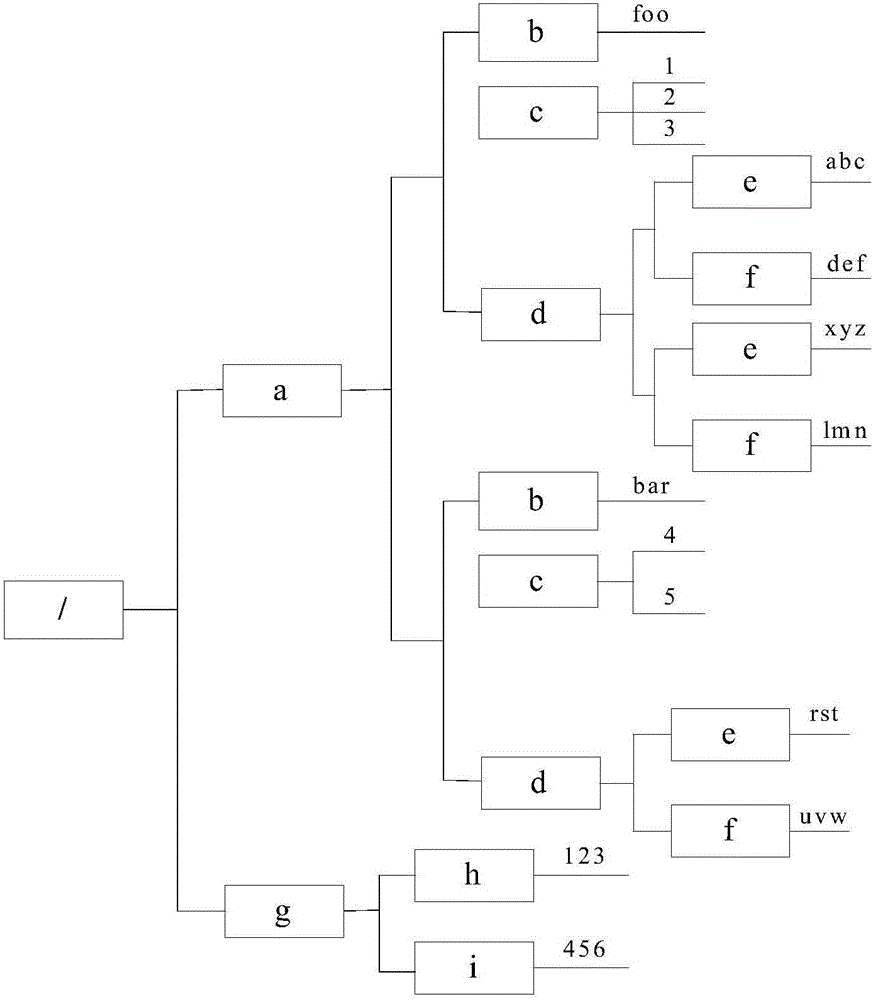
the structure of the environmentally friendly knitted fabric provided by the present invention; figure 2 Flow chart of the yarn wrapping machine for environmentally friendly knitted fabrics and storage devices; image 3 Is the parameter map of the yarn covering machine
View more
Image
Smart Image Click on the blue labels to locate them in the text.
Viewing Examples
Smart Image
Click on the blue label to locate the original text in one second.
Reading with bidirectional positioning of images and text.
Smart Image
Examples
Experimental program
Comparison scheme
Effect test
Embodiment 1
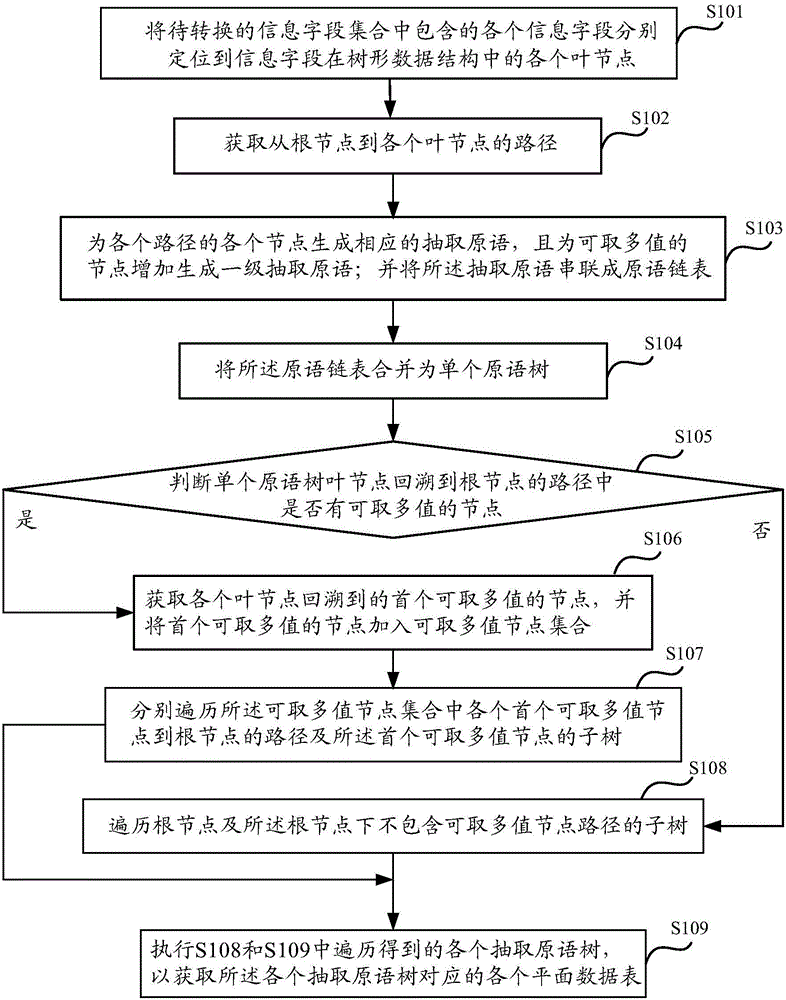
[0051] like figure 1 As shown, it is a method for converting tree nested data into a flat data table provided in the embodiment of the present invention, and the specific steps are as follows:
[0052] S101. Locate each information field in the information field set to be converted to a leaf node in a tree data structure.
[0053] For a tree structure, nodes include root nodes, branch nodes and leaf nodes, and each stage corresponds to a different field name, where the field names of the leaf nodes are associated with specific data, and each branch node (or intermediate node, That is, the intermediate nodes except the root node and the leaf node) are all information groups, which do not associate with any data except for nodes containing subordinate fields.
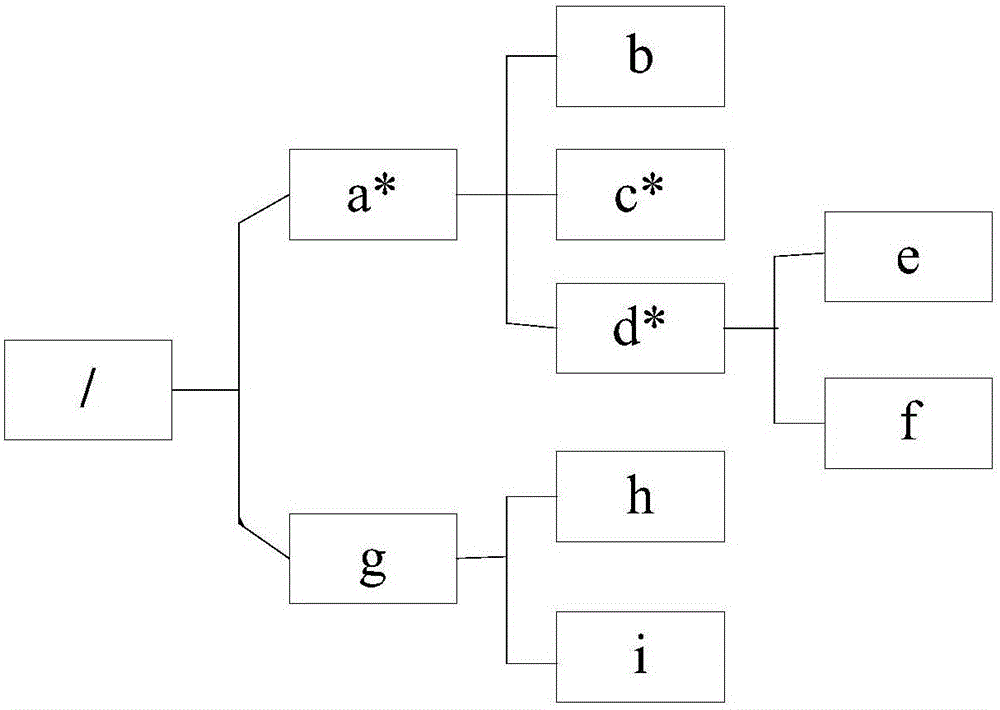
[0054] like figure 2 It shows an example of the definition of a tree-shaped nested structure: where / represents the root of the data object, and each letter from a to i represents the field name on different levels, a...
Embodiment 2
[0098] In order to further illustrate the technical solution of this application, this application provides an example of a specific application scenario, as follows:
[0099] S201, assuming that the information of each information field in the information field set to be converted is weight information, height information, admission diagnosis information, discharge diagnosis information, operation date and operation name, which correspond to leaf node weight, height, admission diagnosis , discharge diagnosis, date of operation, and name of operation.
[0100] S202. Calculate a path from the root node to each of the leaf nodes. And generating corresponding extraction primitives for each node of each path, and concatenating the extraction primitives into a primitive linked list.
[0101] In this embodiment, the following data extraction primitives are defined:
[0102] CID-generate preset public fields; the public fields include but not limited to at least one of the followin...
the structure of the environmentally friendly knitted fabric provided by the present invention; figure 2 Flow chart of the yarn wrapping machine for environmentally friendly knitted fabrics and storage devices; image 3 Is the parameter map of the yarn covering machine
Login to View More
PUM
Login to View More
Abstract
An embodiment of the present invention discloses a method for converting a tree-like nested data into a plane data table. The method comprises: A. separately locating each information field contained in a to-be-converted information field set onto each leaf node, which corresponds to the information field, in a tree-like data nested structure; B. acquiring each path from a root node to each leaf node; C. generating each primitive chained list according to each path; D. combining the primitive chained lists into a single primitive tree; E. traversing each node the single primitive tree, so as to acquire each extracted primitive tree; and F. executing each extracted primitive tree, so as to acquire each plane data table corresponding to each extracted primitive tree. Therefore, the method disclosed by the embodiment of the present invention is beneficial for automatically carrying out the structure conversion process of converting the tree-like nested data into the plane data table, thereby effectively reducing costs of subsequent data usage.
Description
technical field [0001] The invention relates to the field of information technology, in particular to a method for converting tree nested data into flat data tables. Background technique [0002] In fields such as medical care and the Internet, it often occurs that information of multiple dimensions is integrated into a single data object. Usually, such data objects are represented as irregular deeply nested tree structures. In the tree data structure, each leaf node is an information field, and its value can be single-valued or multi-valued; each branch node is an information group, and the information group can be repeated or non-repeated, and non-repeated information A group can contain a heterogeneous number of nodes, while a group of repeated information can contain an isomorphic variable number of nodes. Although this tree-shaped nested structure is convenient for data expression and storage, it is difficult to be accepted by various data processing systems designed f...
Claims
the structure of the environmentally friendly knitted fabric provided by the present invention; figure 2 Flow chart of the yarn wrapping machine for environmentally friendly knitted fabrics and storage devices; image 3 Is the parameter map of the yarn covering machine
Login to View More
Application Information
Patent Timeline
Application Date:The date an application was filed.
Publication Date:The date a patent or application was officially published.
First Publication Date:The earliest publication date of a patent with the same application number.
Issue Date:Publication date of the patent grant document.
PCT Entry Date:The Entry date of PCT National Phase.
Estimated Expiry Date:The statutory expiry date of a patent right according to the Patent Law, and it is the longest term of protection that the patent right can achieve without the termination of the patent right due to other reasons(Term extension factor has been taken into account ).
Invalid Date:Actual expiry date is based on effective date or publication date of legal transaction data of invalid patent.



 Login to View More
  Login to View More