
A method for synthesizing (nitroalkynyl) benzene compounds
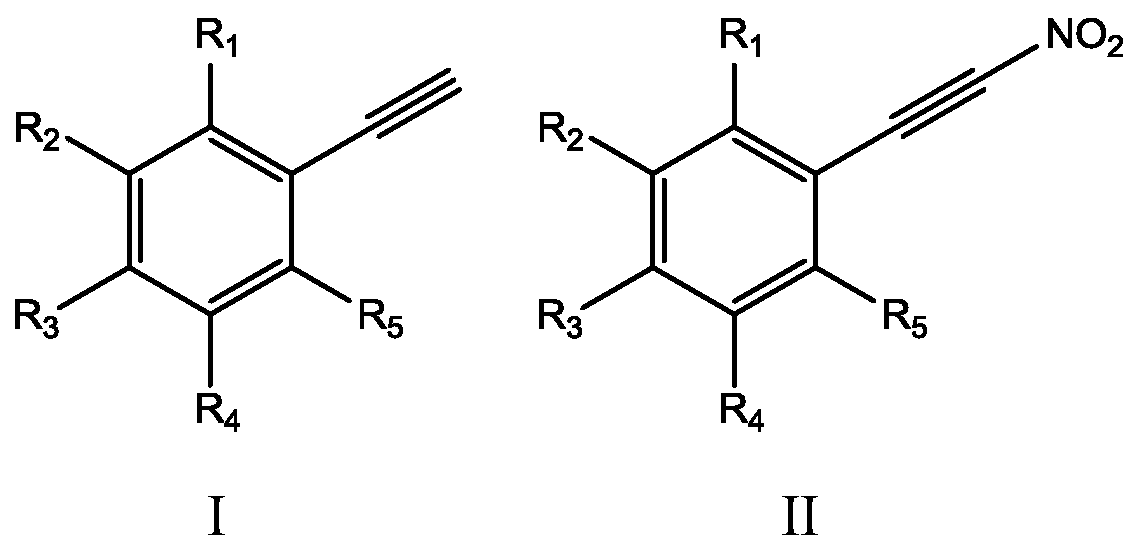
A technology of nitroalkynyl benzene and compounds, which is applied in the field of preparation of benzene compounds, can solve the problems of low product yield and purity, difficult nitration reaction, difficult to obtain target products, etc., and achieves good substrate adaptability and selectivity The effect of good properties and simple reaction steps
- Summary
- Abstract
- Description
- Claims
- Application Information
AI Technical Summary
Problems solved by technology
Method used
Image

Examples
Embodiment 1
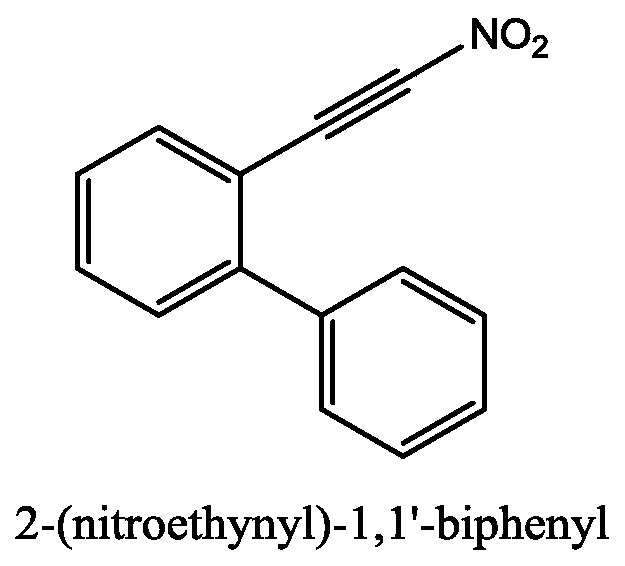
[0032] (1) Add 0.5mmol (89mg) of 2-phenylphenylacetylene, 1mmol (133mg) of N-chlorosuccinimide, 1mmol (154mg) of silver nitrite and 5ml of acetonitrile into a sealed pressure vessel with a volume of 25ml. The mixture was reacted at 25°C for 8 hours. After the TLC detection reaction finished, the reaction solution was diluted with dichloromethane, filtered to obtain the clear liquid, separated by column chromatography (eluent ratio: sherwood oil to ethyl acetate volume ratio 10:1), and collected the product containing Eluent, the eluent was distilled off to obtain 2-(nitroalkynyl)-1,1'biphenyl (78% yield).
[0033]
[0034] yellow solid; 1 H NMR (CDCl 3 ,500MHz):δ7.79(d,J=1.0Hz,1H),7.66(t,J=1.5Hz,1H),7.57(m,2H),7.47(m,5H),
Embodiment 2
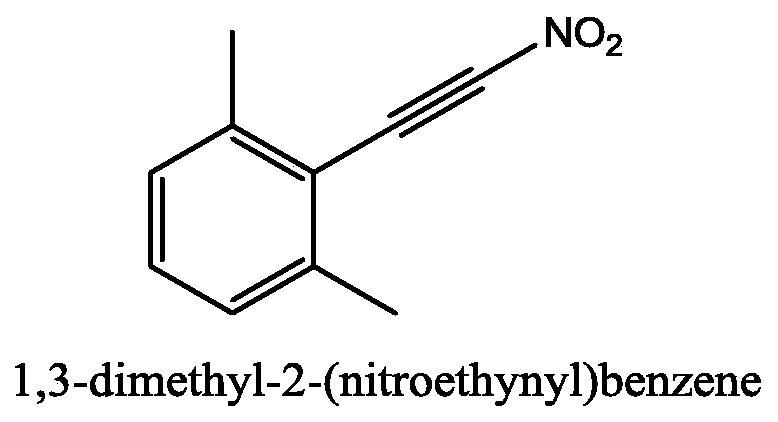
[0036] Add 0.5mmol (65mg) of 2,6-dimethylphenylacetylene, 0.5mmol (67mg) of N-chlorosuccinimide, 0.5mmol (77mg) of silver nitrite and 5ml of acetonitrile into a 25ml sealed pressure vessel in sequence middle. The mixture was reacted at 25°C for 8 hours. After the TLC detection reaction finished, the reaction solution was diluted with dichloromethane, filtered to obtain the clear liquid, separated by column chromatography (eluent ratio: sherwood oil to ethyl acetate volume ratio 10:1), and collected the product containing Eluent, eluent was distilled off to obtain 2,6-dimethyl-(nitroalkynyl)benzene (56% yield).
[0037]
[0038] white solid, 1 H NMR (CDCl 3 ,500MHz):δ7.35(t,J=7.5Hz,1H),7.13(d,J=7.5Hz,2H),6.17(s,6H).
Embodiment 3
[0040] Add 0.5mmol (80mg) of 3,5-dimethoxyphenylacetylene, 1mmol (133mg) of N-chlorosuccinimide, 1mmol (154mg) of silver nitrite and 4ml of acetonitrile into a sealed pressure vessel with a volume of 25ml. . The mixture was reacted at 40°C for 8 hours. After the TLC detection reaction finished, the reaction solution was diluted with dichloromethane, filtered to obtain the clear liquid, separated by column chromatography (eluent ratio: sherwood oil to ethyl acetate volume ratio 10:1), and collected the product containing Eluent, eluent was distilled off to obtain 1,3-dimethoxy-5-(nitroalkynylbenzene) (66% yield).
[0041]
[0042] white solid; 1 H NMR (CDCl 3 ,500MHz): δ6.76(d,J=2.5Hz,2H),6.66(d,J=2.0Hz,1H),3.81(s,6H)
PUM
 Login to View More
 Abstract
Description
Claims
Application Information
 Login to View More