
A method for preparing ethylene cracking material by hydrogenation of liquefied gas
A technology in the direction of liquefied gas and feed, which is used in the processing of gas mixtures, hydrocarbon oil treatment products, and hydrocarbon oil treatment. Fast and other problems, to achieve the effect of gentle temperature bulb, reducing the temperature rise of the reaction, and reducing the temperature rise
- Summary
- Abstract
- Description
- Claims
- Application Information
AI Technical Summary
Problems solved by technology
Method used
Image



Examples
Embodiment 1
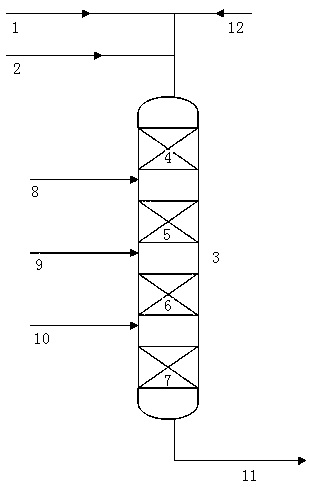
[0048] The reaction adopts a fixed-bed reactor and feeds upwards. The catalyst is loaded in four stages, from top to bottom, the catalyst volume fraction of each stage is: 10%, 15%, 25%, 50%. The reaction is divided into four stages to feed hydrogen, and the amount of hydrogen fed to each stage of the bed is respectively: the amount of hydrogen entering the first catalyst bed in the first stage is 30v% of the chemical hydrogen consumption required for the reaction, and the amount of hydrogen entering the second catalyst bed in the second stage The amount of hydrogen in the bed is 30v% of the chemical hydrogen consumption required for the reaction, the amount of hydrogen entering the third catalyst bed in the third stage is 30v% of the chemical hydrogen consumption required for the reaction, and the fourth stage enters the fourth catalyst bed The amount of hydrogen is 50v% of the chemical hydrogen consumption required for the reaction. In addition to the liquefied gas, the rea...
Embodiment 2
[0061] Raw material used in this embodiment, catalyst are the same as embodiment 1. Distillate oil (coker gasoline) was not introduced during the reaction. The hydrogenation process conditions and results are listed in Table 7. The amount of carbon deposited in each section of the catalyst bed after operation is shown in Table 8.
[0062] Table 7 Operating conditions and results of liquefied gas hydrogenation reactor
[0063] Reaction conditions
[0064] Table 8 Coke analysis data of bed catalysts in each section after operation
[0065] Coke deposition in each section of the reactor bed
[0066] From the reaction results in Tables 7 and 8, it can be seen that the method of introducing hydrogen in stages in the scheme of the present invention is adopted, and distillate oil (coker gasoline) is not introduced during the reaction. The temperature rise of each section of the catalyst bed is higher than that in Example 1, and the amount of carbon deposits in ...
PUM
 Login to View More
 Abstract
Description
Claims
Application Information
 Login to View More