
Control method for preventing leaf vegetables against root-knot nematode
A technology for root-knot nematode disease and root-knot nematode, applied in plant protection, botanical equipment and methods, horticulture, etc., can solve problems such as high cost, impact on economic income, damage to ecological environment, etc. Significant benefits, the effect of improving soil structure
- Summary
- Abstract
- Description
- Claims
- Application Information
AI Technical Summary
Problems solved by technology
Method used
Image


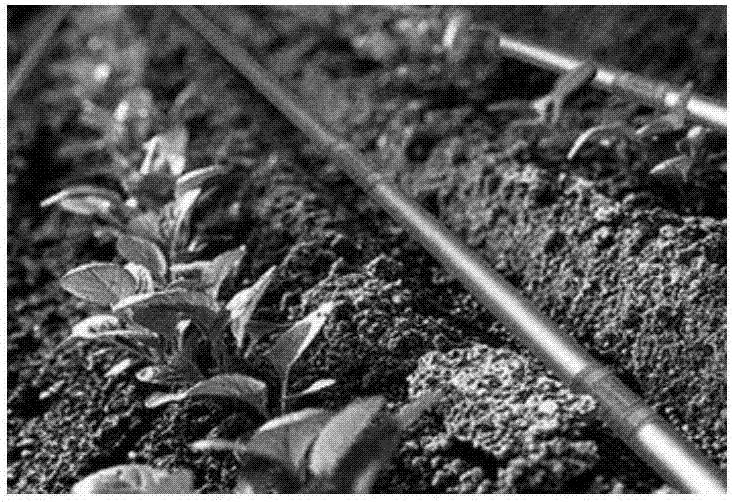
Examples
Embodiment 1
[0070] An experiment was carried out in a simple greenhouse in Hanting District, Shouguang City. The greenhouse was 10 years old. Vegetable farmers have been growing celery in a conventional way, and root-knot nematodes were serious in the greenhouse. The phenomenon of internal dead trees is very serious. There are also root-knot nematodes on some purslane, amaranth and other weeds. The investigation found that there are about 10 root-knot nematodes per plant in celery, and the yield per mu is about 5,500 jin. Vegetable farmers have never done stuffy shed treatment , In view of this, we first adopted the method of the present invention to carry out the shed processing. Then divide the shed area into 6 parts, each 0.5 mu, and mark them as test field 1, test field 2, test field 3, test field 4, test field 5 and test field 6 in sequence, and plant 3 consecutive crops.
[0071] 1. The first crop: Chinese celery, which is root-knot nematode susceptible.
[0072] On August 20, 2014...
PUM
 Login to View More
 Abstract
Description
Claims
Application Information
 Login to View More