
Two-cistron expression vector suitable for HEK293 cell, and preparation method, expression system and application thereof
An expression vector and bicistronic technology, which is applied in the field of genetic engineering and can solve the problems of inability to screen stably transformed cell lines and not including screening markers.
- Summary
- Abstract
- Description
- Claims
- Application Information
AI Technical Summary
Problems solved by technology
Method used
Image

Examples
Embodiment 1
[0048] The construction of a bicistronic expression vector suitable for HEK293 cells, the specific steps are as follows:
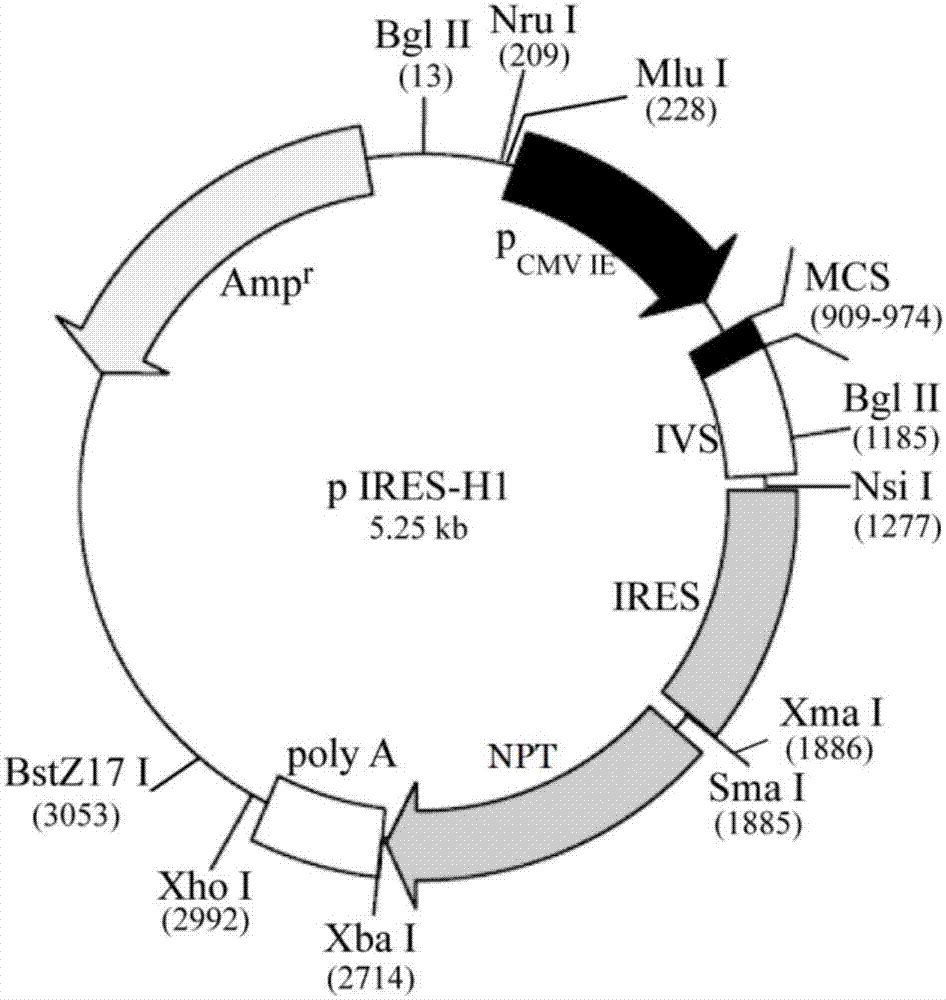
[0049] 1. Construction of pIRES-H1 vector
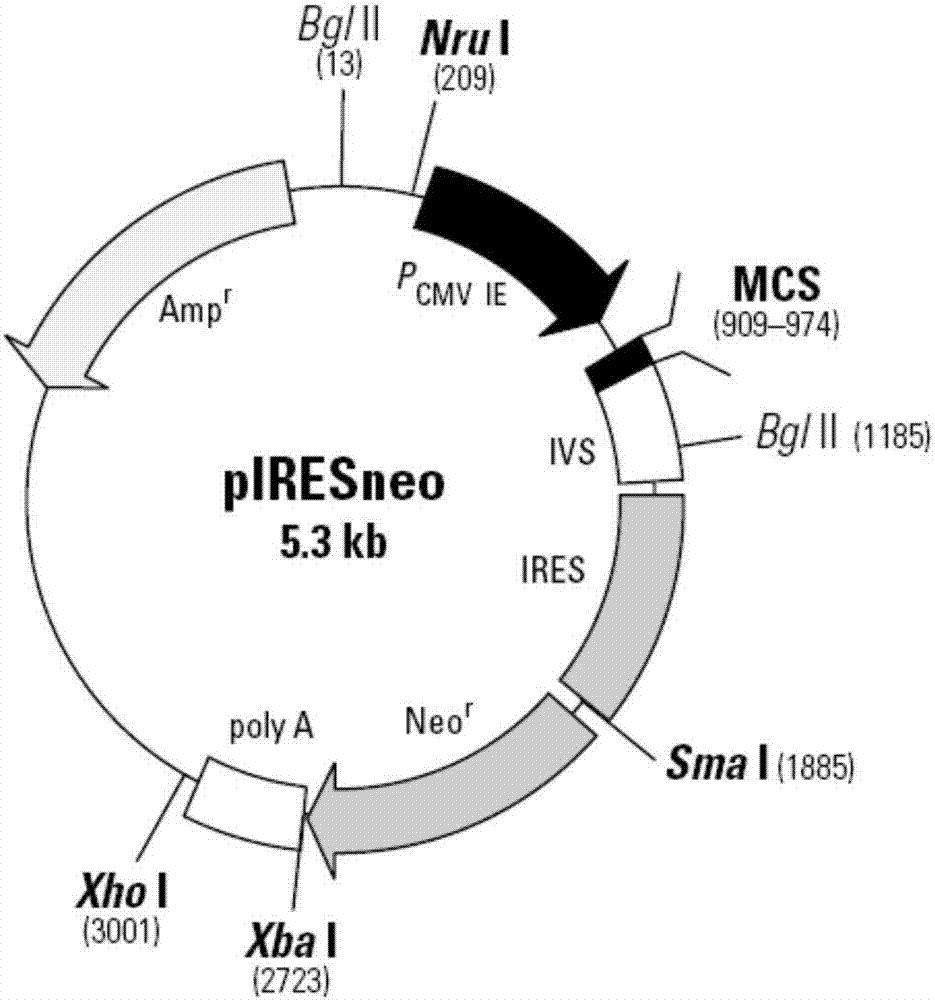
[0050] The purpose of this step is to pIRES-neo carrier (its structure is as follows figure 1 Shown) the selection marker gene was replaced by the NPT resistance weakening gene.
[0051] 1) Artificially synthesized NPT resistance weakening gene
[0052] The NPT resistance weakening gene (as shown in SEQ ID NO.3) was designed and artificially synthesized, which was specifically handed over to General Biogene (Anhui) Co., Ltd. to complete.
[0053] In order to facilitate cloning and ensure sequence integrity, when synthesizing the weakened NPT resistance gene, AAC CCCGGGATAATTCCTGCAGCCAAT sequence was introduced at the 5′ end, where AAC was the protective base, CCCGGG was the XmaI restriction site, and ATAATTCCTGCAGCCAAT was the partial sequence on the vector pIRES-Neo (GenBank: U89673.1, bases 1892-1909); the 3...
Embodiment 2
[0077] The construction of the eukaryotic cell expression system, the specific steps are as follows:
[0078] 1. Construction of a bicistronic expression vector containing an exogenous gene of erythropoietin (EPO)
[0079] 1) Synthetic EPO sequence
[0080] According to the EPO sequence published by NCBI (GenBank: JN849371.1, bases 1 to 582), the EPO sequence was artificially synthesized (EcoRI and BamHI restriction sites were introduced at the 5' end and 3' end respectively), and the details were handed over to General Biotech. Gene (Anhui) Co., Ltd. completed.
[0081] 2) Construction of a bicistronic expression vector containing the EPO sequence
[0082] The artificially synthesized EOP sequence was digested with EcoRI / BamHI double-enzyme primers, and pIRES-neo and pIRES-H2 plasmid DNA were simultaneously digested with EcoRI / BamHI double-enzyme. The digestion results were identified by agarose gel electrophoresis, and the digested EPO sequence fragments and pIRES-neo and...
Embodiment 3
[0089] Construction of bicistronic expression vector pIRES-Neo-EPO suitable for HEK293 cells.
[0090] Refer to the method in Example 2 to construct the pIRES-Neo-EPO expression vector containing the EPO exogenous gene, which differs from pIRES-H2-EPO as follows:
[0091] 1) Different screening markers; pIRES-Neo-EPO screening marker is 1906-2709 on the vector (GenBank: U89673.1, base 1906-2709); pIRES-H2-EPO screening marker sequence is as SEQ ID NO.2 shown;
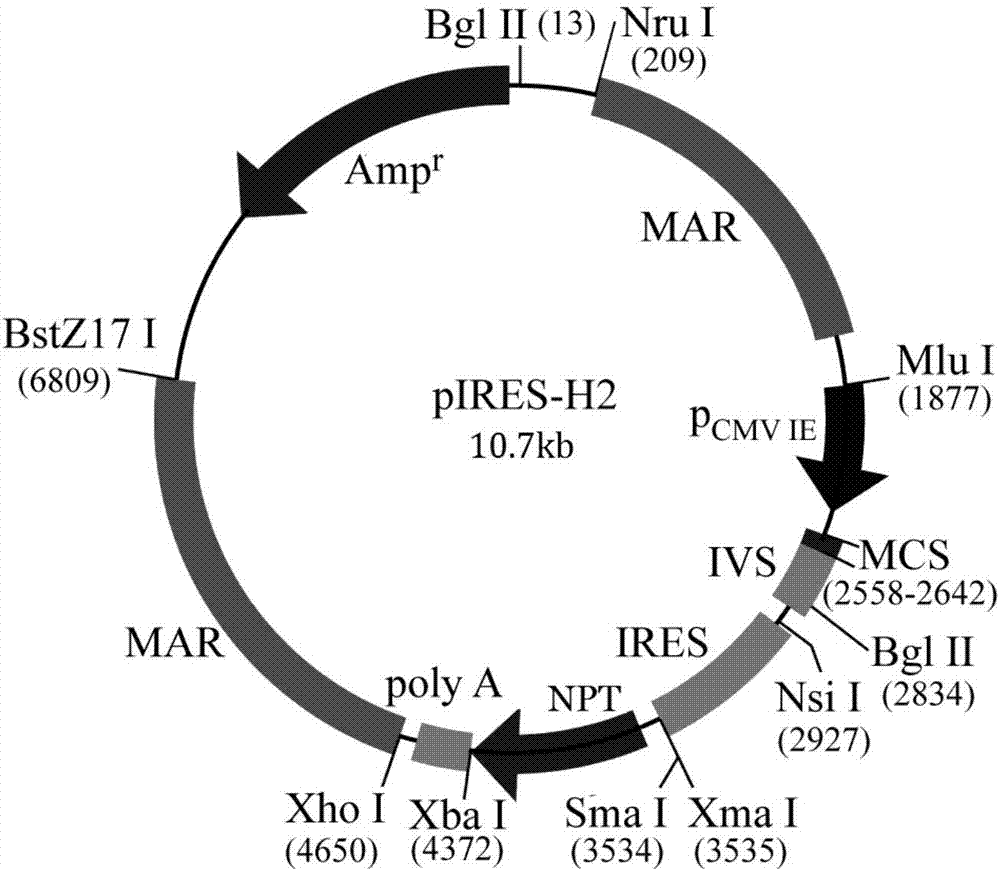
[0092] 2) pIRES-Neo-EPO does not contain the MAR sequence at both ends, and pIRES-H2-EPO contains the human X-29 MAR sequence before the CMV promoter, and contains the β-globin MAR sequence downstream of poly A.
[0093] Construct the pIRES-Neo-EPO eukaryotic cell expression system, and its construction method is the same as that in Example 2.
PUM
 Login to View More
 Abstract
Description
Claims
Application Information
 Login to View More