
A method for improve that capacity of 1.55 V nanometer lithium titanate battery
A technology of lithium titanate and battery capacity, which is applied in the field of increasing the capacity of 1.55V nano-lithium titanate single battery, can solve the problems of loss of battery performance, reduction of battery cycle times, and shortened battery life, and achieve the goal of breaking the bottleneck of use Effect
- Summary
- Abstract
- Description
- Claims
- Application Information
AI Technical Summary
Problems solved by technology
Method used
Image

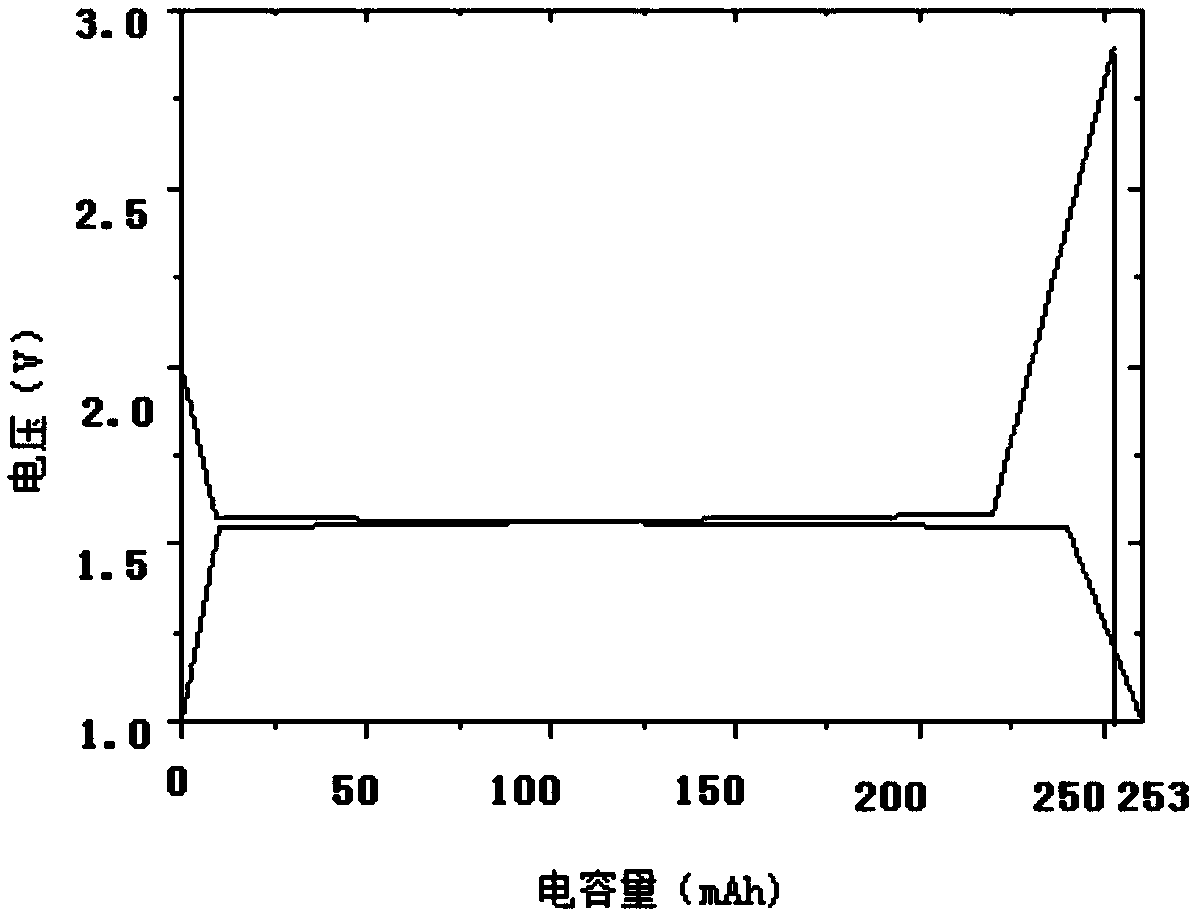

Examples
Embodiment Construction
[0023] The technical solutions of the present invention will be further described below in conjunction with the accompanying drawings and specific embodiments.
[0024] A method for improving the capacity of a 1.55V nano-lithium titanate battery, the specific steps are:
[0025] Step 1: Prepare raw materials
[0026] Weigh and weigh butyl titanate C 16 h 36 o 4 Ti, polyvinyl alcohol PVA, lithium hydroxide LiOH and terbium nitrate Tb (NO 3 ) 3 Four raw materials, the molar ratio of elements lithium, titanium and terbium is required to meet 1.666:1.323:0.01, and the weight of PVA is 5-10% of the total weight of the three raw materials of butyl titanate, lithium hydroxide and terbium nitrate;
[0027] Step 2: Precursor Synthesis
[0028] In butyl titanate C 16 h 36 o 4 Add water and polyvinyl alcohol PVA to Ti to dissolve butyl titanate, then add lithium hydroxide LiOH and terbium nitrate (NO 3 ) 3 After the aqueous solution is mixed evenly, add it to the autoclave, he...
PUM
 Login to View More
 Abstract
Description
Claims
Application Information
 Login to View More