
Manufacturing method of personalized acetabular prosthesis and auxiliary method for total hip replacement
A technology of acetabular prosthesis and manufacturing method, which is applied in the field of total hip replacement, can solve problems such as difficult errors, and achieve the effects of reducing inconsistencies in milling axes, reducing surgical burden, and improving milling quality
- Summary
- Abstract
- Description
- Claims
- Application Information
AI Technical Summary
Problems solved by technology
Method used
Image

Examples
Embodiment Construction
[0031] The present invention is further described in conjunction with the following examples.
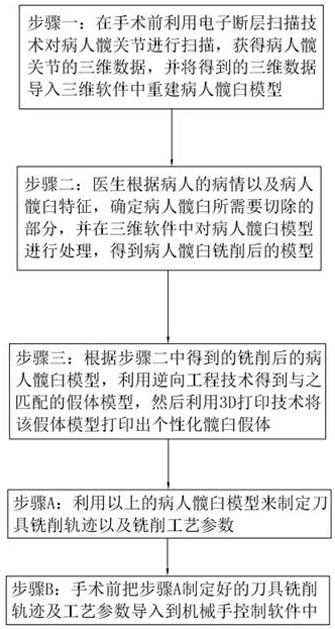
[0032] The auxiliary method of the total hip arthroplasty of the present embodiment,
[0033] Step 1: Scan the patient's acetabular fossa using electron tomography (CT scanning), obtain the three-dimensional data of the patient's acetabulum, and import the data into reverse software, such as mimics software, and then obtain the 3D model of the patient's acetabulum;
[0034] Step 2: According to the patient's condition and the characteristics of the patient's acetabulum, the doctor formulates the part of the patient's acetabulum that needs to be removed, and then imports the 3D model of the acetabulum obtained in the first step into the software that can perform Boolean operations, such as SolidWorks, Obtain the model structure of the patient after milling by performing Boolean operations on the acetabular model;
[0035] Step 3: Import the patient's milled acetabular model obtaine...
PUM
 Login to View More
 Abstract
Description
Claims
Application Information
 Login to View More