SCARA robot friction model improvement and dynamical parameter identification method

A dynamic parameter and friction model technology, applied in instruments, simulators, computer control, etc., can solve the problems of insufficient torque prediction accuracy and insufficient parameter identification accuracy, so as to speed up the optimization time, improve the accuracy, and not exceed the limit. Effect

A dynamic parameter and friction model technology, applied in instruments, simulators, computer control, etc., can solve the problems of insufficient torque prediction accuracy and insufficient parameter identification accuracy, so as to speed up the optimization time, improve the accuracy, and not exceed the limit. Effect

CN110531707AActive Publication Date: 2019-12-03WUXI XINJIE ELECTRICAL

Image

Smart Image Click on the blue labels to locate them in the text.
Viewing Examples
Smart Image
  • SCARA robot friction model improvement and dynamical parameter identification method
  • SCARA robot friction model improvement and dynamical parameter identification method
  • SCARA robot friction model improvement and dynamical parameter identification method

Examples

Experimental program
Comparison scheme
Effect test

Embodiment Construction

[0061] The preferred embodiments of the present invention will be described below in conjunction with the accompanying drawings. It should be understood that the preferred embodiments described here are only used to illustrate and explain the present invention, and are not intended to limit the present invention.

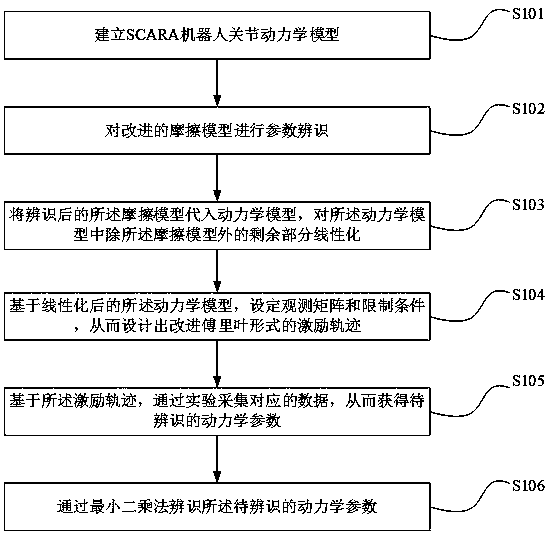
[0062] like figure 1 As shown, a friction model improvement and dynamic parameter identification method for a SCARA robot, including:

[0063] S101: establishing a joint dynamics model of the SCARA robot;

[0064] S102: Perform parameter identification on the improved friction model;

[0065] S103: Substituting the identified friction model into a dynamic model, and linearizing the rest of the dynamic model except the friction model;

[0066] S104: Based on the linearized dynamics model, set an observation matrix and restriction conditions, so as to design an excitation trajectory in an improved Fourier form;

[0067] S105: Based on the excitation trajectory, colle...

the structure of the environmentally friendly knitted fabric provided by the present invention; figure 2 Flow chart of the yarn wrapping machine for environmentally friendly knitted fabrics and storage devices; image 3 Is the parameter map of the yarn covering machine
Login to View More

PUM

No PUM Login to View More

Abstract

The invention discloses an SCARA robot friction model improvement and dynamical parameter identification method, which comprises the following steps: establishing an SCARA robot joint dynamical model;performing parameter identification on an improved friction model; substituting the identified friction model into the dynamical model, and linearizing the rest part, except the friction model, in the dynamical model; on the basis of the linearized dynamical model, setting an observation matrix and limiting conditions to design an excitation track in an improved Fourier form; based on the excitation track, collecting corresponding data through an experiment to obtain dynamical parameters to be identified; and identifying the dynamical parameters to be identified through a least square method.The method has the advantages of improving the precision of parameter identification and the accuracy of torque prediction.

Description

the structure of the environmentally friendly knitted fabric provided by the present invention; figure 2 Flow chart of the yarn wrapping machine for environmentally friendly knitted fabrics and storage devices; image 3 Is the parameter map of the yarn covering machine
Login to View More

Claims

the structure of the environmentally friendly knitted fabric provided by the present invention; figure 2 Flow chart of the yarn wrapping machine for environmentally friendly knitted fabrics and storage devices; image 3 Is the parameter map of the yarn covering machine
Login to View More

Application Information

Patent Timeline
03 Dec 2019
Publication
CN110531707A