Image patch matching method based on multi-scale convolution
A matching method and multi-scale technology, applied in the field of image processing, can solve the problem of not considering the multi-scale features of the patch, and achieve the effect of overcoming insufficient training, improving training efficiency, and eliminating differences.
- Summary
- Abstract
- Description
- Claims
- Application Information
AI Technical Summary
Problems solved by technology
Method used
Image



Examples
Embodiment
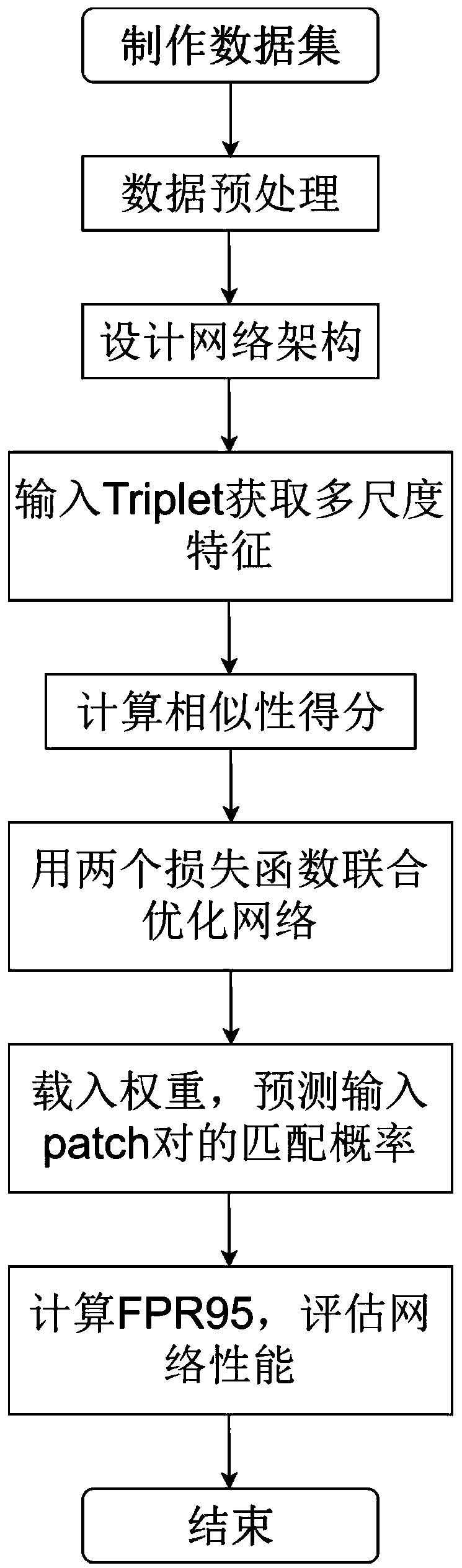
[0084] S1. To evaluate the performance of our method, we validate it on the widely used homogeneous dataset UBC PhotoTour and the heterogeneous dataset VIS-NIR. UBC PhotoTour contains three subsets: Liberty, Yosemite, and Notredame. The three subsets contain 450K, 634K, and 468K independent patch blocks and 160K, 230K, and 147K unique 3D points. VIS-NIR contains 9 subsets, namely: Country, Field, Forest, Indoor, Mountain, Oldbuilding, Street, Urban, Water, and the matching samples and non-matching samples in each subset account for half. On the UBC PhotoTour dataset, we train on Liberty, Yosemite, and Notredame respectively, and then test on the other two subsets. On the VIS-NIR dataset, we train on the Country subset and test on the other 8 subsets;
[0085] S2. Each independent 3D point on the UBC PhotoTour dataset contains 2-5 patches, and 2 patches with the same 3D point form a matching pair. Randomly select 2 patches for each 3D point on each subset of UBC PhotoTour (T ...
PUM
 Login to View More
 Abstract
Description
Claims
Application Information
 Login to View More