Unlock instant, AI-driven research and patent intelligence for your innovation.
Coupling objective lens for confocal microendoscope
What is Al technical title?
Al technical title is built by PatSnap Al team. It summarizes the technical point description of the patent document.
A technology of confocal microscopy and coupled objects, applied in the field of coupled objective lenses
Active Publication Date: 2020-03-27
JINGWEI SHIDA MEDICAL TECH WUHAN CO LTD
View PDF3 Cites 0 Cited by
Summary
Abstract
Description
Claims
Application Information
AI Technical Summary
This helps you quickly interpret patents by identifying the three key elements:
Problems solved by technology
Method used
Benefits of technology
Problems solved by technology
[0005] Therefore, it is a problem to be solved to design a coupling objective lens that can aim at excitation light and fluorescence achromatism, large working distance, matching numerical aperture and optical fiber bundle numerical aperture, and good coupling performance.
Method used
the structure of the environmentally friendly knitted fabric provided by the present invention; figure 2 Flow chart of the yarn wrapping machine for environmentally friendly knitted fabrics and storage devices; image 3 Is the parameter map of the yarn covering machine
View more
Image
Smart Image Click on the blue labels to locate them in the text.
Viewing Examples
Smart Image
Click on the blue label to locate the original text in one second.
Reading with bidirectional positioning of images and text.
Smart Image
Examples
Experimental program
Comparison scheme
Effect test
Embodiment 1
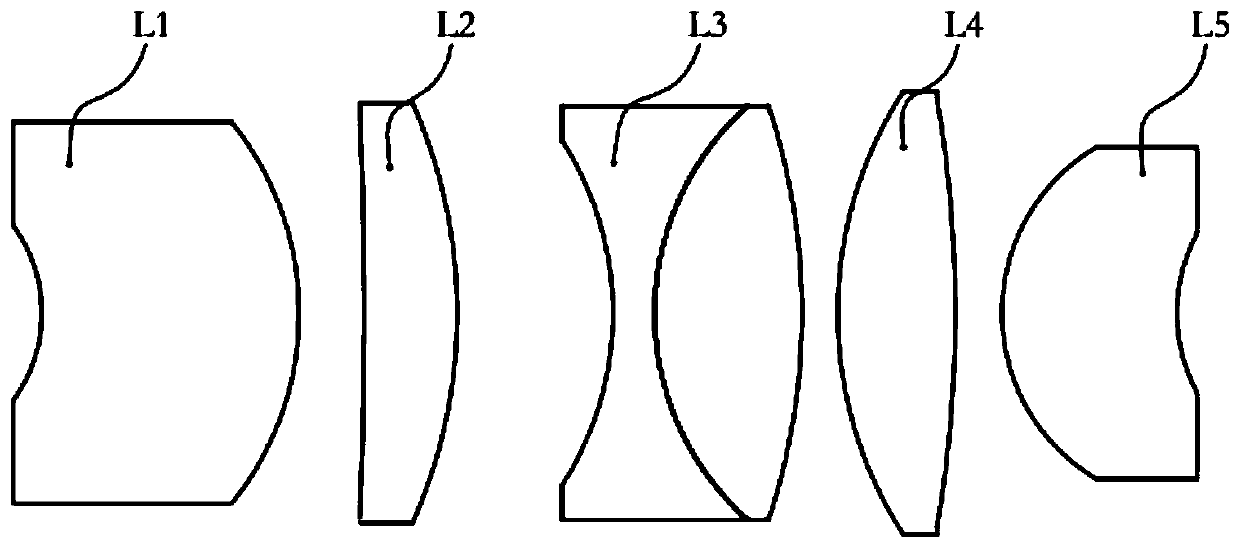
[0017] like figure 1 As shown, this embodiment provides a coupling objective lens for a confocal microendoscope, comprising a first lens L1 with negative refractive power, a second lens L2 with positive refractive power, and a third lens with negative refractive power Lens L3, fourth lens L4 with positive refractive power, fifth lens L5 with positive refractive power. The light passes through the first lens L1, the second lens L2, the third lens L3, the fourth lens L4, and the fifth lens L5 in sequence, and finally forms an image on the image plane.
[0018] Further, the first lens L1, the second lens L2, the third lens L3, the fourth lens L4, and the fifth lens L5 are all spherical lenses. Specifically, the third lens is a double cemented lens, which is composed of a double concave lens and a double convex lens. This structure is more convenient for process processing and simplifies the manufacturing process. The specific parameters of each lens are shown in Table 1.
[0...
Embodiment 2
[0032] The lens structure in this embodiment is the same as that in the first embodiment, the difference is the specific parameters of each lens, see Table 2 for details.
[0033] Table 2 Specific parameters of the coupling objective of the confocal microendoscope (unit: mm)
[0034]
[0035] Wherein, the radius of curvature of the front surface of the first lens L1 is -8.389mm, the radius of curvature of the rear surface is -16.130mm, the central thickness T1 of the first lens is 14.591mm, the back surface of the first lens and the front surface of the second lens are The center thickness of the surface is 2.939mm, the material of the first lens is H-ZLAF50D, the clear aperture of the front surface of the first lens is 5mm, and the clear aperture of the rear surface is 10.60mm;
[0036] The radius of curvature of the front surface of the second lens L2 is 93.760mm, the radius of curvature of the rear surface is -34.051mm, the center thickness T2 of the second lens is 6.237...
the structure of the environmentally friendly knitted fabric provided by the present invention; figure 2 Flow chart of the yarn wrapping machine for environmentally friendly knitted fabrics and storage devices; image 3 Is the parameter map of the yarn covering machine
Login to View More
PUM
Login to View More
Abstract
The invention provides a coupling objective lens for a confocal microendoscope. The coupling objective lens comprises a first lens with negative focal power, a second lens with positive focal power, athird lens with negative focal power, a fourth lens with positive focal power and a fifth lens with positive focal power which are sequentially arranged from an object side to an image side along anoptical axis. According to the coupling objective lens, the incident angle and the emergent angle of light are strictly controlled through cooperation of all the lenses, achromatism is conducted on exciting light and fluorescence signals, and the numerical aperture is made to be matched with the numerical aperture of an optical fiber bundle while the large working distance is guaranteed.
Description
technical field [0001] The invention relates to the technical field of probe-type confocal endoscopes, in particular to a coupling objective lens for confocal microendoscopes. Background technique [0002] The probe-type confocal microendoscope consists of two subsystems: the confocal host and the confocal probe. The former provides optical drive and partial fluorescencesignal collection functions, and the latter transmits the optical drive coupled from the former and collects in a flexible manner at the same time. fluorescencesignal. The interaction between these two subsystems is through the coupling objective lens. Because the coupling objective acts as a bridge linking the above, the performance of the coupling objective and the matching with the optical parameters of the entire system are very important. [0003] In order to adapt to the observation of biological specimens and the conversion between objective lenses, various standard documents, such as "GB / T 2609-20...
Claims
the structure of the environmentally friendly knitted fabric provided by the present invention; figure 2 Flow chart of the yarn wrapping machine for environmentally friendly knitted fabrics and storage devices; image 3 Is the parameter map of the yarn covering machine
Login to View More
Application Information
Patent Timeline
Application Date:The date an application was filed.
Publication Date:The date a patent or application was officially published.
First Publication Date:The earliest publication date of a patent with the same application number.
Issue Date:Publication date of the patent grant document.
PCT Entry Date:The Entry date of PCT National Phase.
Estimated Expiry Date:The statutory expiry date of a patent right according to the Patent Law, and it is the longest term of protection that the patent right can achieve without the termination of the patent right due to other reasons(Term extension factor has been taken into account ).
Invalid Date:Actual expiry date is based on effective date or publication date of legal transaction data of invalid patent.

 Login to View More
  Login to View More