
Defect-driven third-party library version upgrade recommendation method
A recommendation method and defect technology, applied in the field of defect-driven third-party library version upgrade recommendation, can solve problems such as difficult to determine, third-party library cannot be upgraded in time, and affect software system function and quality
- Summary
- Abstract
- Description
- Claims
- Application Information
AI Technical Summary
Problems solved by technology
Method used
Image

Examples
Embodiment Construction
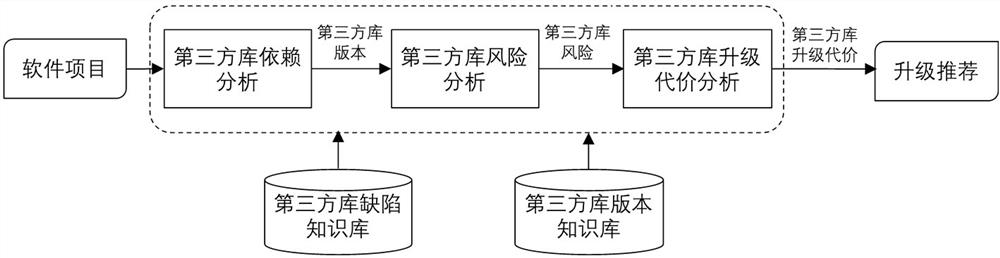
[0020] The specific embodiment of the present invention is described below for Java, Maven software project, and its main use process is:
[0021] (1) Third-party library dependency analysis. Obtain the third-party library version that the software project depends on by parsing the dependency configuration file pom..xml of Java and Maven software projects;
[0022] (2) Risk analysis of third-party libraries. Obtain the third-party library API list through the static analysis tool Soot; traverse the abstract syntax tree of the source code of the software project through JavaParser and obtain the third-party library API called by the software project; obtain the call graph of the called third-party library API through the static analysis tool Soot And judge whether the third-party library API affected by the defect is included in the call graph; analyze and summarize the number of third-party library defects affecting the software project, the number of defective third-party li...
PUM
 Login to View More
 Abstract
Description
Claims
Application Information
 Login to View More