Classification model tendency test method and system based on layering technology
What is AI technical title?
AI technical title is built by Patsnap AI team. It summarizes the technical point description of the patent document.
A classification model and layered technology technology, applied in the field of blockchain and machine learning, to achieve the effect of reliable evaluation and verification results
Pending Publication Date: 2021-07-09
应急管理部大数据中心
View PDF0 Cites 0 Cited by
Summary
Abstract
Description
Claims
Application Information
AI Technical Summary
This helps you quickly interpret patents by identifying the three key elements:
Problems solved by technology
Method used
Benefits of technology
Problems solved by technology
However, how to reasonably adjust the proportion of the test set according to the proportion of the training
Method used
the structure of the environmentally friendly knitted fabric provided by the present invention; figure 2 Flow chart of the yarn wrapping machine for environmentally friendly knitted fabrics and storage devices; image 3 Is the parameter map of the yarn covering machine
View more
Image
Smart Image Click on the blue labels to locate them in the text.
Viewing Examples
Smart Image
Click on the blue label to locate the original text in one second.
Reading with bidirectional positioning of images and text.
Smart Image
Examples
Experimental program
Comparison scheme
Effect test
Example Embodiment
[0020] Example one
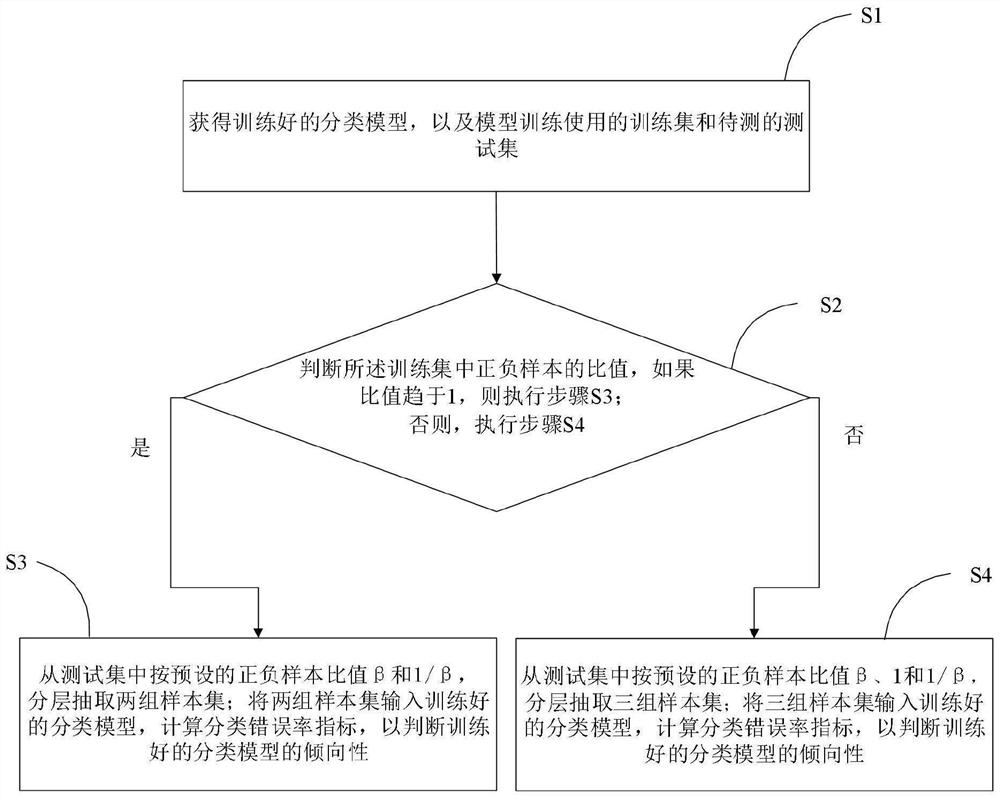
[0021] Such as figure 1 As shown, a classification model of a layered technique provided by the embodiment of the present invention, including the following steps:
[0022] Step S1: Get a well-trained classification model, as well as the training set and the test set to be tested;
[0023] Step S2: Determine the ratio of the positive and negative samples in the training set, if the ratio tends to 1, then step S3: Otherwise, perform step S4;
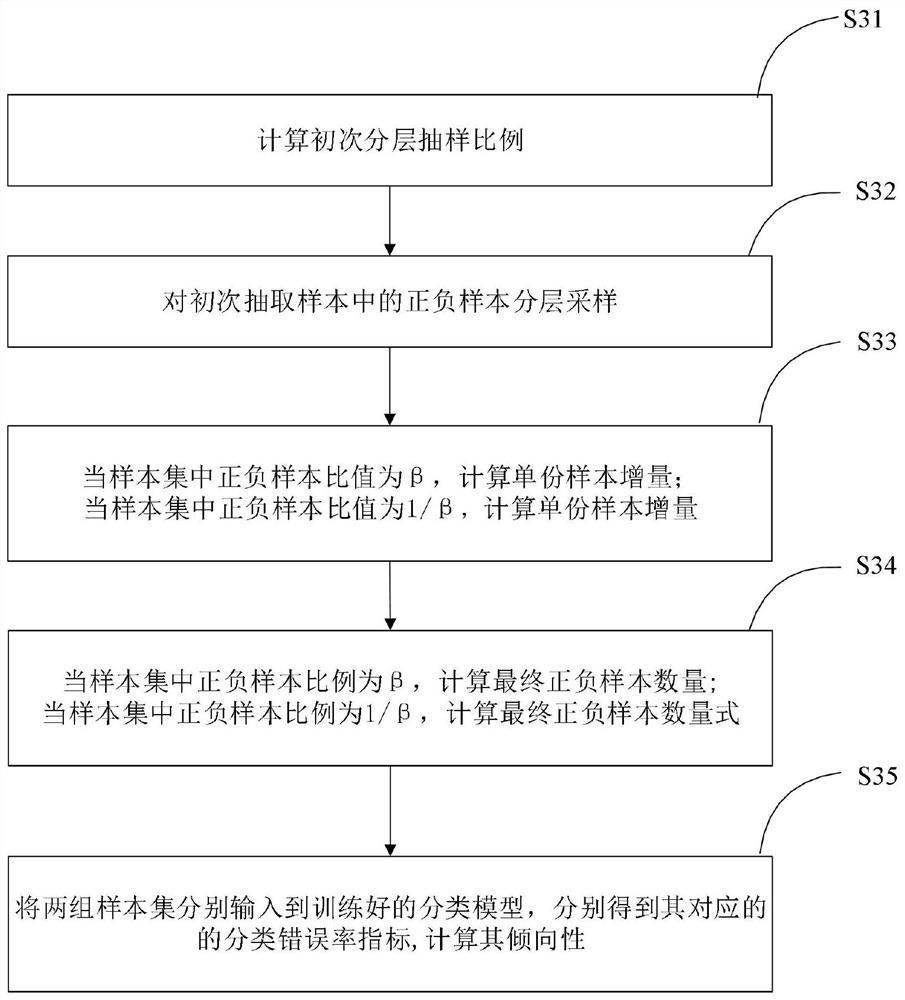
[0024] Step S3: From the test set, according to the preset positive and negative sample ratio β and 1 / β, the layered sample set; enter the two sets of sample sets into the training well-trained classification model, calculate the classification error rate indicator, to determine the training The tendency of the classification model;
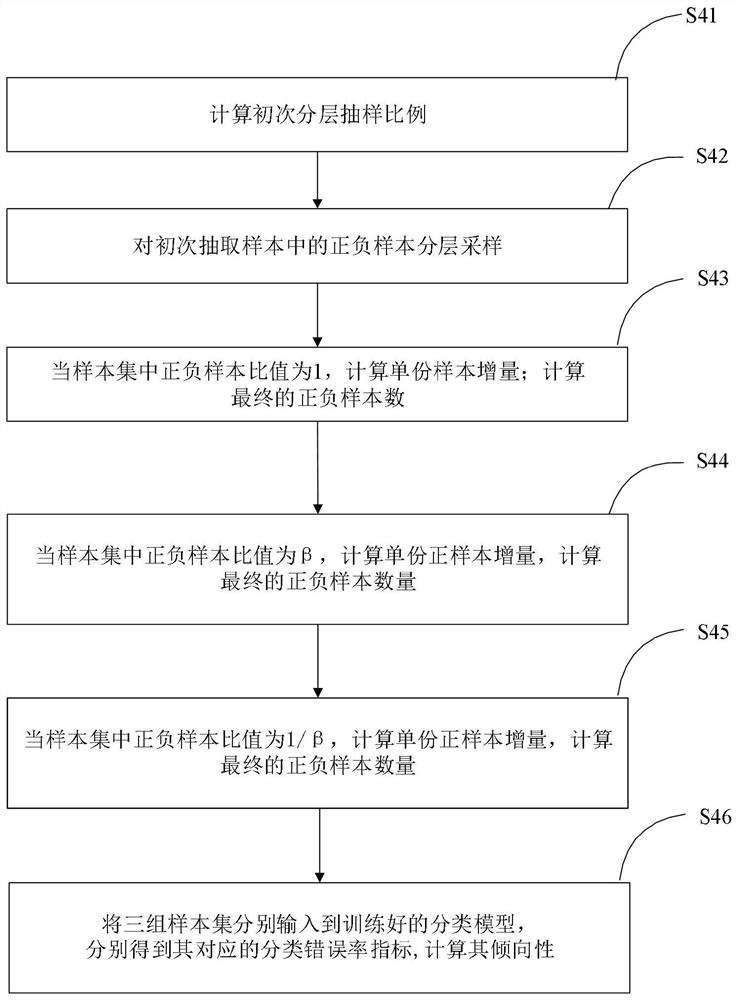
[0025] Step S4: From the test concentration according to the preset positive and negative sample ratio β, 1 and 1 / β, the layered extraction of three sets of samples; input three sets of ...
Example Embodiment
[0096] Example 2
[0097] Such as Figure 4 As shown, embodiments of the present invention provide a classification model of layered techniques, a tendency test system, including the following modules:
[0098] Get models and data modules 51 for obtaining training-trained classification models, as well as training sets used in model training and test set to be tested;
[0099] The determination module 52 is used to determine the ratio of the positive and negative samples in the training set. If the ratio tends to 1, the two sets of samples and inspection modules are collected; otherwise, the three sets of samples and inspection modules are executed;
[0100] The two sets of samples and inspection modules 53 were collected, and the two sets of sample sets were extracted from the preset positive and negative sample ratio β and 1 / β, and the two sets of sample sets were introduced. ClassificationError rate indicators to determine the tendency of the classification model of the training...
the structure of the environmentally friendly knitted fabric provided by the present invention; figure 2 Flow chart of the yarn wrapping machine for environmentally friendly knitted fabrics and storage devices; image 3 Is the parameter map of the yarn covering machine
Login to View More
PUM
Login to View More
Abstract
The invention relates to a classification model tendency test method and system based on a layering technology. The method comprises the following steps: S1, obtaining a trained classification model, a training set and a test set; S2, determining the ratio of positive and negative samples in the training set, if the ratio tends to 1, executing step S3, otherwise, executing step S4; S3, extracting two groups of sample sets in a layered manner from the test set according to preset positive and negative sample ratios beta and 1/beta; inputting the two groups of sample sets into the trained classification model, and calculating a classification error rate index to determine the tendency of the trained classification model; and S4, extracting three groups of sample sets from the test set in a layered manner according to preset positive and negative sample ratios beta, 1 and 1/beta; and inputting the three groups of sample sets into the trained classification model, and calculating a classification error rate index to determine the tendency of the trained classification model. According to the method, different sampling proportions are set, the model tendency is tested on a test set, and the model tendency is evaluated through classification performance indexes.
Description
technical field [0001] The invention relates to the fields of block chain and machine learning, in particular to a classification model tendency inspection method and system based on hierarchical technology. Background technique [0002] After training a machine learning classification model by using the training data, usually, a good classification model should be able to fully learn the essential feature expression of the training data, and at the same time have good performance in transferring to other data to be classified performance, that is, it has good generalization. However, since the performance of the model will not only be affected by the rationality of its own algorithm design but also be affected by the proportion of training data categories, it shows that it has good recognition performance for certain categories of data and poor recognition performance for data categories trained by using a small number of samples. Phenomena, how to verify whether the model...
Claims
the structure of the environmentally friendly knitted fabric provided by the present invention; figure 2 Flow chart of the yarn wrapping machine for environmentally friendly knitted fabrics and storage devices; image 3 Is the parameter map of the yarn covering machine
Login to View More
Application Information
Patent Timeline
Application Date:The date an application was filed.
Publication Date:The date a patent or application was officially published.
First Publication Date:The earliest publication date of a patent with the same application number.
Issue Date:Publication date of the patent grant document.
PCT Entry Date:The Entry date of PCT National Phase.
Estimated Expiry Date:The statutory expiry date of a patent right according to the Patent Law, and it is the longest term of protection that the patent right can achieve without the termination of the patent right due to other reasons(Term extension factor has been taken into account ).
Invalid Date:Actual expiry date is based on effective date or publication date of legal transaction data of invalid patent.


 Login to View More
  Login to View More