AI technical title is built by Patsnap AI team. It summarizes the technical point description of the patent document.
A technology of process and washing medium, which is applied in the field of washing process, and can solve the problems of unobserved, damaged catalyst component particles, etc.
Pending Publication Date: 2021-07-23
BOREALIS AG
View PDF98 Cites 0 Cited by
Summary
Abstract
Description
Claims
Application Information
AI Technical Summary
This helps you quickly interpret patents by identifying the three key elements:
Problems solved by technology
Method used
Benefits of technology
Problems solved by technology
It is expected that relatively severe separation processes such as hydrocyclone separation may somehow damage catalyst component particles (e.g. cause them to agglomerate or break up), but this has not been observed
Method used
the structure of the environmentally friendly knitted fabric provided by the present invention; figure 2 Flow chart of the yarn wrapping machine for environmentally friendly knitted fabrics and storage devices; image 3 Is the parameter map of the yarn covering machine
View more
Image
Smart Image Click on the blue labels to locate them in the text.
Viewing Examples
Smart Image
Click on the blue label to locate the original text in one second.
Reading with bidirectional positioning of images and text.
Smart Image
Examples
Experimental program
Comparison scheme
Effect test
example 1
[0257] Preparation of ZN Catalysts by Emulsion Solidification
[0258] raw material
[0259] TiCl 4 (CAS 7550-45-90) was supplied by a commercial source.
[0260] 20% butyl ethyl magnesium (Mg(Bu)(Et)) in toluene supplied by Crompton
[0261] 2-Ethylhexanol supplied by Merck Chemicals
[0262] 3-Butoxy-2-propanol supplied by Sigma-Aldrich
[0263] Bis(2-ethylhexyl) citrate by Contract Chemicals
[0264] 1-254 by Evonik
[0265] Heptane, supplied by Chevron
[0266] Preparation of Mg complex
[0267] 3.4 liters of 2-ethylhexanol and 810 ml of propylene glycol butyl monoether (4 / 1 molar ratio) were added to the 20 l reactor. Then, 7.8 liters of a 20% solution of BEM (butylethylmagnesium) in toluene supplied by Crompton GmbH were slowly added to the well stirred alcohol mixture. During the addition, the temperature was kept at 10°C. After the addition, the temperature of the reaction mixture was raised to 60°C and mixing was continued at this temperature for 30 minute...
example 2
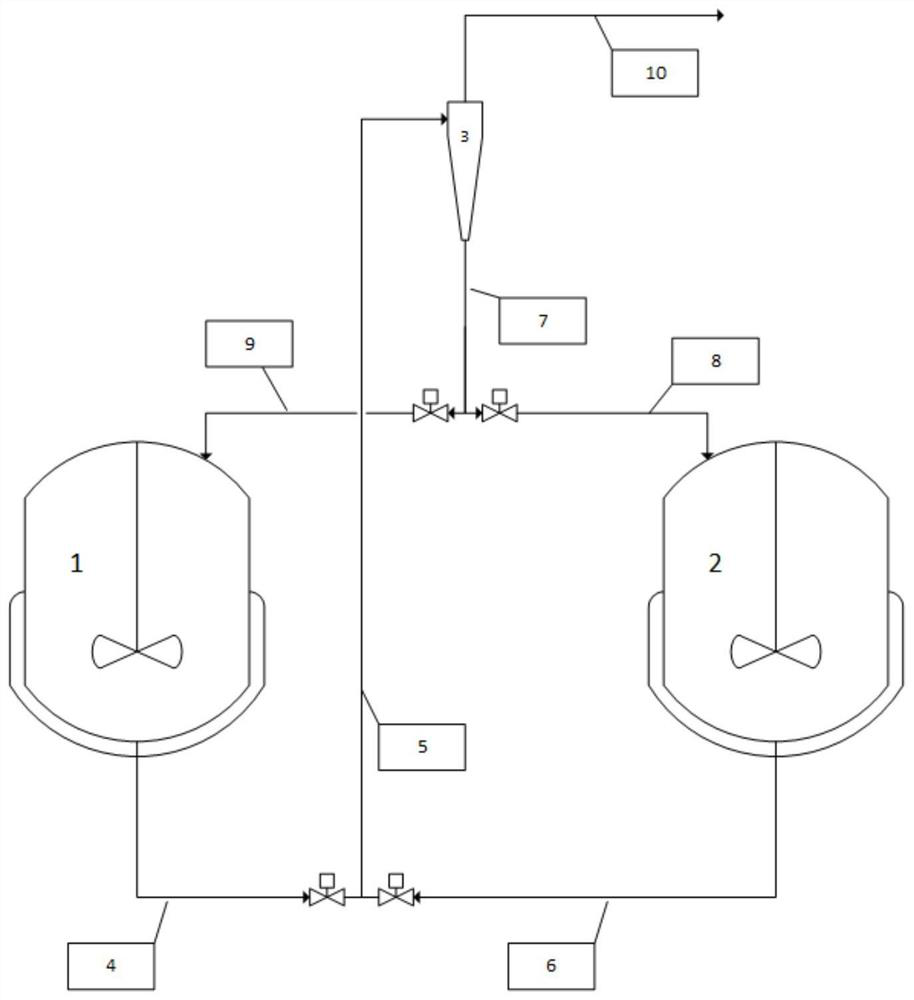
[0274] A hydrocyclone with a fractional particle size d50 of 13 μm was purchased from Krebs. Particles smaller than 13 μm enter the waste stream essentially from the top of the cyclone. Trials were carried out using a hydrocyclone connected to the catalyst preparation reactor unit 1 by connecting lines 4 and 5 . The catalyst was prepared according to the procedure described in Example 1.
[0275] The separation in the hydrocyclone is completed in less than 25 minutes.
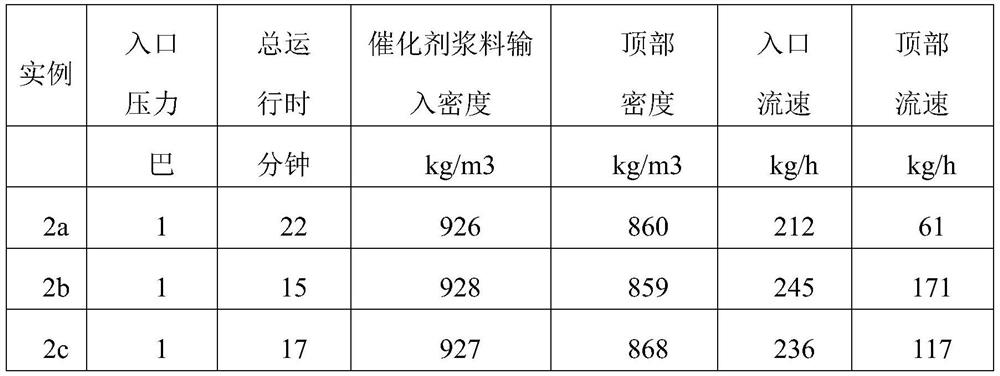
[0276] refer to figure 1 , in hydrocyclone unit 3, the solid catalyst particles and liquid medium are separated by transferring the mixture from reactor 1 through a hydrocyclone. The bottoms stream was removed from the hydrocyclone and transferred to Reactor 2. The pressure difference between inlet and top was 0.7 bar.
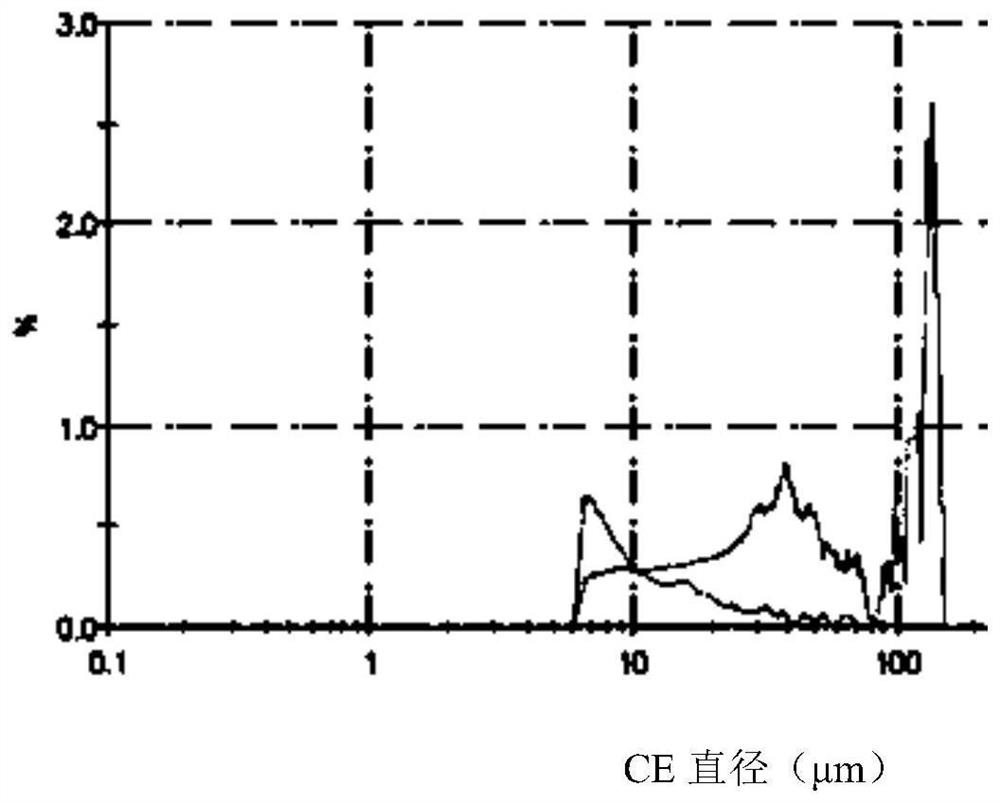
[0277] When analyzed using a Malvern particle size analyzer, the sample showed a fractional particle size of about the desired 13 μm ( figure 2 ).
[0278]
[0279] Example 3 - Washi...
the structure of the environmentally friendly knitted fabric provided by the present invention; figure 2 Flow chart of the yarn wrapping machine for environmentally friendly knitted fabrics and storage devices; image 3 Is the parameter map of the yarn covering machine
Login to View More
PUM
Property
Measurement
Unit
particle size
aaaaa
aaaaa
particle size
aaaaa
aaaaa
Login to View More
Abstract
A process for washing a particulate substance comprising: (i)combining a particulate substance and a first washing medium in a first vessel to form a slurry and washing the particulate substance with said washing medium; (ii)transferring the slurry to a hydrocyclone; (iii)removing a first by-product stream depleted in particulate substance and a first product stream enriched in particulate substance from the hydrocyclone; (iv)transferring the first product stream to a second vessel and in the presence of a second washing medium forming a slurry and washing the particulate substance with said second washing medium e.g. by agitation thereof; (v)transferring the slurry to ahydrocyclone; (vi)removing a second by-product stream depleted in particulate substance and a second product stream enriched in particulate substance from the hydrocyclone.
Description
technical field [0001] The present invention relates to a novel process for washing particulate compositions, particularly particles of solid olefin polymerization catalyst components, using a hydrocyclone. In one embodiment, the present invention involves washing solid catalyst component particles in multiple washing steps using a hydrocyclone. In another embodiment, the present invention involves the use of a hydrocyclone to separate solid catalyst component particles from the medium in which they are prepared and from the washing medium in which these particles are then washed. The process of the present invention uses a "pendulum" separation procedure that uses hydrocyclones to speed up the separation process. Background technique [0002] The use of solid olefin polymerization catalysts to prepare polyolefins, such as polyethylene and polypropylene, is well known. Typically, these solid catalysts contain external supports. [0003] Supported Ziegler-Natta (ZN) cataly...
Claims
the structure of the environmentally friendly knitted fabric provided by the present invention; figure 2 Flow chart of the yarn wrapping machine for environmentally friendly knitted fabrics and storage devices; image 3 Is the parameter map of the yarn covering machine
Login to View More
Application Information
Patent Timeline
Application Date:The date an application was filed.
Publication Date:The date a patent or application was officially published.
First Publication Date:The earliest publication date of a patent with the same application number.
Issue Date:Publication date of the patent grant document.
PCT Entry Date:The Entry date of PCT National Phase.
Estimated Expiry Date:The statutory expiry date of a patent right according to the Patent Law, and it is the longest term of protection that the patent right can achieve without the termination of the patent right due to other reasons(Term extension factor has been taken into account ).
Invalid Date:Actual expiry date is based on effective date or publication date of legal transaction data of invalid patent.



 Login to View More