An Adaptive Vacuum Forced Zero-Crossing DC Breaking Method Based on Superconducting Current Limiting

A superconducting current-limiting, DC breaking technology, applied in the direction of automatic disconnection emergency protection devices, electrical components, emergency protection circuit devices, etc., can solve the problems of poor reliability, breaking failure, high di/dt, etc. Achieve the effect of improving service life, improving breaking reliability, and enhancing small current breaking capacity

CN113612192BActive Publication Date: 2022-05-06XI AN JIAOTONG UNIV
10 Cites 0 Cited by

Patent Information

Authority / Receiving Office
CN · China
Patent Type
Patents(China)
Current Assignee / Owner
Publication Date
2022-05-06

Smart Images

  • Figure 1
    Figure 1
  • Figure 2
    Figure 2
  • Figure 3
    Figure 3
Patent Text Reader

Abstract

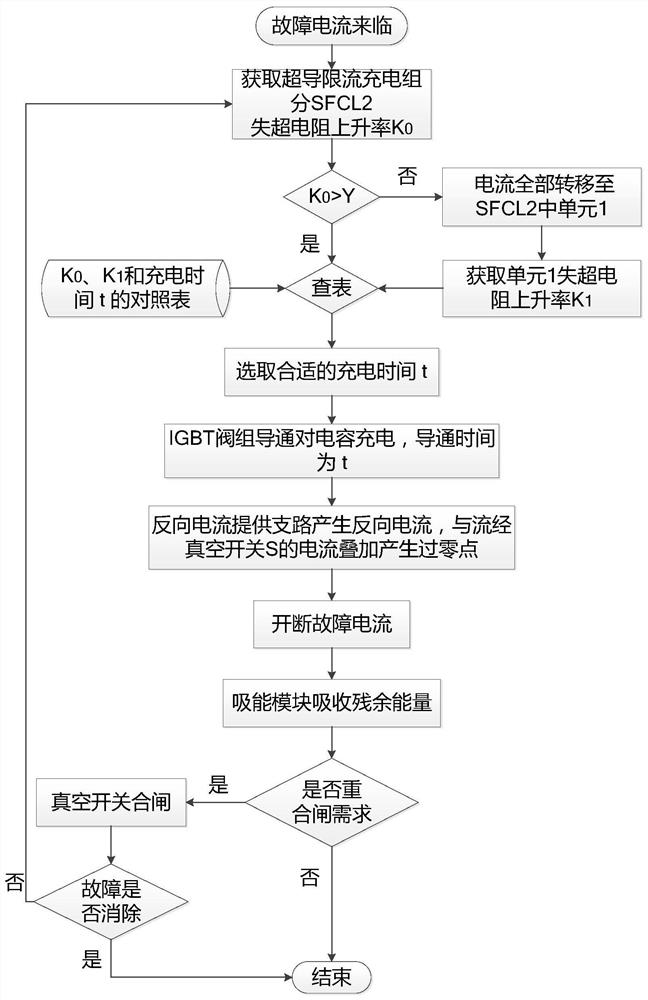
The invention discloses an adaptive vacuum forced zero-crossing DC breaking method based on superconducting current limiting. When the system fails, the quenching resistance rising rate K of part of the superconducting strip in the superconducting current limiter is obtained. 0 , compare K 0 and threshold Y size, if K 0 >Y, then according to the K-t comparison table, select the charging time t 0 ; On the contrary, the current is concentrated on the single superconducting coil, and the rate of rise of the quench resistance of the coil is obtained K 1 , and choose t 1 ; Then turn on the IGBT group, use the quench voltage to charge the capacitor, after completion, trigger the reverse current supply branch to generate a reverse current, superimpose with the current flowing through the vacuum switch to generate a zero-crossing point, and break the fault current; the energy absorption branch Absorb residual energy; finally, if there is no reclosing command, the process ends; otherwise, the vacuum switch is closed, and it is judged to repeat the above process or end the process according to whether the fault is eliminated. The invention solves the problem that the small current of the forced zero-crossing vacuum direct current circuit breaker is difficult to break, and has the ability of automatic reclosing.
Need to check novelty before this filing date? Find Prior Art

Description

technical field

[0001] The invention relates to the technical field of superconducting applications and DC breaking, in particular to an adaptive vacuum forced zero-crossing DC breaking method based on superconducting current limiting. Background technique

[0002] The high-voltage flexible DC grid can reliably realize long-distance, large-capacity, and high-efficiency power transmission, and is one of the key technologies for renewable energy consumption in the open sea. However, the method of fault removal on the DC side is a difficult point in the construction of the HVDC flexible grid. On the one hand, the DC current has no natural zero-crossing point, and the equipment cannot break the circuit with the help of the natural zero point of the current. The energy stored in the system inductance of several megajoules to tens of megajoules must be released through the high-voltage DC circuit breaker. On the other hand, the short-circuit fault current rise rate in the high-vo...

Examples

Embodiment Construction

[0027] The present invention will be described in further detail below in conjunction with the accompanying drawings and specific embodiments.

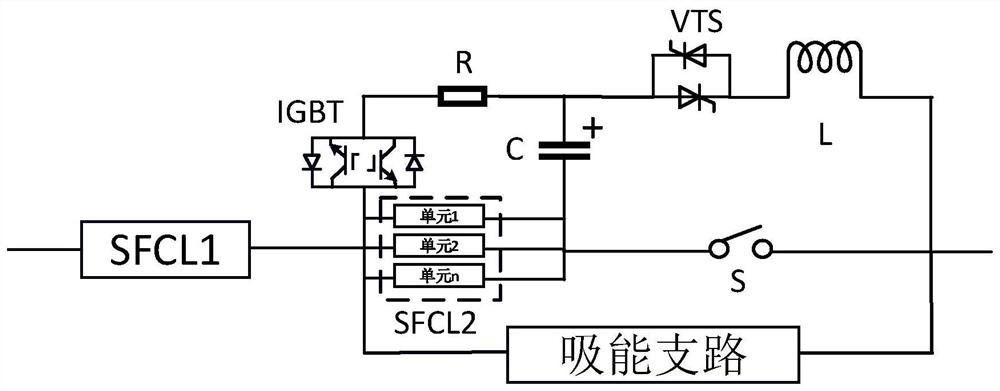
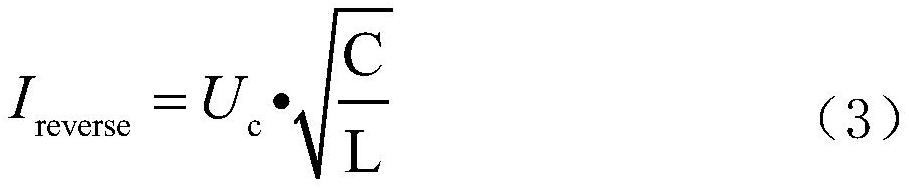
[0028] Such as figure 2Shown is a specific embodiment of the present invention. An adaptive vacuum forced zero-crossing DC breaking method based on superconducting current limiting, characterized in that the vacuum forced zero-crossing DC circuit breaker applicable to the DC breaking method includes a main flow branch, a charging circuit, Reverse current supply branch and energy absorption branch. The main flow branch consists of a superconducting current limiting component SFCL1, a superconducting current limiting charging component SFCL2, and a fast vacuum switch S connected in series. The superconducting current-limiting charging component SFCL2 is composed of several superconducting current-limiting charging units connected in parallel. The charging circuit is connected in parallel at both ends of the superconducting current-l...