Dynamic social network representation learning method
A social network and learning method technology, applied in the direction of instruments, data processing applications, calculations, etc., can solve problems such as inability to evolve, difficult to accurately describe the evolution trend of nodes, and difficult to reflect important network attributes of social networks, so as to achieve the effect of enriching network information
- Summary
- Abstract
- Description
- Claims
- Application Information
AI Technical Summary
Problems solved by technology
Method used
Image



Examples
Embodiment 1
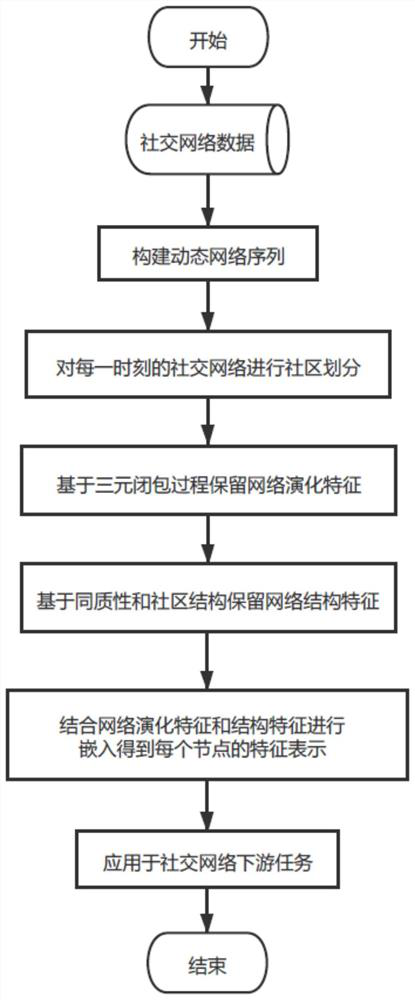
[0058] A dynamic social network representation learning method is realized based on ternary closure pattern analysis and community structure; including the following steps:
[0059] Step 1: Construct a dynamic network sequence, based on a given set of time steps {1,2,...,T}, for the social network data of a certain time step, construct a subgraph G {a} =(V,E {a} ,W {a} ), a∈{1,2,…,T};
[0060] Among them, V is a set of nodes, representing users in the network; E {a} is the set of edges at the current time step, representing the relationship between users; W {a} is a set of weights, representing the connection strength between users; the dynamic network is a sequence of subgraphs of all time steps G={G (1) ,G (2) ,...,G (T)};
[0061] Step 2: Community division, according to the structure of the network, and mark the community where each node is located; since the dynamic network evolves with time, it is necessary to perform community division on the network at each time...
Embodiment 2
[0085] This example is four real social network datasets, including fb-messages, ia-facebook, ia-contacts and ia-retweet, the specific information of which is shown in Table 1.
[0086] Table 1 Statistics of Weibo-Douban Network Data
[0087]
[0088] Step 1: For each dataset, we first construct the corresponding dynamic network sequence G={G (1) ,G (2) ,...,G (T)}, and then learn the low-dimensional vector U={U of each node at different time steps by the present invention (1) , U (2) ,...,U (T)}.
[0089] Step 2: In order to verify the performance of the proposed method, this example selects five classic network representation learning methods for comparison, including: DeepWalk, LINE, Node2vec, DynamicTriad and TNE, where DeepWalk, LINE and Node2vec are static network representation learning models, and DynamicTriad and TNE are dynamic network representation learning models. After weighing the computational complexity and computational performance, we use dimension...
PUM
 Login to View More
 Abstract
Description
Claims
Application Information
 Login to View More