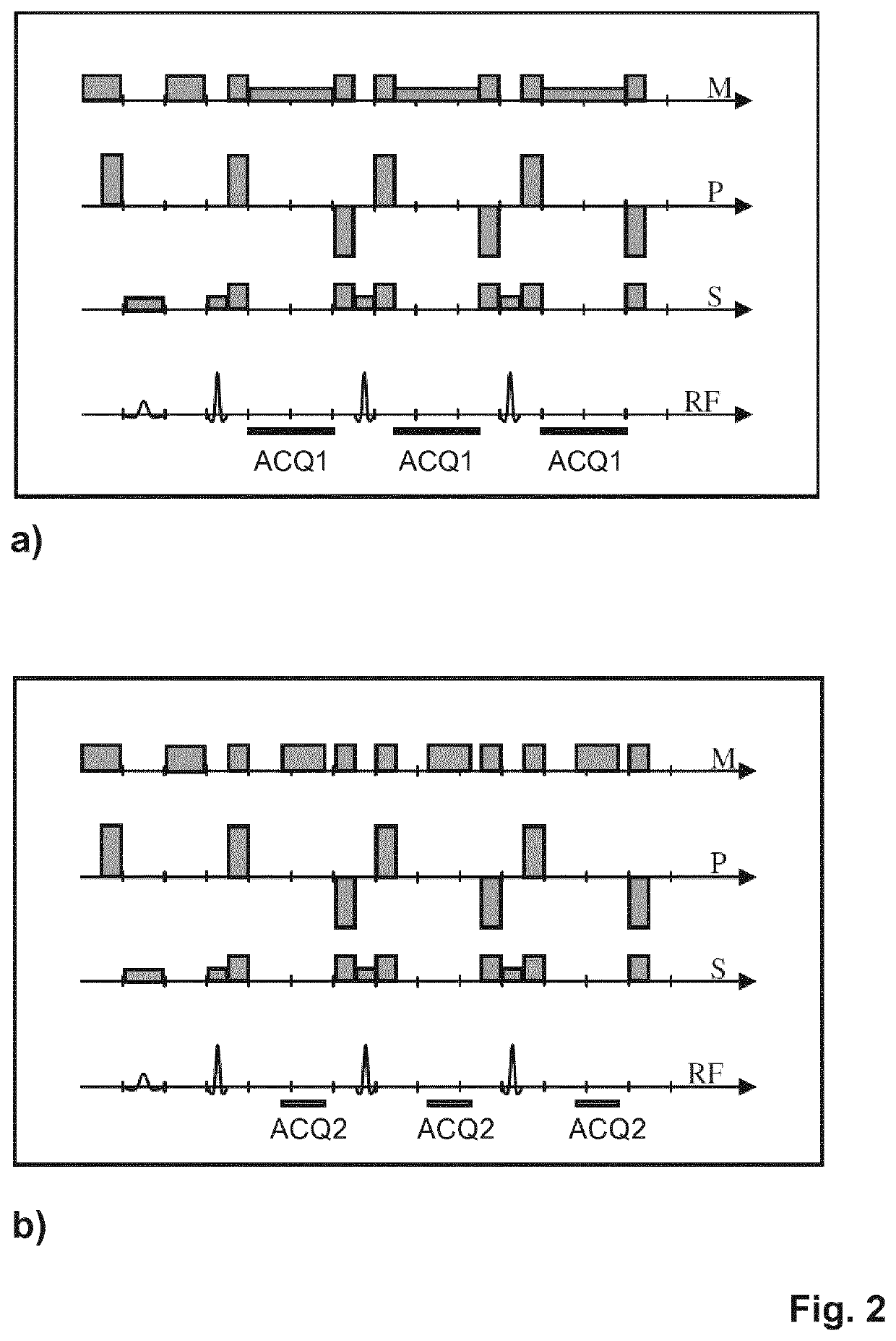
[0019]According to the invention, the number of phase encodings (i.e., the number of k-space lines / profiles) in the acquisition of the in phase signals is smaller than the number of phase encodings in the acquisition of the (partially) out of phase signals. The reduction of the number of phase encodings correspondingly reduces the SNR in an MR image reconstructed from the first (in phase) MR echo signals. This enables tailoring the SNR in the in phase and water (or fat-suppressed) images individually as required, by adapting the SNR in the MR image reconstructed from the first (in phase) MR echo signals relative to the SNR in an MR image reconstructed from the second ((partially) out of phase) MR echo signals. Preferably, the number of phase encodings of the first and second imaging sequences are chosen such that the SNR in the MR image reconstructed from the first (in phase) MR echo signals is essentially equal to the SNR in the MR image reconstructed from the second ((partially) out of phase) MR echo signals.
[0020]In this way, the invention achieves an improved noise propagation in the water / fat separation and, simultaneously, a reduced overall scan time.
[0022]According to a preferred embodiment of the invention, each of the first and second imaging sequences are repeated, partially or entirely, for signal accumulation, wherein the number of repetitions of the first imaging sequence may be different from the number of repetitions of the second imaging sequence. Selectively repeating the first and second imaging sequences respectively can be used in order to further tailor the SNR in the in phase, water, and fat images individually, including improving it in the in phase images and equalizing it in the in phase and water images. Simultaneously, the overall scan time can be kept within acceptable limits.
[0025]As the object is subjected to multiple shots of the first and second imaging sequences, the number of shots of the first imaging sequence may be chosen to be smaller than the number of shots of the second imaging sequence. In this way, a smaller number of phase encodings of the first imaging sequence than the number of phase encodings of the second imaging sequence within the meaning of the invention can be obtained.
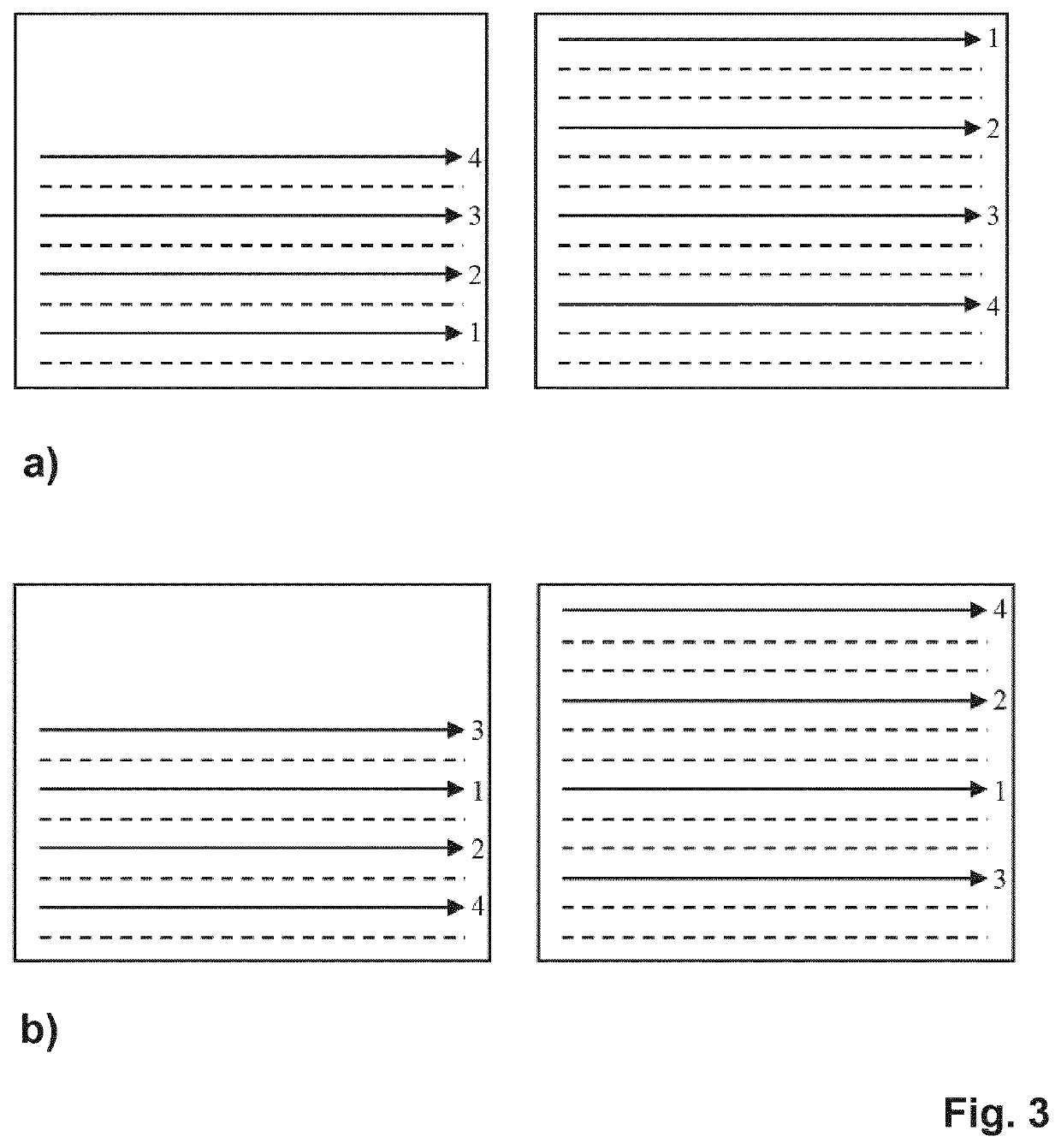
[0026]Preferably, the echo orders of the first and second imaging sequences are chosen such that first and second MR echo signals acquired from a central position in k-space have identical or adjacent echo index numbers, the echo index number indicating the position of each MR echo signal in the train of echo signals generated by each shot of the first or second imaging sequence. By choosing the echo orders in this way, the contrast in the in phase and (partially) out of phase images can be kept as similar as possible.
[0028]In a preferred embodiment of the invention, the phase encoding scheme of the first imaging sequence is chosen such that k-space is incompletely sampled using a partial Fourier technique. By applying a partial Fourier technique to the acquisition of the first MR echo signals a corresponding reduction of the number of phase encodings of the first imaging sequence in comparison to the number of phase encodings of the second imaging sequence can be obtained. The partial Fourier technique exploits the symmetry of the MR signal data in k-space to reduce the number of phase encodings (and correspondingly the required acquisition time) by sampling only an asymmetric part of k-space. The symmetry in k-space is a basic property of Fourier transformation and is called Hermitian symmetry. Thus, from the known symmetry properties for the MR signal data a full MR image can be reconstructed from the MR signal data from only one half of k-space. The conditions under which Hermitian symmetry holds and the corrections that must be applied when the assumption is not strictly obeyed must be considered. A prerequisite for partial Fourier imaging is that phase shifts are slowly varying across the object. In this regard, the invention takes advantage from the typically very smooth spatial variation of the phase in the in phase TSE image data. However, to avoid problems due to slowly varying phase shifts, a little more than one half of k-space should be covered by the first imaging sequence. Preferably, both (positive and negative) sides of k-space (in the phase encoding direction) are acquired in a low spatial frequency range while at higher spatial frequencies the MR signal data are acquired only on one side. The fully sampled low frequency portion can be used to characterize (and correct for) any slowly varying phase shifts.


 Login to View More
  Login to View More