Method of removing high density stickies from secondary papermaking fibers

US20020129909A1Inactive Publication Date: 2002-09-19GPCP IP HLDG LLC

Image

Smart Image Click on the blue labels to locate them in the text.
Viewing Examples
Smart Image
  • Method of removing high density stickies from secondary papermaking fibers
  • Method of removing high density stickies from secondary papermaking fibers
  • Method of removing high density stickies from secondary papermaking fibers

Examples

Experimental program
Comparison scheme
Effect test

examples

[0044] Pilot plant trials showed that flotation cells such as the Comer Cybercel.RTM. can successfully deink secondary centrifugal cleaner rejects, with better results obtained if the consistency is kept close to 0.6%. Consistency refers to weight percent fiber or associated solids such as ash unless the context indicates otherwise. Results on 42% office waste (Grade A) and 100% office waste (Grade B) are shown in Table 1.

1TABLE 1 Pilot Plant Results for Brightness Gain, Dirt + Ash Removal Efficiency on Grades A and B at Halsey and Results Used in Simulation Models Grade: A B Model Consistency: 0.69% 0.90% 0.62% Brightness Gain: 18.5% 5.3% Dirt Removal: 77-89% 65-87% 80% Ash removal: 63% 64% 64%

[0045] A simulation model was used to calculate the impact of a Comer Cybercel.RTM. flotation cell to deink forward cleaner rejects on solids loss, ash removal and on removal efficiency of mid-dirt (>150 microns) from a 1.sup.st washer to the deinked pulp (while running grade B at 336 tpd at ...

the structure of the environmentally friendly knitted fabric provided by the present invention; figure 2 Flow chart of the yarn wrapping machine for environmentally friendly knitted fabrics and storage devices; image 3 Is the parameter map of the yarn covering machine
Login to View More

PUM

PropertyMeasurementUnit
Lengthaaaaaaaaaa
Fractionaaaaaaaaaa
Fractionaaaaaaaaaa
Login to View More

Abstract

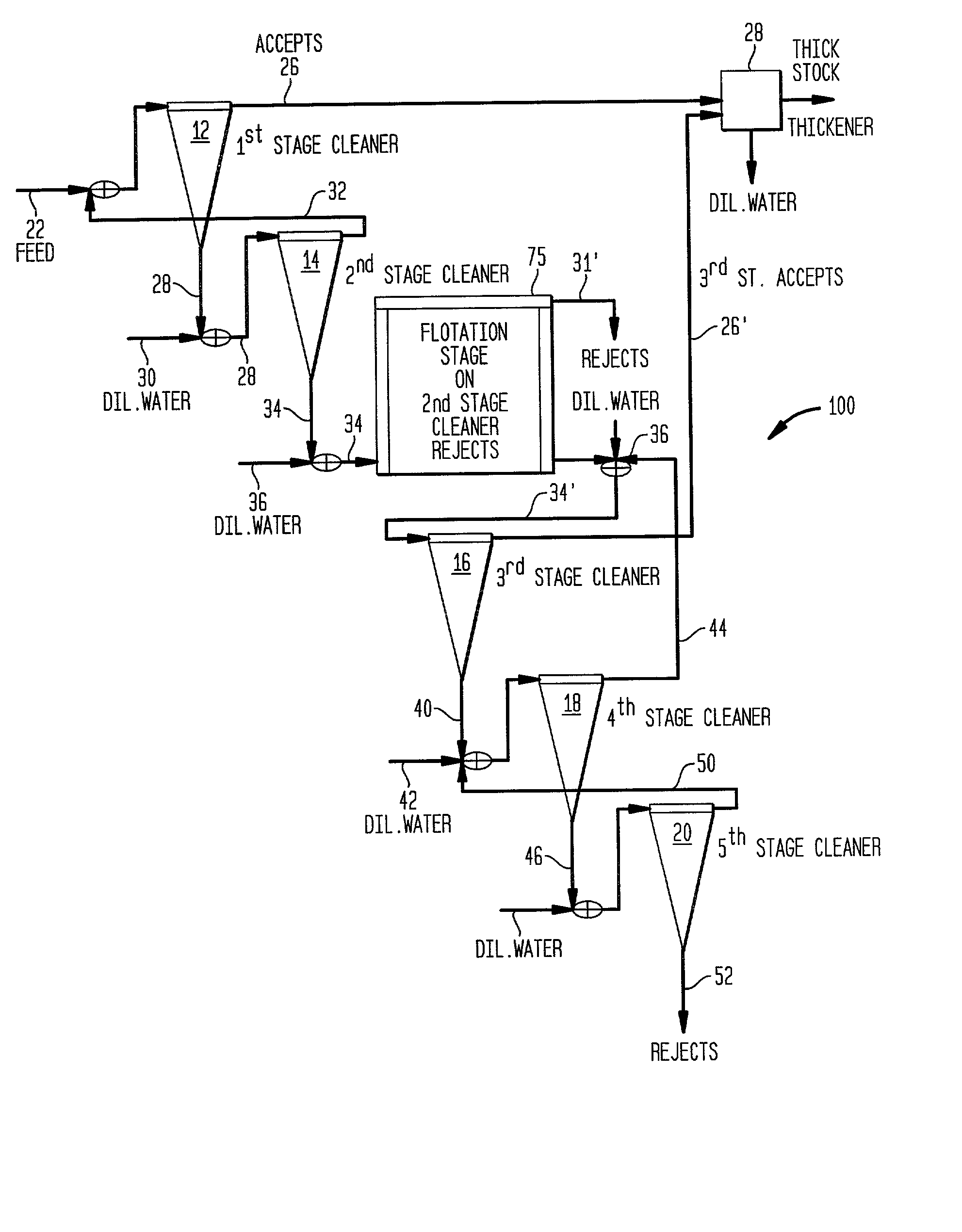
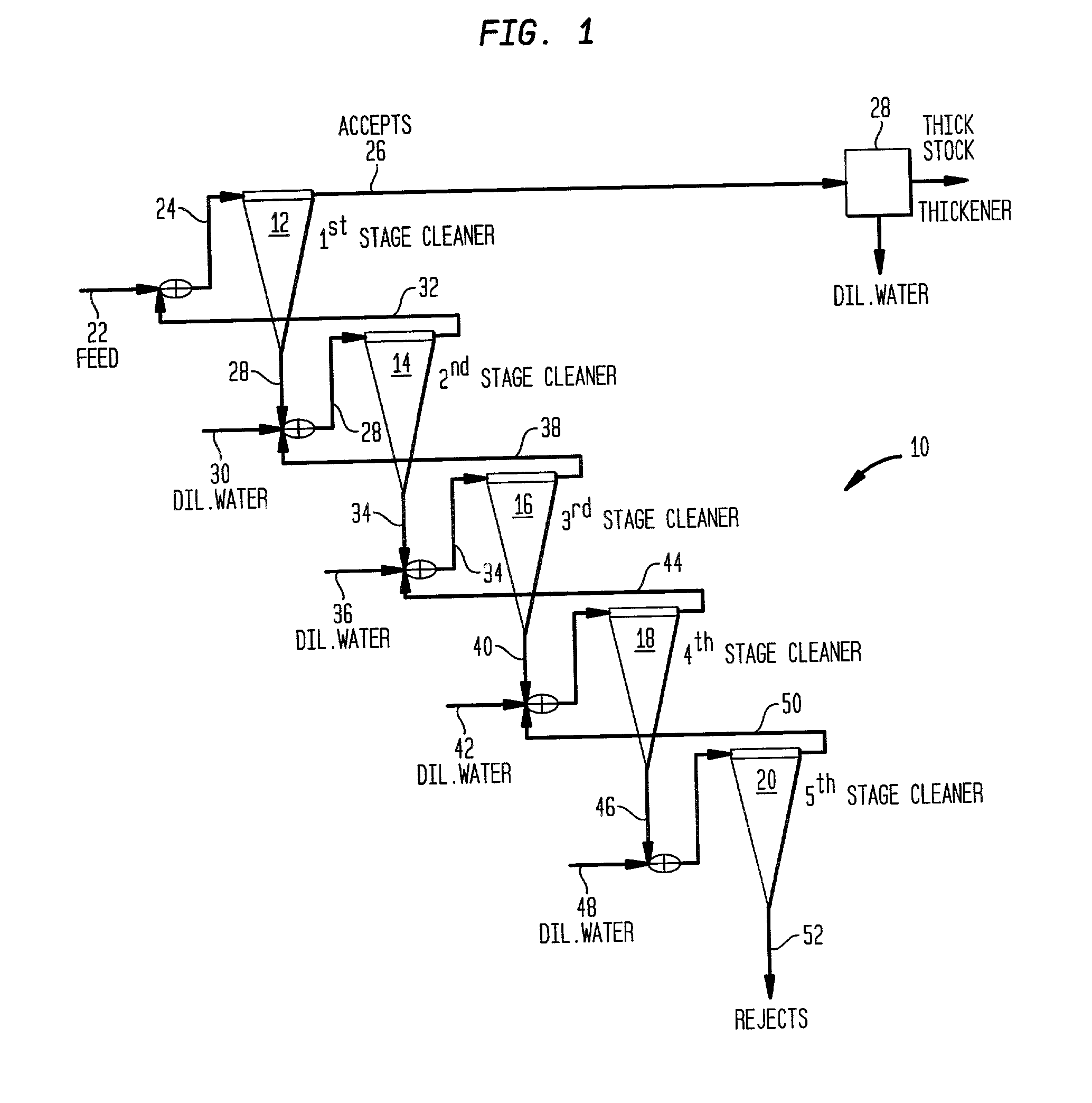
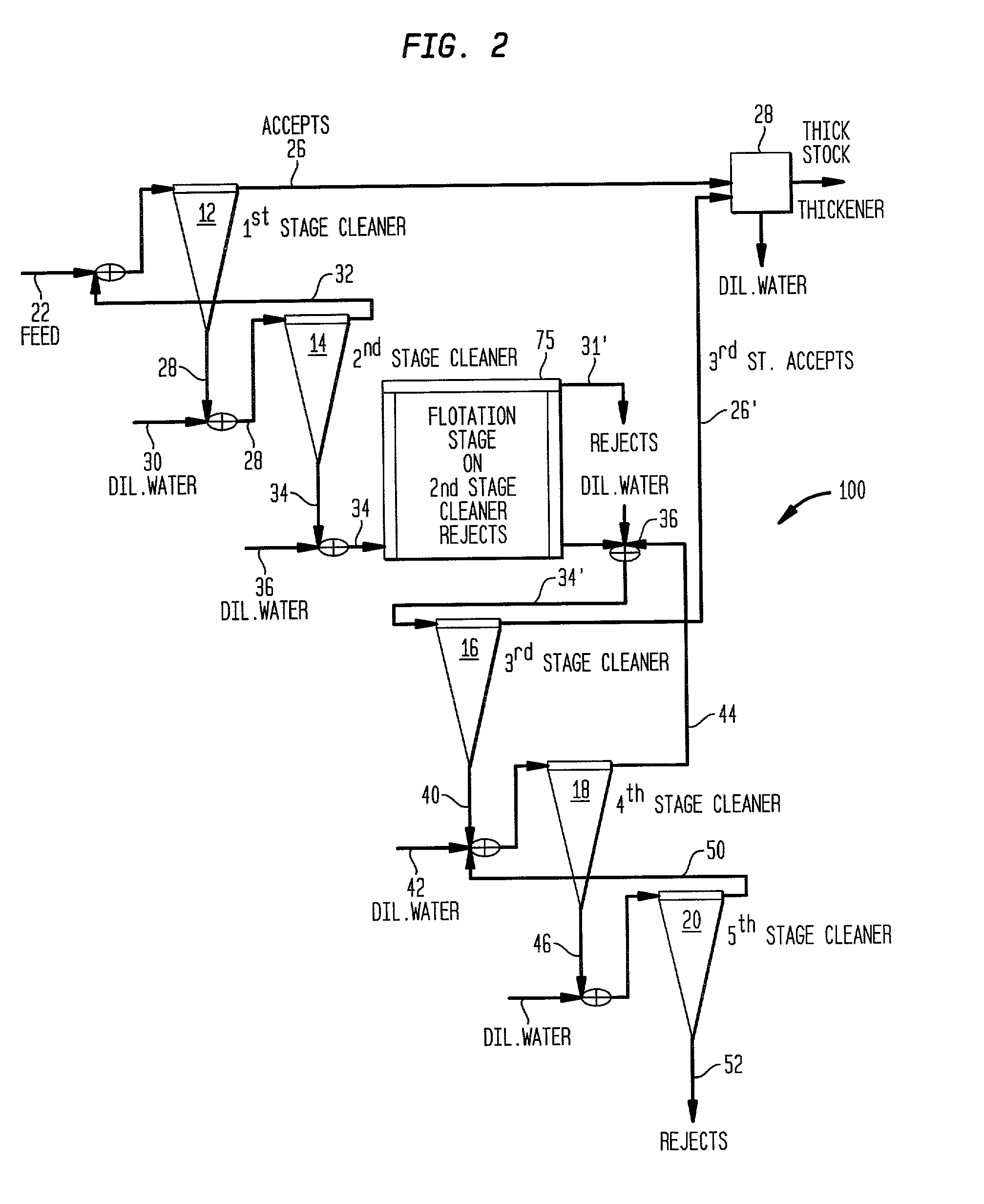
A hybrid method for processing papermaking fibers to remove high density stickies typically includes utilizing a multistage array of forward cleaners coupled with a flotation cell which increases overall efficiency of the system. In a preferred embodiment, a first rejects aqueous stream from a first stage bank of centrifugal cleaners is treated in a flotation cell before being fed to a second stage bank of centrifugal cleaners. With the improved technique, the accepts from the first stage bank of centrifugal cleaners may be combined with the accepts from the second stage bank of centrifugal cleaners and fed forward to a thickening device, for example. The technique is also suitably employed for removing stickies from material which has already been screened with a fine screen.

Description

CROSS-REFERENCE TO RELATED APPLICATIONS AND CLAIM FOR PRIORITY[0001] This application is a continuation-in-part application of co-pending application Ser. No. 09 / 772,395, filed Jan. 30, 2001, now U.S. Pat. No. ______, which in turn was based upon Provisional Application Serial No. 60 / 180,348, filed Feb. 4, 2000. The priority of the foregoing applications, both entitled "Hybrid Multistage Forward Cleaner System With Flotation Cell", is hereby claimed.TECHNICAL FIELD[0002] The present invention relates generally to papermaking fiber processing and more particularly to a method useful for removing stickies from secondary or recycle paper pulp by incorporating a hybrid multistage forward cleaner system with an integrated flotation cell. The method is particularly effective for removing stickies that have already passed through a screening stage.BACKGROUND[0003] Processing of papermaking fibers to remove contaminants is well known in the art, including the use of forward cleaners and flo...

Claims

the structure of the environmentally friendly knitted fabric provided by the present invention; figure 2 Flow chart of the yarn wrapping machine for environmentally friendly knitted fabrics and storage devices; image 3 Is the parameter map of the yarn covering machine
Login to View More

Application Information

Patent Timeline
19 Sep 2002
Publication
US20020129909A1
IPC
D21D5/00; D21D5/24; D21F1/70
CPC
D21C5/02; D21D5/00; D21D5/24; D21F1/70; Y10S162/04; Y02W30/648; Y02W30/64
Inventors
DE JONG, ROBERT L.; SLEETER, RICHARD L. JR.