Check patentability & draft patents in minutes with Patsnap Eureka AI!

Application editing apparatus and data processing method and program

Inactive Publication Date: 2003-02-20
IBM CORP
View PDF14 Cites 62 Cited by
  • Summary
  • Abstract
  • Description
  • Claims
  • Application Information

AI Technical Summary

Problems solved by technology

However, creating a view for each desired model each time it is required entails too much working cost.
However, this is in fact no more than static conversion performed for each individual rule.
Therefore, it does not accommodate dynamic changes made to the source model.
Therefore, it does not support dynamic changes to the source.
However, these methods in which a required view having the required interface is created entail much creation cost.
However, an interface between a model and a view is complicated in some applications.
If a narrow interface, that is, the smallest set of operations to be adapted, is large, generating the Adapter pattern requires much working cost.
However, model conversion by the model converter is static.
Therefore, if a change is made to a source model, its converted model cannot immediately be updated with the change made to a view.
That is, the source application cannot know what event is generated by the model for making the change to the view in the target application and therefore cannot make an update in such a manner that only a changed portion of the source model is reflected in its target view.
Thus, this method is inefficient in that the old target model-view pair is discarded and the new, target model-view pair is generated based on the updated source model.
Especially, if the data size of one or both of the source model or target model is large, a large amount of time is required for processing each preview request.
In terms of hardware, a large amount of memory space is consumed.
Furthermore, if data about a cursor position or the position of selected area that is generated during editing is held in a target model-view pair, because of re-creating the model-view pair rather than reflecting only a change made to the source model in the target model-view pair, the data is lost each time the model-view pair is re-created.
However, because the definition of the source model-view pair is typically different from that of the target model-view pair, the event for updating the target view cannot be generated from the update in the source model.
Vdiff is difference generation cost.

Method used

the structure of the environmentally friendly knitted fabric provided by the present invention; figure 2 Flow chart of the yarn wrapping machine for environmentally friendly knitted fabrics and storage devices; image 3 Is the parameter map of the yarn covering machine
View more

Image

Smart Image Click on the blue labels to locate them in the text.
Viewing Examples
Smart Image
  • Application editing apparatus and data processing method and program
  • Application editing apparatus and data processing method and program
  • Application editing apparatus and data processing method and program

Examples

Experimental program
Comparison scheme
Effect test

second embodiment

[0247] Conversion between model HTMLDOM and model TreeNode is a simple one-to-one conversion. Therefore, view Jtree (0) is the same as the view of model HTMLDOM. Hence, in the following description, conversion from model HTMLDOM into model SwingDocument will be described. The model conversion will be used (that is, model conversion is performed for each corresponding element).

[0248] FIG. 20 shows a screen image displayed in view JTree (0) using a Web page ( ) of IBM Corporation as model HTMLDOM. FIG. 21 shows a screen image of this Web page displayed in view Jtree (1). FIG. 22 shows a screen image of the same Web page displayed in view JEditorPane.

[0249] It is assumed here that an operation is performed for deleting a DOM node (IMG0) representing image data including title "Power packed offer displayed in the portion adjacent to the center in FIG. 22".

[0250] FIG. 23 shows a portion including this node (IMG0) in model HTMLDOM before the node (IMG0) is deleted. FIG. 24 shows a portio...

second example

[0275] In a second example, an XML editor having the function of previewing HTML converted by XSL is used. Model conversion according to the second embodiment is also used in this example.

[0276] FIG. 28 shows an internal structure of the XML editor. In FIG. 28, a model-vie pair consisting of model TreeNode and view TreeEditor is a typical XML tree editor (for example Xeena from IBM). The tree editor model, TreeNode, is converted by the model converter 40, which is an XSLT processor, into an HTML DOM (model HTMLDOM). Model HTMLDOM is displayed in WYSIWIG format in view "HTML Viewer". View HTML Viewer may be a typical Web browser.

[0277] If a change is made to model TreeNode by the tree editor, the changed position is reported to the XSLT processor and a corresponding position in model HTMLDOM is changed through conversion by the XSLT processor.

[0278] Then the application B execution module 30 calculates a difference between model HTMLDOMs before and after the change. The difference is...

third example

[0292] The examples in which models having a tree structure have been described above. A third example can be applied to conversion of models having other structures than a tree structure. In this example a source model (model A) having a two-dimensional array structure is converted into an HTML table.

[0293] FIG. 34 shows models A and B before model A is converted.

[0294] In FIG. 34, model A is presented in a table view and model B is presented in a tree view of an HTML table.

[0295] A case will be considered where the current income column is deleted from model A in FIG. 34.

[0296] FIG. 35 shows models A and B after this change is made.

[0297] As shown in model A in FIG. 35, the current income column is deleted. When this change is made to model A, it is reflected in model B through model conversion. When a difference between elements before and after conversion under the TABLE element of model B is generated, it can be found that the right most element (element TH or TD) is deleted fr...

the structure of the environmentally friendly knitted fabric provided by the present invention; figure 2 Flow chart of the yarn wrapping machine for environmentally friendly knitted fabrics and storage devices; image 3 Is the parameter map of the yarn covering machine
Login to View More

PUM

No PUM Login to View More

Abstract

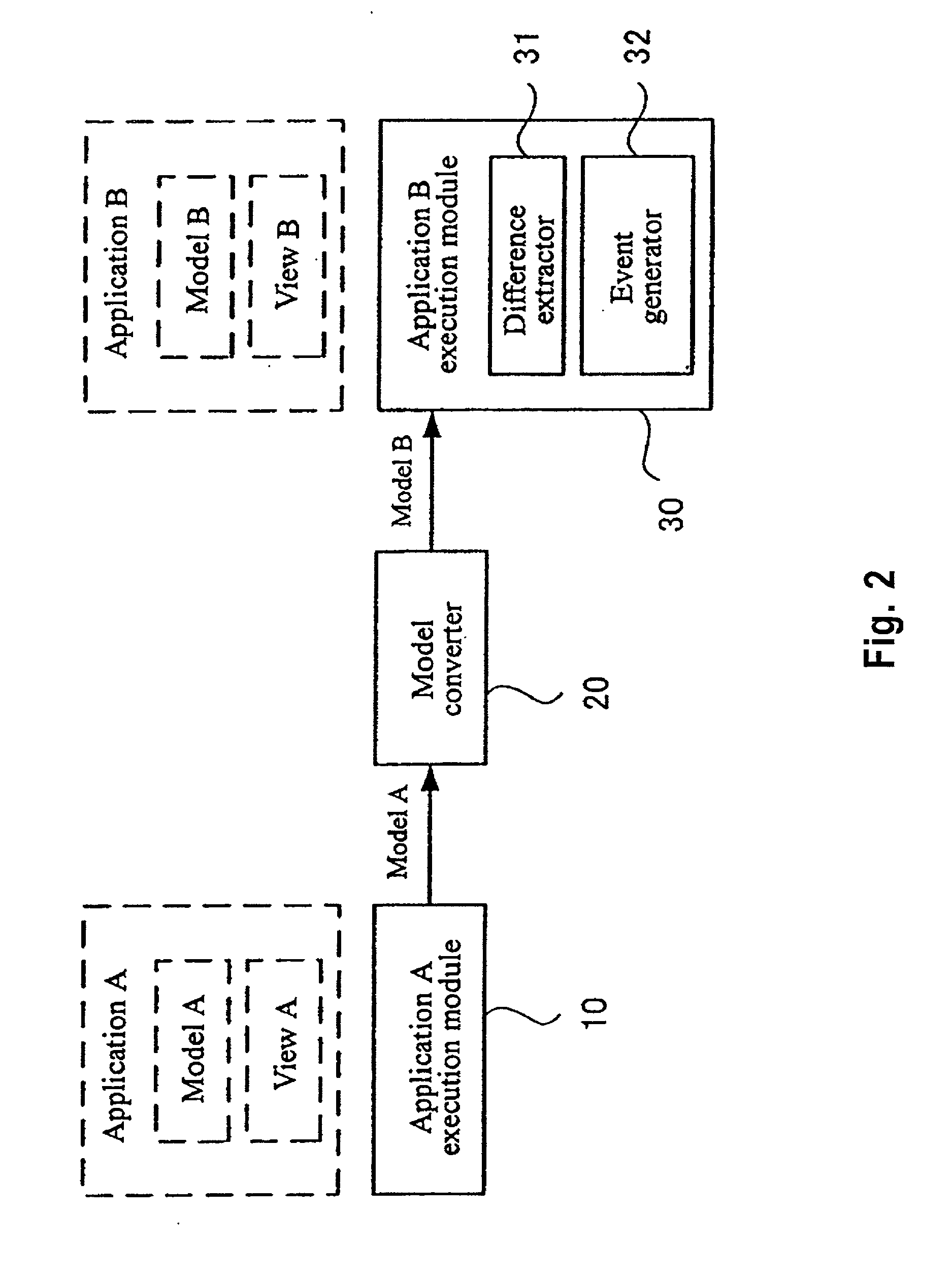
In an apparatus for editing an application having a model and a view separated from each other, there is provided an application A execution module for editing a first model in the application, a model converter for converting the first model into a second model, and an application B execution module for displaying the second model in its view on a display device. The application B execution module includes an event generator for generating an event based on an update made to the second model when the second model is updated and changes the view displayed on the display device based on the event generated by the event generator.

Description

[0001] 1. Field of the Invention[0002] The present invention relates to a method of converting a model and displaying a view in an application having a model object and a view object separated from each other.[0003] 2. Background of the Invention[0004] A basic approach to interactively writing an application program is to separate the application into a model object (hereinafter called "model"), which is logic of the application, and a view object (hereinafter called "view"), which is an implementation of the application displayed on a display device. Separating the application into the model and view allows a variety of views to be associated with one model. That is, one program can be used in a variety of display implementations according to processes or operations.[0005] FIG. 36 illustrates the relationship between a model and views.[0006] In the example shown in FIG. 36, three views, WYSIWYG (What You See Is What You Get), tree, and source views, are provided for one model (whic...

Claims

the structure of the environmentally friendly knitted fabric provided by the present invention; figure 2 Flow chart of the yarn wrapping machine for environmentally friendly knitted fabrics and storage devices; image 3 Is the parameter map of the yarn covering machine
Login to View More

Application Information

Patent Timeline
no application Login to View More
IPC IPC(8): G09G5/00G06F9/44
CPCG06F8/10
Inventor KONDO, GO
Owner IBM CORP
Features
  • R&D
  • Intellectual Property
  • Life Sciences
  • Materials
  • Tech Scout
Why Patsnap Eureka
  • Unparalleled Data Quality
  • Higher Quality Content
  • 60% Fewer Hallucinations
Social media
Patsnap Eureka Blog
Learn More