
Method for accurate mass determination with ion trap/time-of-flight mass spectrometer
a mass spectrometer and time-of-flight technology, applied in the field of instruments, can solve the problems of inability to inability to accurately determine an elemental composition, and inability to apply mass calibration through internal reference methods for accurate mass determination of product ions obtained by ms/ms analysis, etc., to achieve high accuracy and accurate mass determination of product ions generated by ms/ms
- Summary
- Abstract
- Description
- Claims
- Application Information
AI Technical Summary
Benefits of technology
Problems solved by technology
Method used
Image

Examples
first embodiment
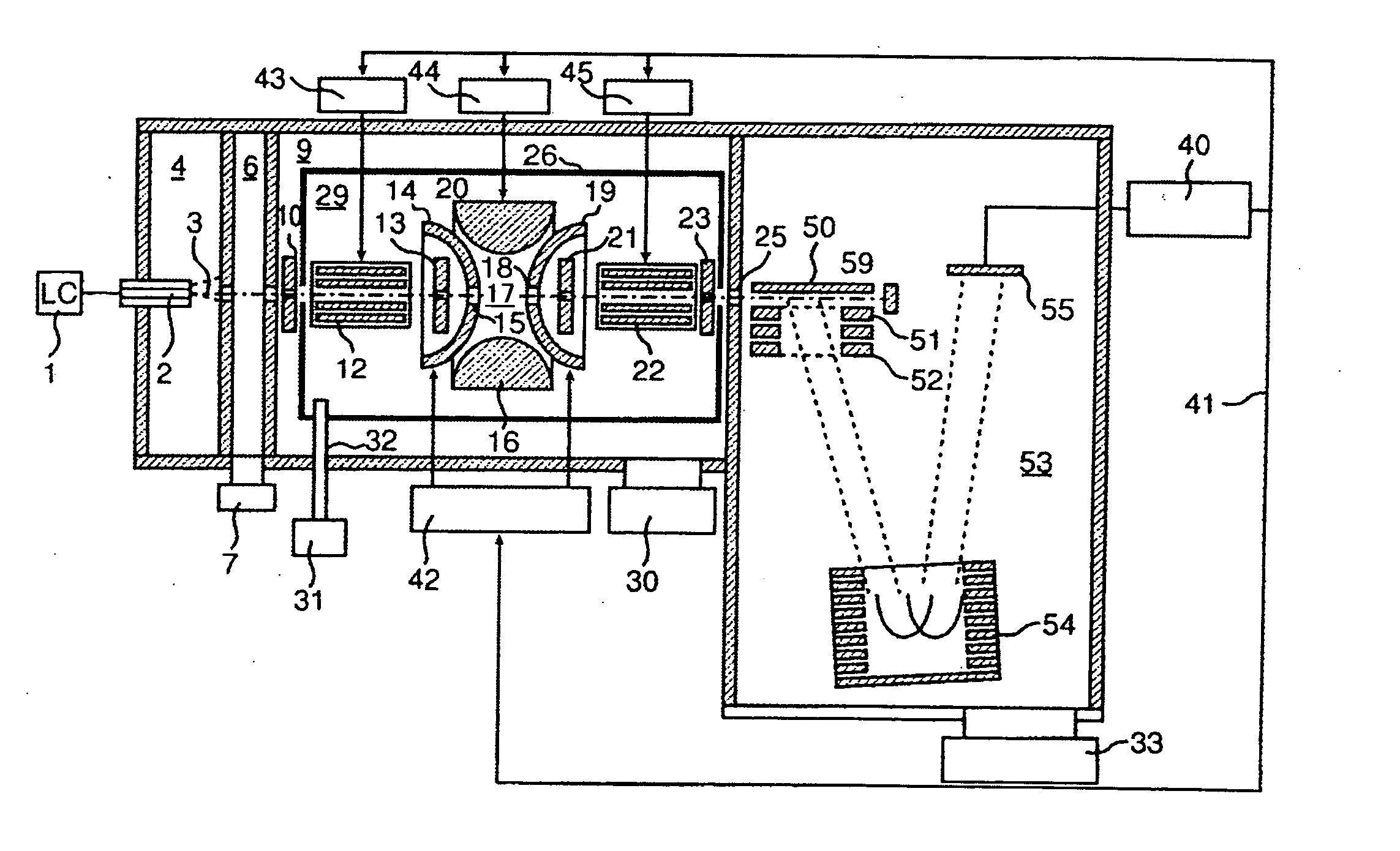
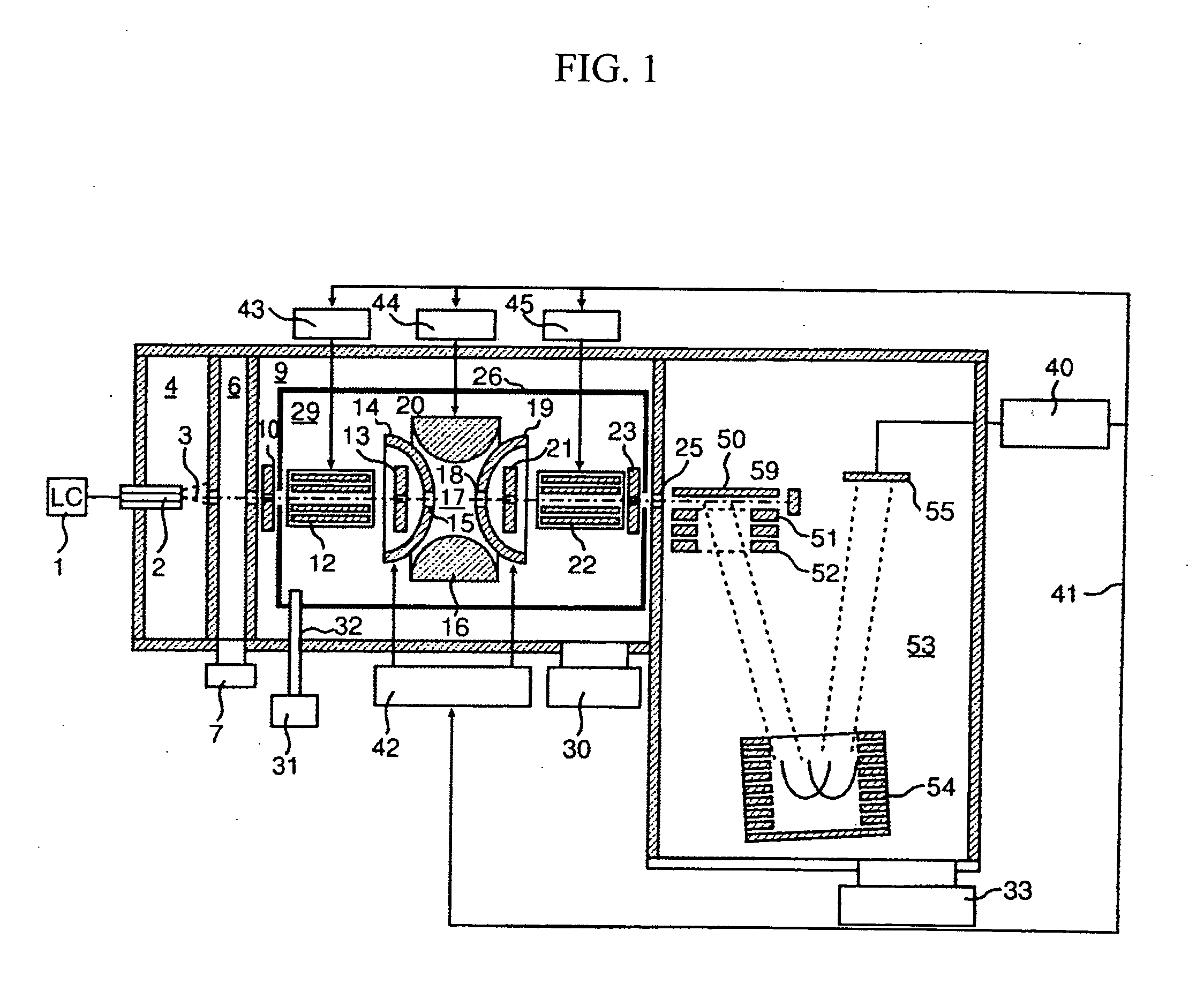
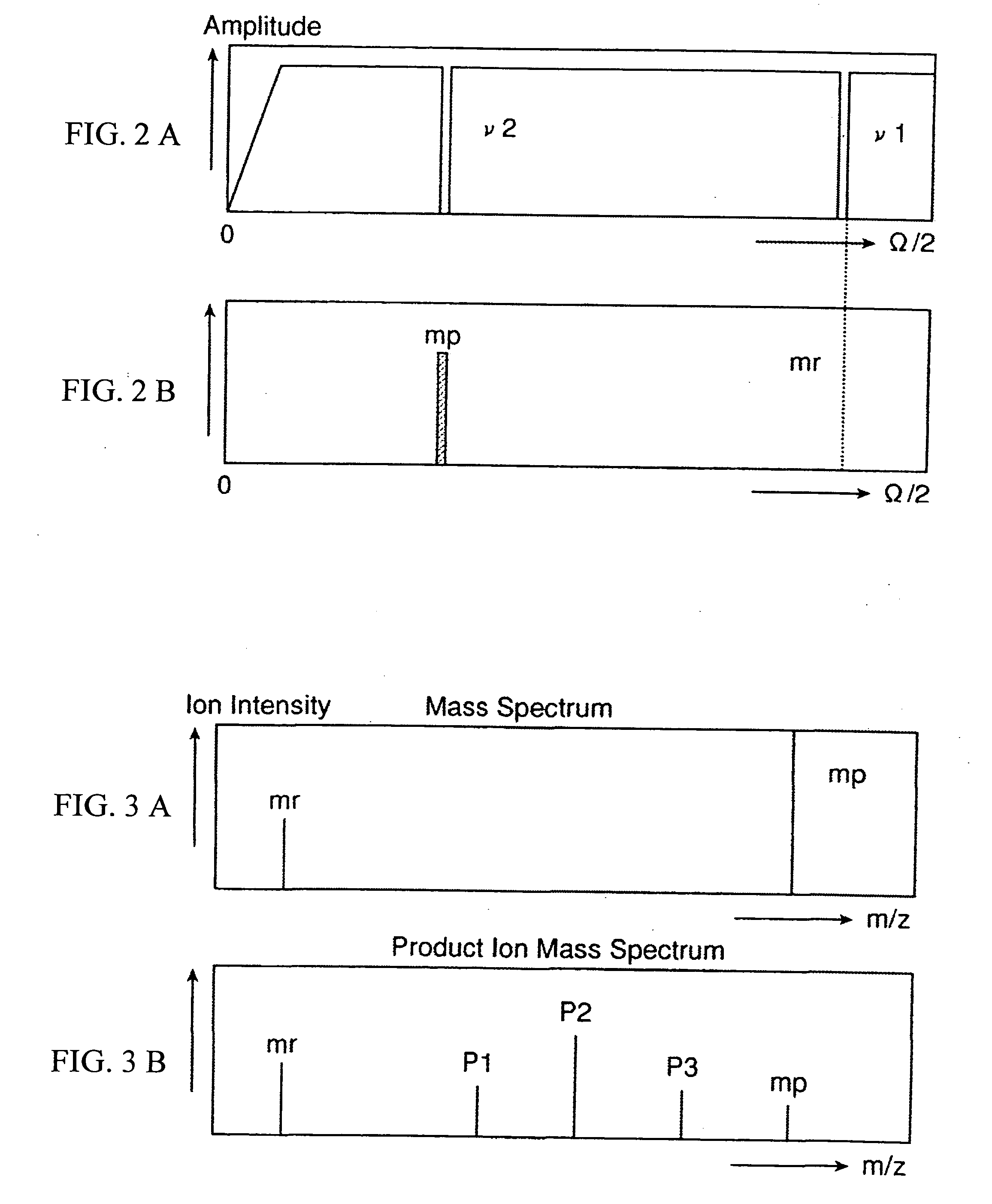
[0036] One embodiment of the present invention is explained referring to FIGS. 1 to 3.
[0037] A sample solution transferred from a liquid chromatograph (LC) 1 is introduced into a nebulizer probe 2 of an ESI ion source, sprayed into the atmosphere 4 as positively charged fine droplets, and ionized. The generated ions are introduced into a high vacuum chamber 9 evacuated with a turbo molecular pump (TMP) 30 via an intermediate pressure chamber 6 evacuated with an oil rotary pump (RP) 7. The ions are accelerated by a direct-current voltage applied to an ion acceleration electrode 10 and injected into an ion transmission space 29 through an aperture on an ion transmission housing 26 that is a metallic shield cylinder placed in the high vacuum chamber 9. In the ion transmission housing 26, a first multipole ion guide 12, an ion trap 20, and a second multipole ion guide 22 are arranged in tandem.
[0038] Here, the first multipole ion guide 12 plays a role in transmitting the ions generate...
second embodiment
[0090] Since there is a time interval between Step 1 and Step 2 in the first embodiment, a drift of the parameters a, b, and c in Equation 3 due to the time elapsed must be considered. On the other hand, when standard material ions are made plural to improve the accuracy, it is necessary to increase notches in response to an increase in the standard material ions, thus giving rise to a possibility that isolation of a precursor ion becomes inefficient. Hence, in the present embodiment, a method is presented in which not only is Step 1 in the first embodiment rendered unnecessary but also the efficiency of isolation of the precursor ion (mp) is not reduced by making the standard material ion (mr) isolated with the precursor ion (mp) only one.
[0091] The measurement in the present embodiment is carried out by the following two steps:
[0092] Step A: Simultaneous measurement of standard material and analyte sample, and MS / MS Step B: Mass calibration of product ions obtained by MS / MS
[009...
PUM
| Property | Measurement | Unit |
|---|---|---|
| pressure | aaaaa | aaaaa |
| frequency voltage | aaaaa | aaaaa |
| voltage | aaaaa | aaaaa |
Abstract
Description
Claims
Application Information
 Login to View More