
Golf ball
a golf ball and ball body technology, applied in the field of golf balls, can solve the problems of unintentional application of sidespins unsuitable for use by less skilled and/or high handicap golfers, and difficult manufacturing of wound balls, etc., to achieve the effect of increasing resiliency, high density elastomeric nucleus, and being more durable and softer
- Summary
- Abstract
- Description
- Claims
- Application Information
AI Technical Summary
Benefits of technology
Problems solved by technology
Method used
Image

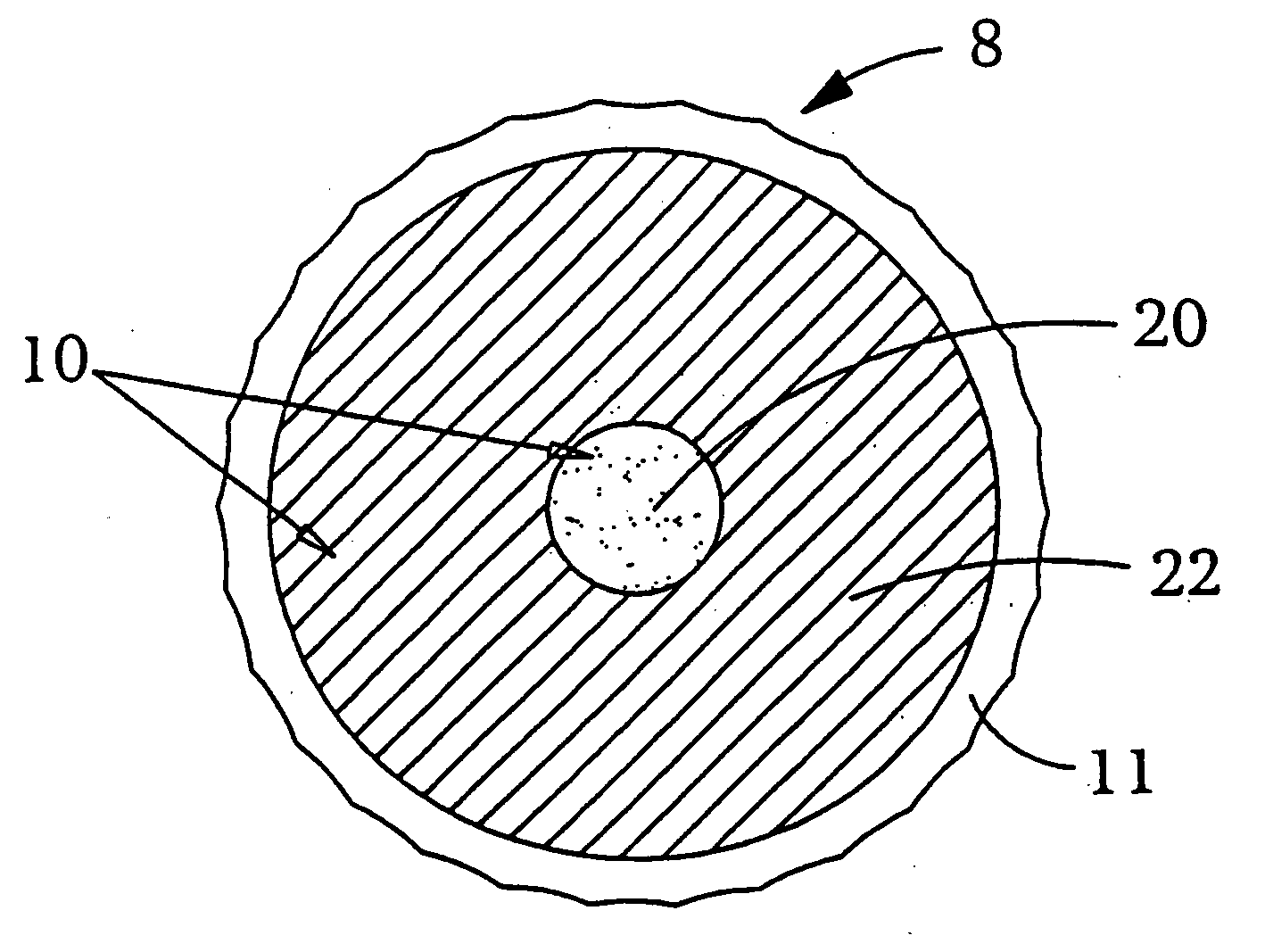
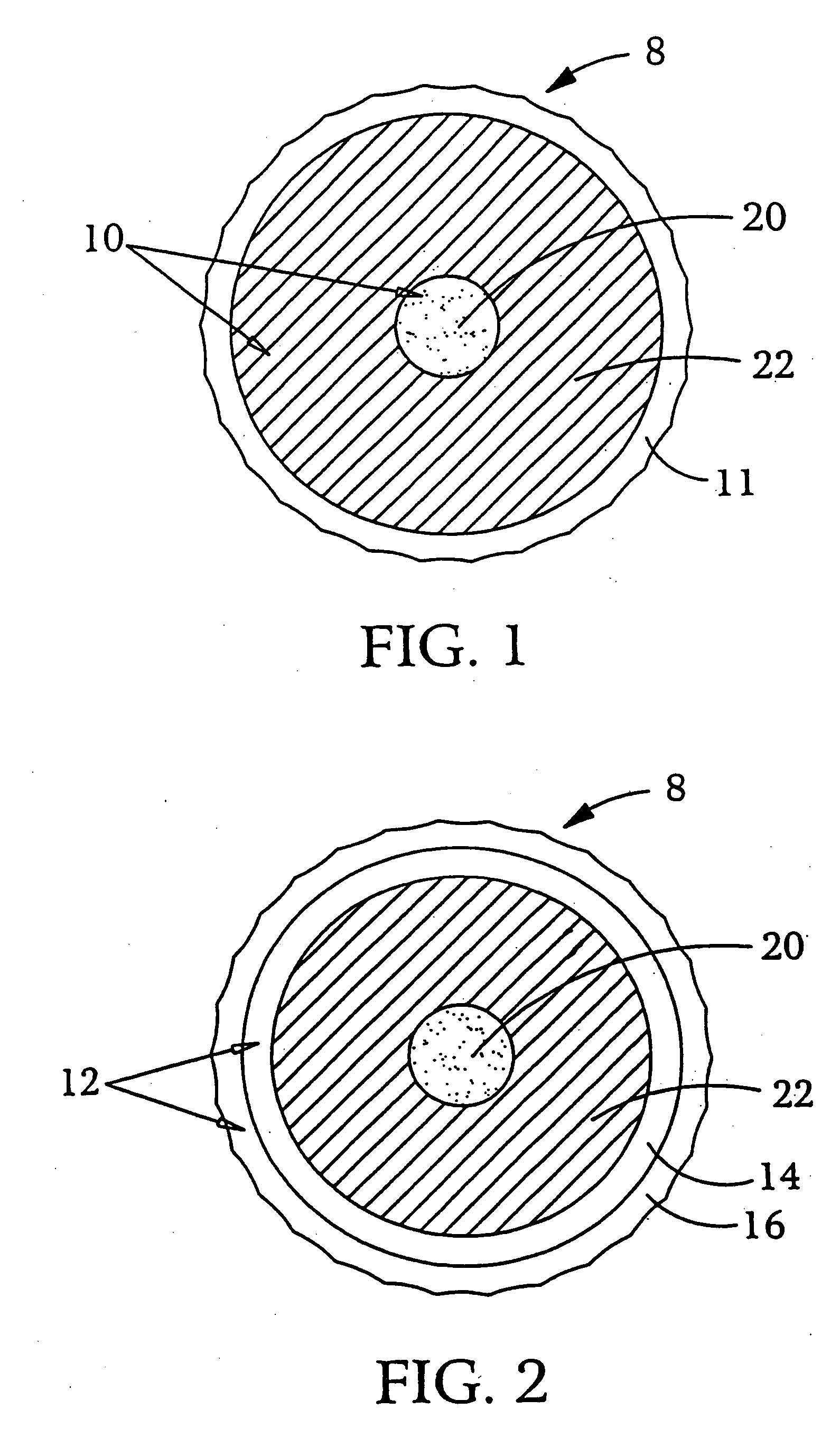
Examples
example 1
Dual Core Golf Ball with Heavy Elastomeric Nucleus Comprising a Tungsten Powder / Polybutadiene Rubber Core, 11 / 32″ Diameter
[0257] 1A. A Dual Core and a Dual Cover Golf Ball
[0258] A heavy spherical center core layer containing powdered tungsten metal in a polybutadiene matrix and having a diameter of 0.344 inches (8.74 mm) was formed with the following composition:
ComponentsphrNeo Cis 40 Butadiene Rubber100.0Kuliter ™ Tungsten Powder (5 microns)1248.5Iron Powder100.0Zinc Oxide5.0Varox ™ 231XL Peroxide Initiator3.0Zinc Diacrylate0.0TOTAL1456.5
[0259] The spherical center core layer comprising the above composition exhibited a specific gravity of 7.65, a weight of 2.7 grams, and a Shore C hardness of 80 (preferred range is 50-95).
[0260] The iron powder of the above composition was optional and was added to the composition in order to attract the formed center to a magnet. Such attraction allows for automated assembly of the 0.344 inch spherical center to the uncured preformed half s...
example 2
[0277] Spin rate testing was conducted with the finished multi-layered covered, dual core golf balls (Example 1A) and single-layered cover, dual core golf balls (Example 1B) of above Example using a driver, a 5 iron, a 9 iron, and a pitching wedge. The golf ball testing machine was set up to emulate the launch conditions of an average Touring Professional Golfer for each particular club. For comparative purposes, commercial golf balls were also tested for spin rate using the same clubs.
[0278] Below are the results of the spin rate testing:
Spin Rate Data for Examples 1A (Dual Core, Dual Cover)and 1B (Dual Core, Single Cover)SpinBallLaunchRateVelocityClubBall TypeAngle(rpm)(ft. / sec.)10.5Example 1A10.93806229.5Intimidator ™Example 1B10.33072231.1DriverStrata ™ Professional 9010.72896227.4Precept ™ MC Spin11.12888226.5Titleist ™ Prestige 9011.03074227.75 Iron ApexExample 1A15.75798184.5Plus ™Example 1B15.07347182.2Strata ™ Professional 9015.85713182.5Precept ™ MC Spin15.85445183.1Tit...
example 3
[0280] One half of the polybutadiene rubber utilized in the inner core of Examples 1-2 was deleted and substituted with polyisoprene. Specifically, 50 phr of Natsyn 2000 was substituted for Neo-Cis 40 according to the following formula:
ACTUALMATERIALPHRSp. Gr.Enichem Neo Cis 4050.000.910Goodyear Natsyn 220050.000.910Kulite Tungsten Powder1386.4019.350(5 microns)Aldrich Iron Oxide, Fe3O464.905.100(less than 5 microns)Zinc Oxide5.005.570Varox 231 XL Peroxide7.501.410TOTALS1563.807.800
[0281] Inner cores having the following properties were produced:
[0282] Specifications: [0283] size: 0.340 inches, 0.006 inches [0284] weight: 2.77 grams, 0.1 grams [0285] hardness: 62 Shore C peak 5 points
[0286] The inner cores, when enclosed with the above outer core and cover formulations, produced golf balls exhibiting the enhanced characteristics of the balls of Example 1.
PUM
 Login to View More
 Abstract
Description
Claims
Application Information
 Login to View More