Unlock instant, AI-driven research and patent intelligence for your innovation.

Method and system for supporting structured aggregation operations on semi-structured data

Inactive Publication Date: 2006-07-20
IBM CORP
View PDF6 Cites 21 Cited by
  • Summary
  • Abstract
  • Description
  • Claims
  • Application Information

AI Technical Summary

Problems solved by technology

This proposal, however, can not express structural grouping operations.

Method used

the structure of the environmentally friendly knitted fabric provided by the present invention; figure 2 Flow chart of the yarn wrapping machine for environmentally friendly knitted fabrics and storage devices; image 3 Is the parameter map of the yarn covering machine
View more

Image

Smart Image Click on the blue labels to locate them in the text.
Viewing Examples
Smart Image
  • Method and system for supporting structured aggregation operations on semi-structured data
  • Method and system for supporting structured aggregation operations on semi-structured data
  • Method and system for supporting structured aggregation operations on semi-structured data

Examples

Experimental program
Comparison scheme
Effect test

example

[0075] GROUP BY TREE($r / / Type, $r / / Salary)→(((7,8), (10,11), (13,14), (17,18)), ((7,8), (13,14), (17,18)), ((10,11)), ((7,8)), ((10,11)), ((13,14),(17,18)), ((13,14),(17,18)), ((7,8)), ((10,11)))

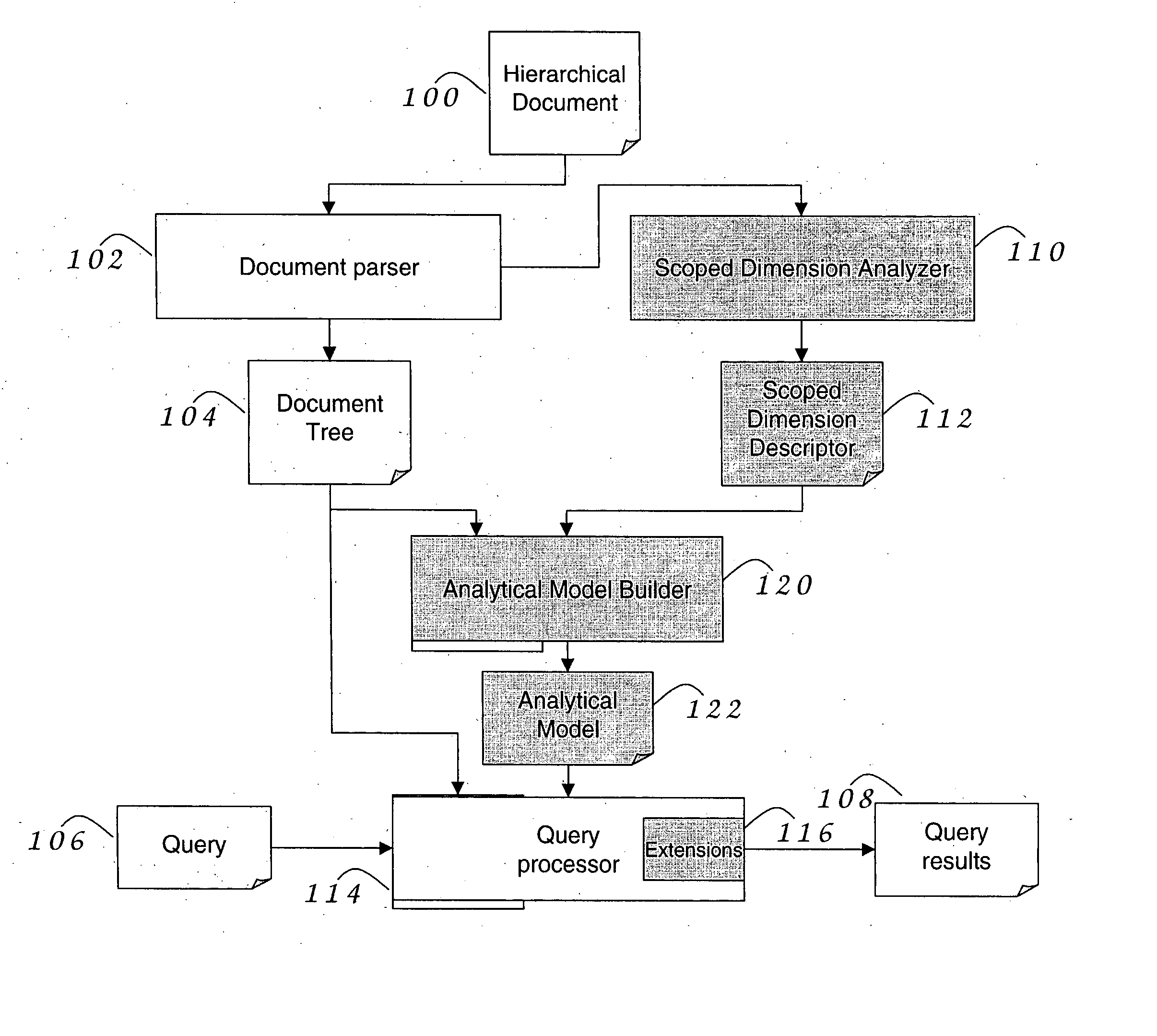
[0076] Any user query with or without aggregation extensions may be transformed into a query tree that is an abstract representation of the query. The extensions proposed in accordance with at least one embodiment of the present invention can be realized as one more operand branch (e.g., for GROUP BY) in the node selection component of the query tree. This way, any existing query optimization techniques can be reused without change for the new extended aggregation operators.

[0077] In accordance with a preferred embodiment of the present invention, a query processor (114) and extensions (116) are laid out in greater detail in FIG. 2. As shown, given user query (106) together with the XML document tree (104) is used by the node generator (200) to generate a list of nodes selected from the do...

the structure of the environmentally friendly knitted fabric provided by the present invention; figure 2 Flow chart of the yarn wrapping machine for environmentally friendly knitted fabrics and storage devices; image 3 Is the parameter map of the yarn covering machine
Login to View More

PUM

No PUM Login to View More

Abstract

The introduction of extensions to query processing systems for XML documents that allow the analysis of such documents via grouping and aggregation operations. Assumed is the existence of an analysis module for extracting information on how parts of an XML document interrelate with other parts. This information is then used together with a user query in order (1) to partition the nodes of the document in various ways and (2) to compute and output the aggregation value of each such partition. To these ends, there are provided new query operators and extensions to query processing systems comprising a hierarchical node list generator and a hierarchical node list processor. The former takes the grouping information from the query as input and generates document node partitionings. The latter takes the node partitionings as input and computes aggregation values for each partition and generates a query result that is returned to the user.

Description

FIELD OF THE INVENTION [0001] The present invention generally relates to analyzing XML documents and, more particularly, to supporting aggregation operations that exploit structural properties of the XML documents. BACKGROUND OF THE INVENTION [0002] Throughout the instant disclosure, numerals in brackets—[]— are keyed to the list of numbered references towards the end of the disclosure. [0003] Over the years, structured aggregation operations for Online Analytical Processing (OLAP) have been studied extensively. Traditional OLAP systems view data using a logical multi-dimensional representation. Vassiliadis and Sellis present a survey of logical models for OLAP computations [6]. Gray et al. first introduced the OLAP CUBE operator [4]. Most database vendors support OLAP in their database systems and most of the OLAP operators, such as, GROUP BY, ROLLUP, DRILLDOWN, and CUBE are supported in the SQL standard as well [2, 6]. [0004] Recently, value-based grouping has been investigated fo...

Claims

the structure of the environmentally friendly knitted fabric provided by the present invention; figure 2 Flow chart of the yarn wrapping machine for environmentally friendly knitted fabrics and storage devices; image 3 Is the parameter map of the yarn covering machine
Login to View More

Application Information

Patent Timeline
no application Login to View More
IPC IPC(8): G06F17/30
CPCG06F17/30923G06F16/83G06F16/835
Inventor BORDAWAKAR, RAJESH R.LANG, CHRISTIAN A.
Owner IBM CORP