Monitoring device for measuring calorie expenditure

a monitoring device and calorie expenditure technology, applied in the field of medical devices for monitoring information, to achieve the effect of reducing the risk of certain medical conditions and building patient complian

US20070073178A1Inactive Publication Date: 2007-03-29BERKELEY HEARTLAB
11 Cites 83 Cited by

Patent Information

Authority / Receiving Office
US · United States
Patent Type
Applications(United States)
Current Assignee / Owner
Publication Date
2007-03-29
Estimated Expiration
Not applicable · inactive patent

Smart Images

  • Figure 1
    Figure 1
  • Figure 2
    Figure 2
  • Figure 3
    Figure 3
Patent Text Reader

Abstract

The invention provides a monitoring device that features: 1) a cardiac sensor component with at least one light-emitting diode and a photodetector; 2) a pedometer component with at least one motion-sensing component (e.g., an accelerometer); and 3) a wireless component with a wireless interface that communicates with an external weight scale. The device also features a microprocessor in electrical communication with the cardiac sensor, pedometer, and wireless components and configured to analyze: 1) a signal from the cardiac sensor component to generate heart rate information; 2) a signal from the pedometer component to generate exercise information; 3) heart rate and exercise information to generate calorie information; and 4) a signal from the external weight scale to calculate weight information (e.g., weight and percent body fat).
Need to check novelty before this filing date? Find Prior Art

Description

CROSS REFERENCES TO RELATED APPLICATION

[0001] This application claims the benefit of U.S. Provisional Application Ser. No. 60 / 721,665 filed on Sep. 29, 2005 and is hereby incorporated by reference.BACKGROUND OF THE INVENTION

[0002] 1. Field of the Invention

[0003] The present invention relates to medical devices for monitoring information, such as heart rate and calories burned, from a subject.

[0004] 2. Description of the Related Art

[0005] Pedometers are common devices that typically include a motion-sensitive component, such as an accelerometer or a tilt switch, that typically generates an analog voltage that peaks in response to motion (e.g., steps). A microcontroller can receive the analog voltage, digitize it, and then process it by counting the peaks to determine a subject's steps. Heart rate monitors are also common devices that measure a subject's heart rate, typically by measuring a biometric signal (i.e., by processing an electrical signal collected by an electrode, such...

Examples

Embodiment Construction

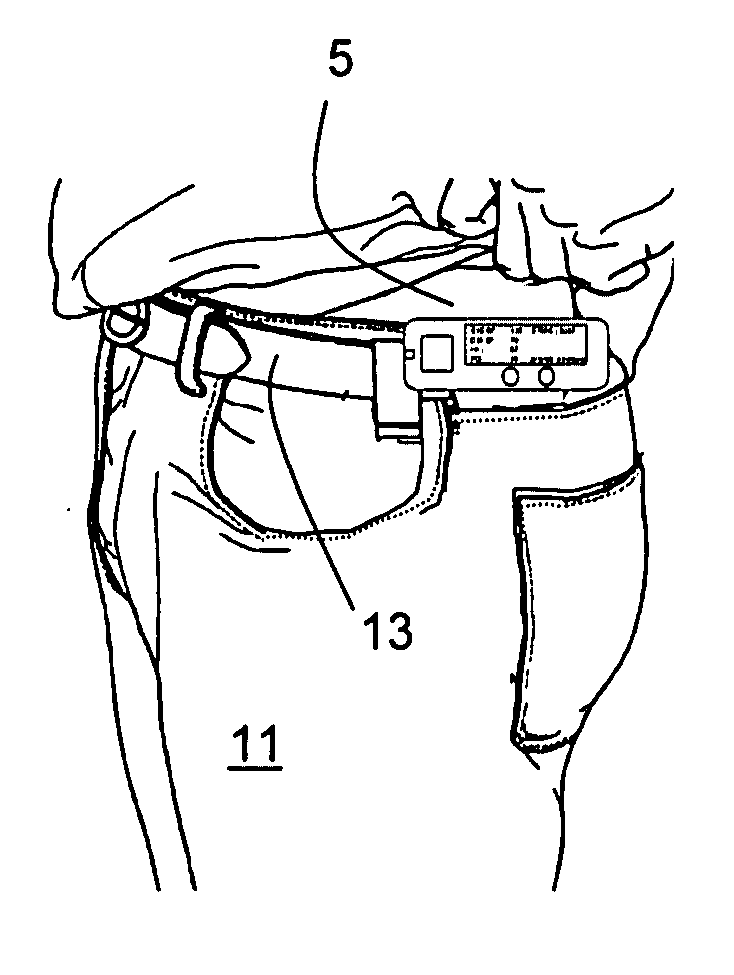
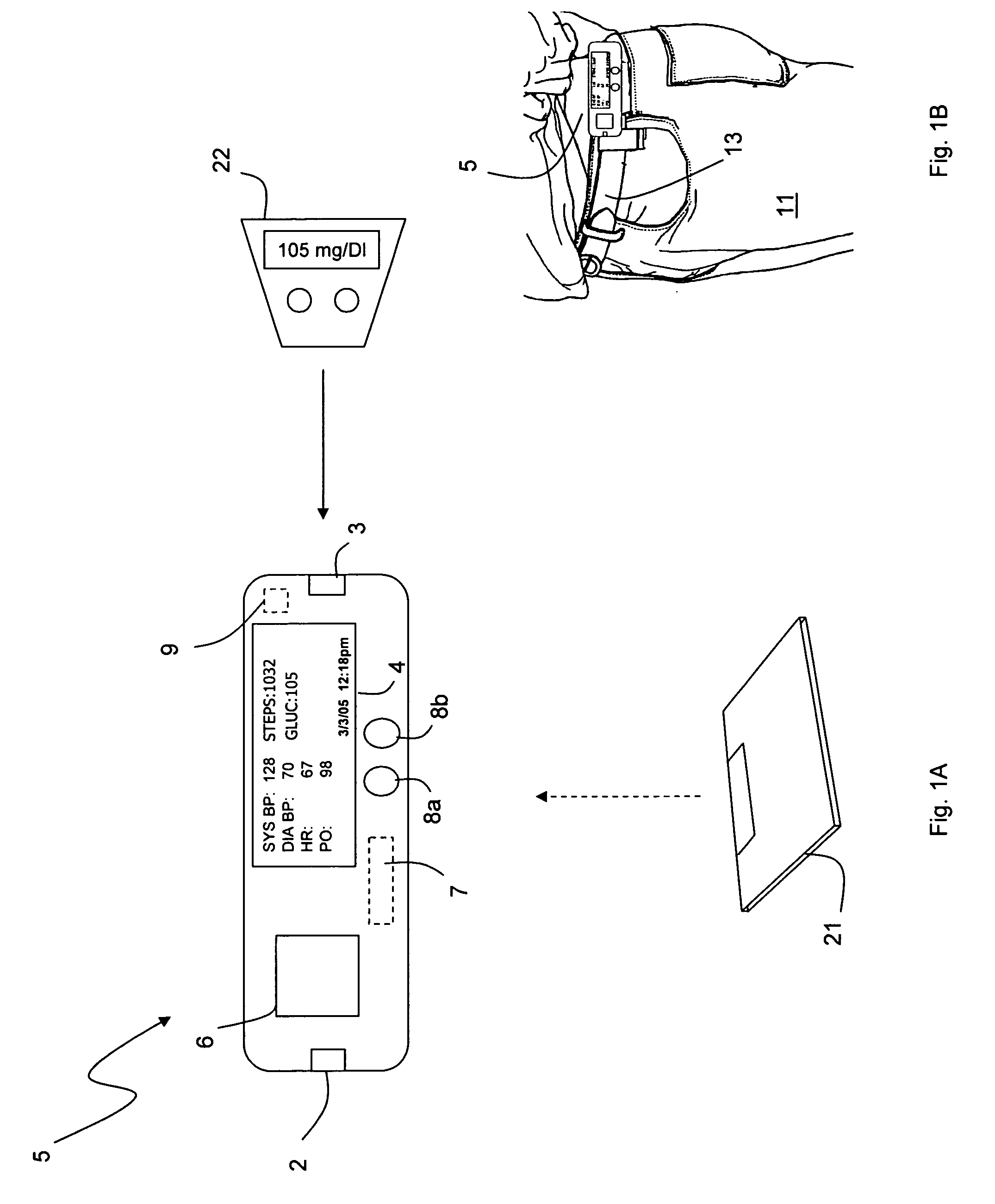
[0021]FIGS. 1A and 1B show a portable, small-scale monitoring device 5 that measures information such as blood pressure, pulse oximetry, heart rate, glucose levels, calories burned and steps traveled from a patient 1. The monitoring device 5, typically worn on the patient's belt 13, features: i) an integrated, optical ‘pad sensor’6 that cufflessly measures blood pressure, pulse oximetry, and heart rate from a patient's finger as described in more detail below; and ii) an integrated pedometer circuit 9 that measures steps and, using one or more algorithms, calories burned. To receive information from external devices, the monitoring device 5 also includes: i) a serial connector 3 that connects and downloads information from an external glucometer 22; and ii) a short-range wireless transceiver 7 that receives information such as body weight and percentage of body fat from an external scale 21. The patient views information from a liquid crystal display (LCD) display 4 mounted on the m...