[0009] A method and system is provided that in a fully automated manner crawls web sites and identifies specific types of web pages, then extracts targeted data from those web pages. An exemplary method according to the invention is a method for identifying product-related information on a web page. One or more text nodes containing product-related information on a first web page are first identified, and the locations of those text nodes are described using one or more vectors. The vectors are then analyzed to identify one or more patterns and to generate a model from those patterns that discriminates between text nodes that contain product-related information and text nodes that do not contain product-related information on a second web page.
[0010] In other more detailed features of the invention, the first and second web pages are written using HTML programming language and the vectors are 4-place vectors in which one field of the vectors represents the text of the text node, one field of the vectors represents the anonymous HTML tag path leading to the text node, one field of the vectors represents the indexed HTML tag path leading to the text node, and one field of the vectors represents the attribute-annotated HTML tag path leading to the text node.
[0011] In other more detailed features of the invention, the model includes one or more symbolic expressions that represent the pattern of text node locations, and the model is used to crawl a plurality of web pages to identify and extract product-related information. The model can also be provided to a client application on a user's computer and used to identify and extract product-related information from web pages as they are displayed to the user.
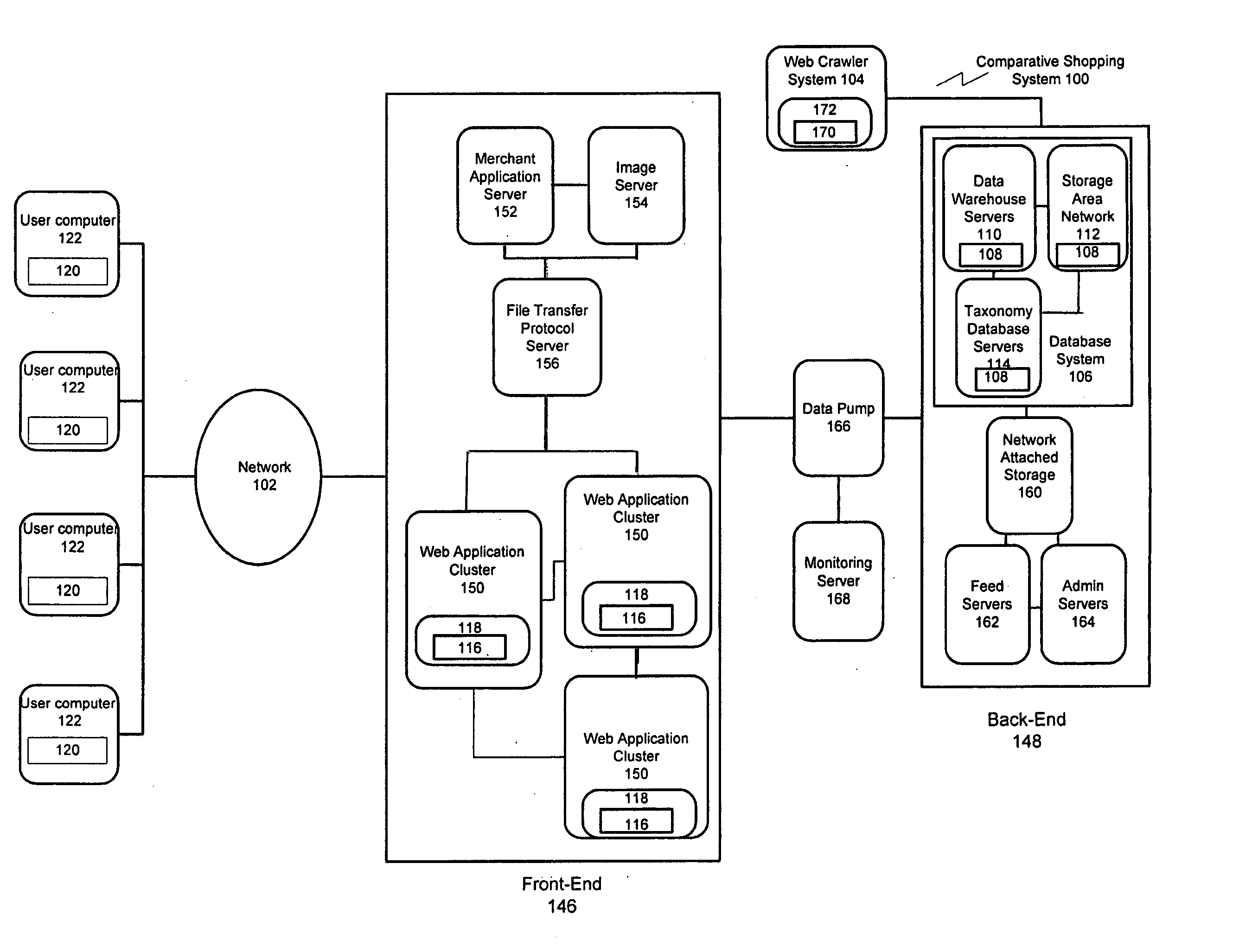
[0012] Embodiments of the present invention also include a system having a first computer having a first computer-readable medium containing a copy of source code for a first web page, and one or more first computer programs configured to parse the copy of the source code to identify all text nodes and analyze the text nodes to identify any text nodes that contain product-related information. One or more second computer programs are configured to generate vectors describing the location of the text nodes containing product-related information, analyze one or more of the vectors to identify one or more patterns and generate one or more models that discriminate between text nodes that contain product-related information and text nodes that do not contain product-related information on a second web page. A second computer is coupled to the first computer and has a second computer-readable medium. One or more of the models are transmitted to the second computer, stored in the second computer-readable medium, and used to identify and extract information about one or more products available for sale on one or more merchant web pages.
[0013] In other more detailed features of this system, the web pages are written using HTML programming language, and the vectors are 4-place vectors where one field of the vectors represents the text of the text node, one field of the vectors represents the anonymous HTML tag path leading to the text node, one field of the vectors represents the indexed HTML tag path leading to the text node, and one field of the vectors represents the attribute-annotated HTML tag path leading to the text node. In other more detailed features of the invention, the model includes one or more symbolic expressions that represent the pattern of text node locations, and the model is used to crawl web pages to identify and extract product-related information.
[0014] Another exemplary method according to the invention is a method for generating a model to identify product-related information on a web site. First, potential product-related text nodes are located on a first web page. Then a representation space is created that describes the potential product-related text nodes on the first web page; and this representation space is analyzed to identify one or more patterns. Those patterns are then used to generate one or more models that discriminate between product-related text nodes and non product-related text nodes on a second web page.


 Login to View More
  Login to View More