
Method and apparatus for generating a frequency warping function and for frequency warping
a frequency warping and function technology, applied in the field of voice conversion and speech recognition, can solve the problems of limiting the usefulness of many applications, serious degraded, and unsatisfactory effects, and achieve the effect of improving the frequency warping function
- Summary
- Abstract
- Description
- Claims
- Application Information
AI Technical Summary
Benefits of technology
Problems solved by technology
Method used
Image

Examples
first embodiment
[0043]FIG. 4 is a flow diagram illustrating the method of frame alignment and frame selection of the present invention.
[0044] In step 401, a pair of occurrences is selected from the training speech of the source speaker and target speaker, with the pair of occurrences belonging to the same or similar phonemes with the same or similar contexts in the training speech of the source speaker and target speaker. The context as used herein includes but is not limited to: neighboring phonemes, position in the word, position in the phrase, position in the sentence, etc.
[0045] If multiple pairs of phonemes with the same or similar contexts are found, some phonemes can be preferred. The formants of some phonemes, such as “e”, are deemed to be of less variance, thus the formants of these phonemes can better represent the characteristics of the speaker.
[0046] If the found multiple pairs of phonemes with the same or similar contexts are identical with each other, some contexts can be preferred,...
second embodiment
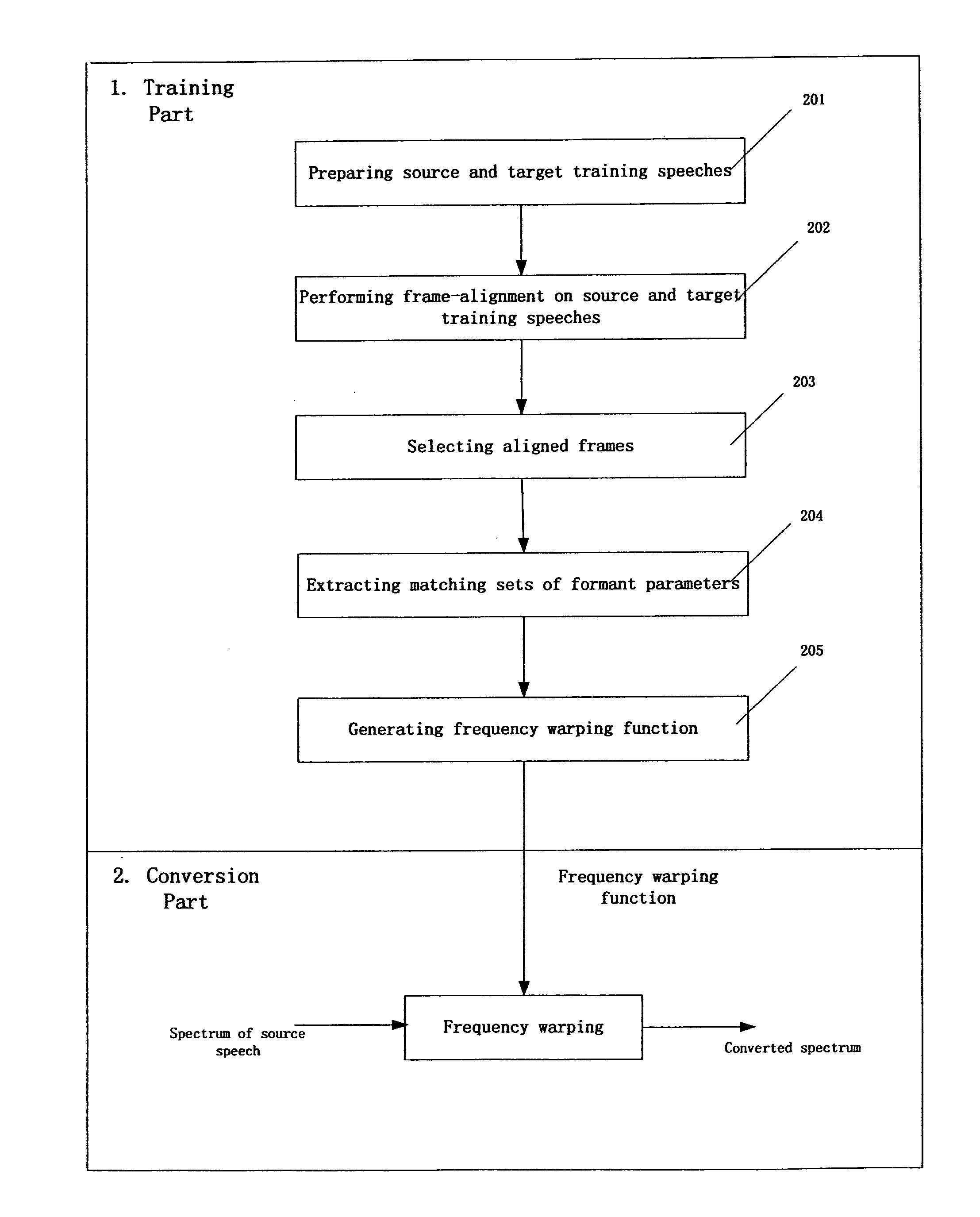
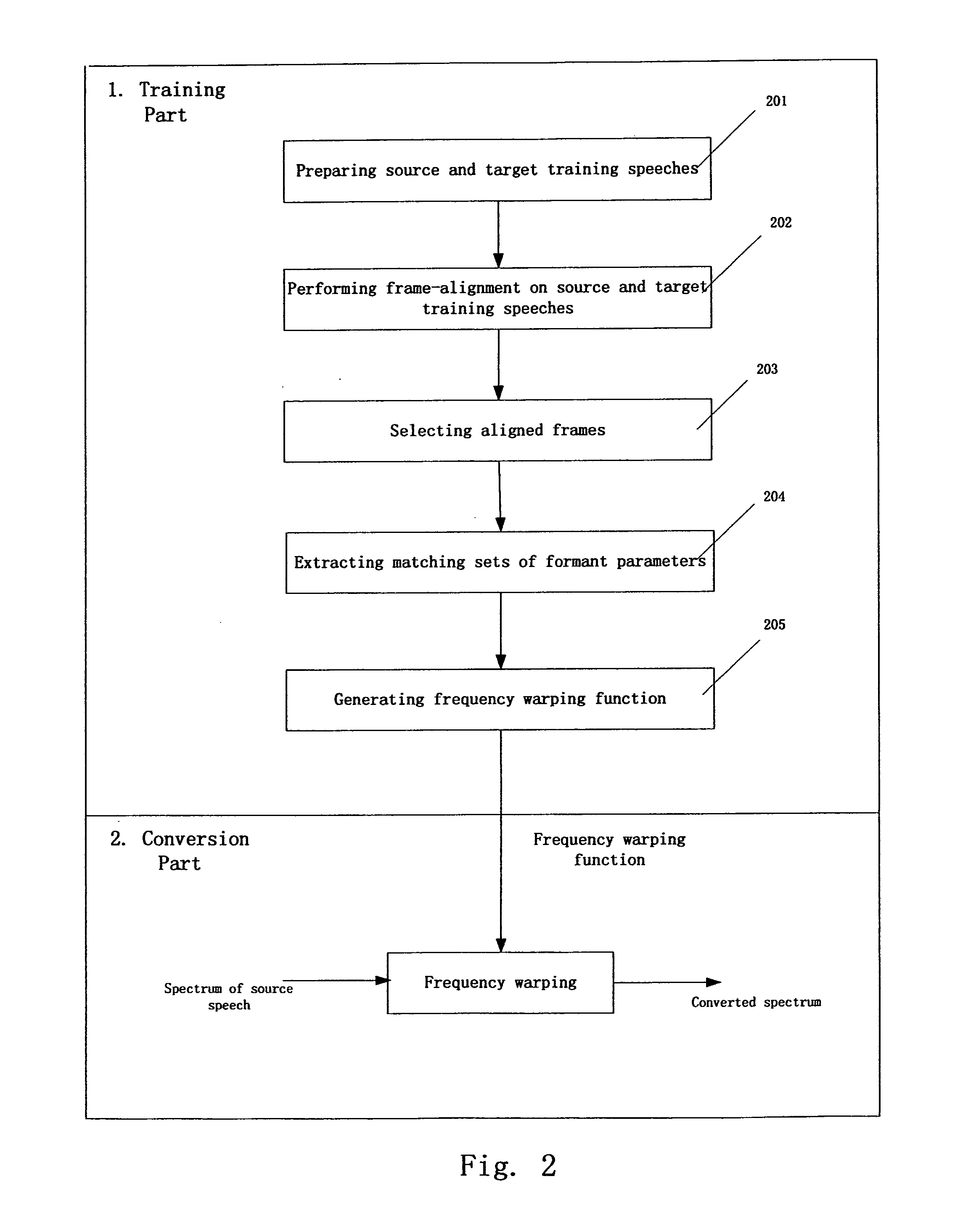
[0050]FIG. 5 is a flow diagram illustrating the frame alignment and frame selection of the present invention. In this second embodiment, when in step 401 a pair of occurrences is obtained in the manner of the above first embodiment, in step 501, the various frames in the occurrence of the target speaker are aligned with the various frames in the occurrence of the source speaker. The alignment can be performed by using the known Dynamic Time Warping (DTW) algorithm. The fundamental point of this method is to find the “best” path through a grid mapping the acoustic features of one pattern to the acoustic features of another pattern. Finding the best path requires solving the minimization problem to evaluate the dissimilarity between two speech patterns. Constraints need to be imposed in order for the result to be meaningful.
[0051] Since the DTW method may obtain multiple aligned frames, selection needs to be performed in step 203. One method of selection is based on the positions of t...
PUM
 Login to View More
 Abstract
Description
Claims
Application Information
 Login to View More