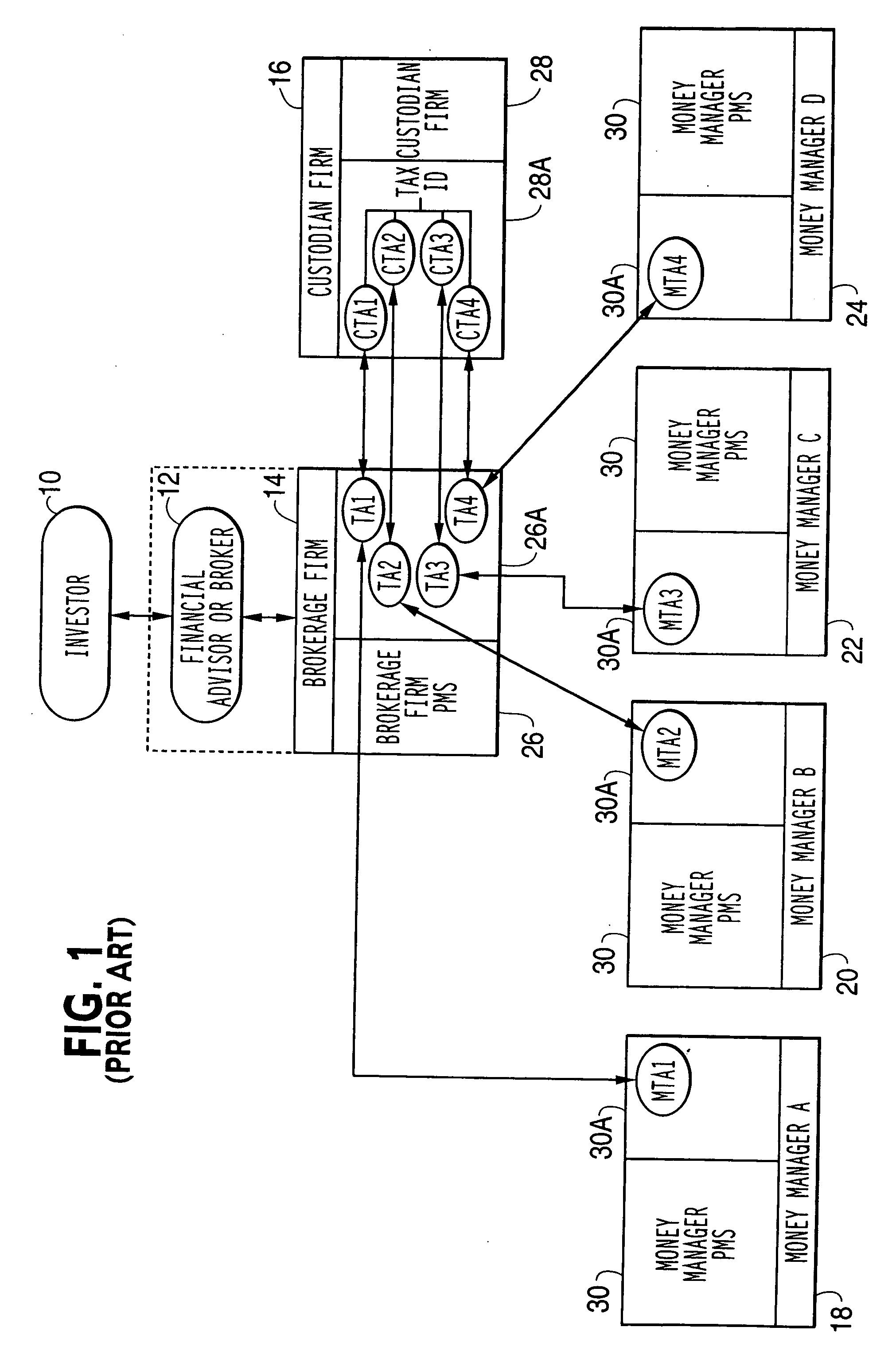
The need to generate multiple trading account statements, i.e. one for each managed trading account, and manually combine these statements into a single brokerage account statement, made reporting to the investor difficult and more expensive for the brokerage firm.
For the investor, the need to review multiple trading account statements for a single brokerage account made the review complex, and the statements difficult to understand and use.
Style-by-style drift monitoring may result in an inefficient number of corrective trades for multiple MTAs.
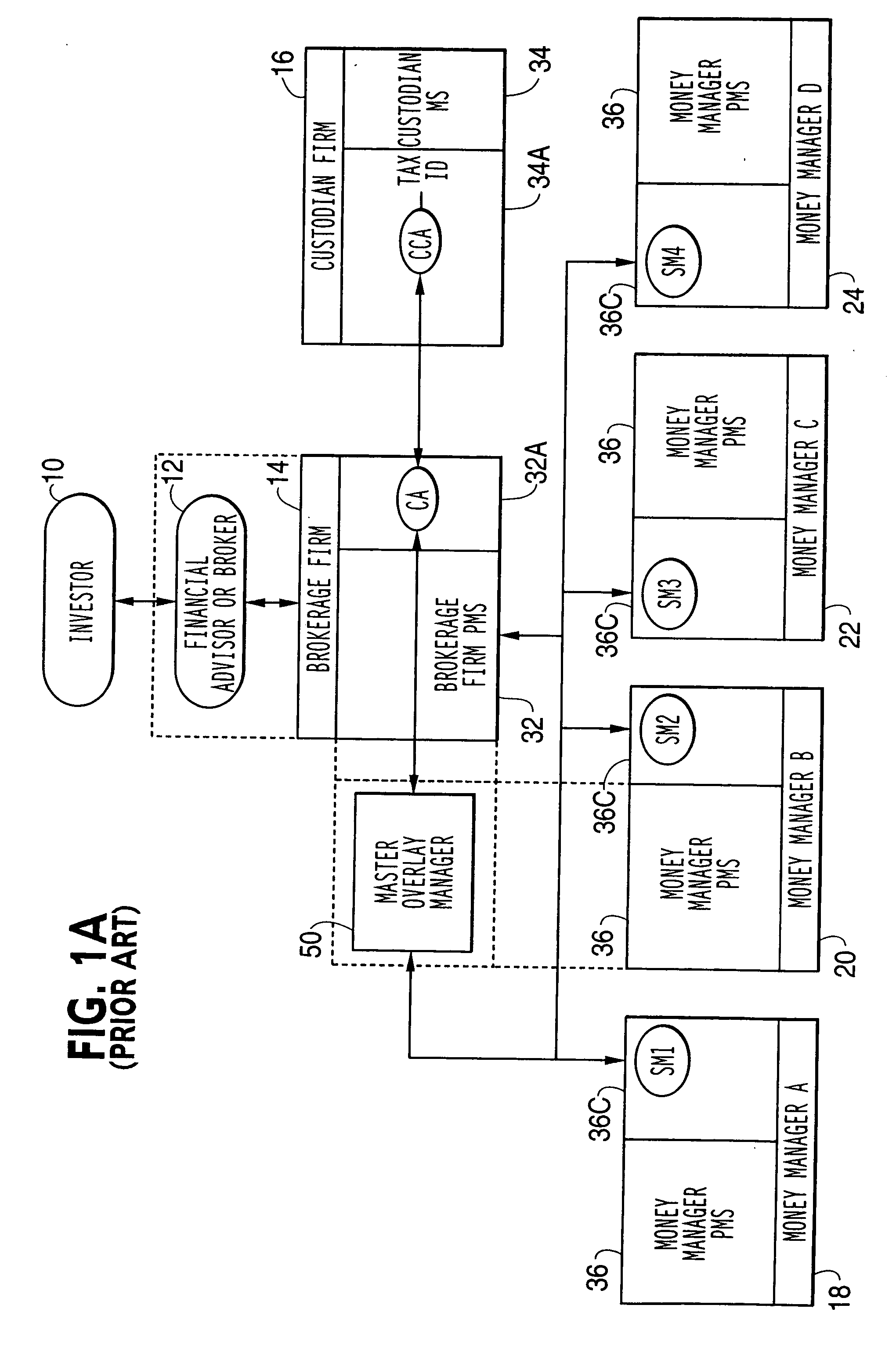
The FIG. 1A and 1B architectures do not provide any automation when it comes to the allocation of assets.
Thus, using the architecture of FIG. 1A, the investor 10 cannot choose desired allocations, or styles, or money managers, but is limited to the predefined allocations, styles and money managers.
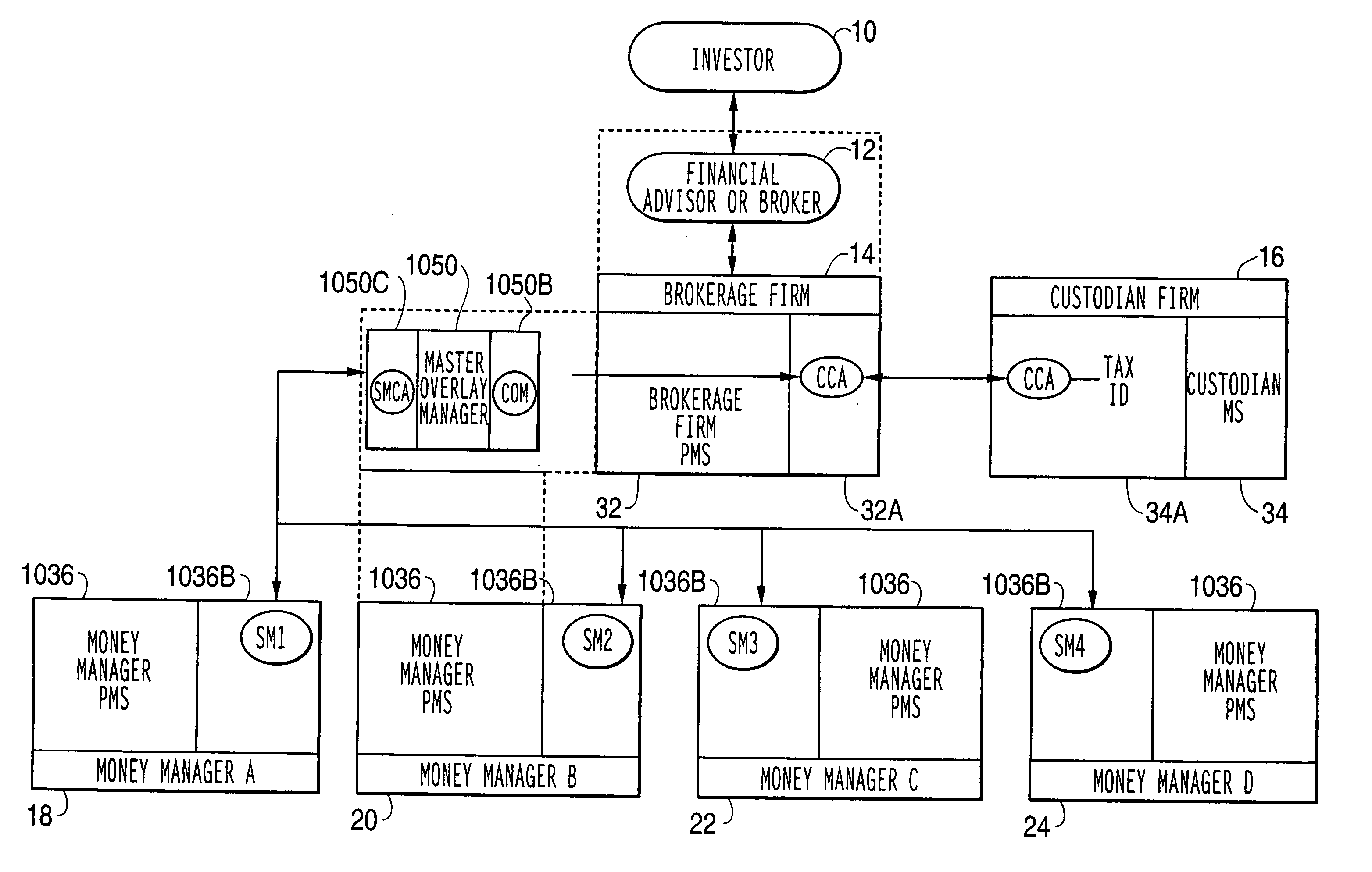
Accordingly, the tracked and reported individual style performance on the account statements generated by the MOM 50 of FIG. 4, may be, and often is, somewhat inaccurate.
Additionally, because the OM used by the MOM 50 does not allow duplicate securities across different styles, the MOM 50 restricts the flexibility of each of the money managers 18-24 to select preferred securities for the respective portion of the MCA assigned to its style.
Thus, the money managers may be prevented from investing in preferred securities, which could detrimentally affect their performance.
Thus, not only is the MOM 50 unable to accurately assess or report on the performance of the individual money manager styles, the MOM 50 also significantly limits the flexibility of the money managers to control how their respective styles are reflected in the OM.
Because each individual MTA serves as its own individual silo, the transactions of one money manager are unknown to the overlay manager and to the other money managers, making it difficult to monitor movements of securities within the entire holdings of the individual investor 10.
Therefore, avoidance of a wash sale violation across the multiple MTAs, i.e. performing tax-aware trading that takes into account the multiple MTAs, and rebalancing allocations across MTAs, can be difficult.
However, this architecture does not provide the money managers 18-24 full flexibility to invest as desired by prohibiting the same security from being held across different styles, and cannot produce true style performance within the MCA.
Rebalancing might additionally be required due to market fluctuations.
However, this may not be the most optimal tax sale for the investor 10.
As a result, a sale by one money manager for one of the MTAs and a purchase by another money manager for another of the MTAs may result in a wash sale violation.
Such situations are difficult to monitor.
However, the MOM 50 is incapable of accurately monitoring cross style allocation drift of the MCA from the cross style allocation set forth in the OM, or of rebalancing across styles, since it does not contain style-specific cash buckets and thus cannot calculate accurate asset valuations for each style.
However, AMOM 50′ does not currently include such functionality.
Thus, the MOM 50 is incapable of maintaining a division of cash among the different styles reflected within the OM.
This results in a significant amount of processing by the MOM to determine if each MCA needs rebalancing and to initiate different trades to rebalance different MCAs.
Furthermore, this will also result in a significant amount of trading by the brokerage firm 14 being required.
The trading may in turn result in additional tax issues for the investors.
However, this is not possible in the FIG. 1A architecture because the style allocation in the OM are fixed and the number of OMs are finite.
However, this is not mandatory.
As noted above, the individual style performances results will be somewhat inaccurate due the lack of consideration of the cash transactions on a


 Login to View More
  Login to View More