At the same time, many people find the act of exercising tedious and time-consuming and will put off
regular exercise because they simply don't enjoy it.
These types of exercise, however, are often difficult to obtain and may not lend themselves to a
regular exercise regimen.
In particular, many of these pursuits require significant space to perform and others can only easily be performed outside.
Therefore, weather and other factors beyond the control of the user can inhibit their ability to obtain the exercise.
Other activities require scheduling with numerous other individuals which requires potentially complex coordination.
Secondly, as these machines can be used indoors, the machines can be used at virtually any time desired by the user, for as long as they desire, and without having to rely on other's schedules, the weather, or other difficult to control factors to be able to exercise.
While working out on a
machine has a number of benefits in both convenience and ease of use, it is often the case that exercising on an
exercise machine is significantly less interesting than participating in an interactive athletic activity or exercising outside.
The
machine is static, solitary, and will generally only have a limited view.
A user on a
machine will, therefore, not necessarily find the exercise as rewarding, or as engaging, as they do when performing other forms of exercise.
This often works well as a
distraction, however, in many cases, the exercise is sufficiently rigorous that the
exercise machine will shake while the exercise is being performed.
The user may also be bouncing or otherwise moving sufficiently quickly to not be able to hold their head steady.
This movement can make it difficult for a user to focus on the reading material during their exercising and can prevent them from using reading for entertainment.
Particularly in gyms, the more complex these systems, the less individualized they are generally.
While whole gym systems provide for a reasonably cost effective way to provide entertainment, they suffer from a number of problems.
Firstly, each individual exerciser cannot select the content they wish to view, but instead are provided only the content that is made available.
In the event that the user finds the content unengaging it will often not serve as the
distraction that it is intended for.
This can particularly be a problem because content selected usually needs to be acceptable to a wide range of people.
Further, it may not always be easy to see or hear a television in a gym or other area where it is shared by a number of machines.
The problem with providing content to each individual user has been two fold.
In the first instance, electronic devices, such as televisions, were simply too large and heavy to be attached individually to exercise machines.
The weight of the devices would make the machines unstable, or overly heavy and cumbersome.
Further,
miniaturization of recording and playback devices have also occurred in recent years.
While it is now cost effective to
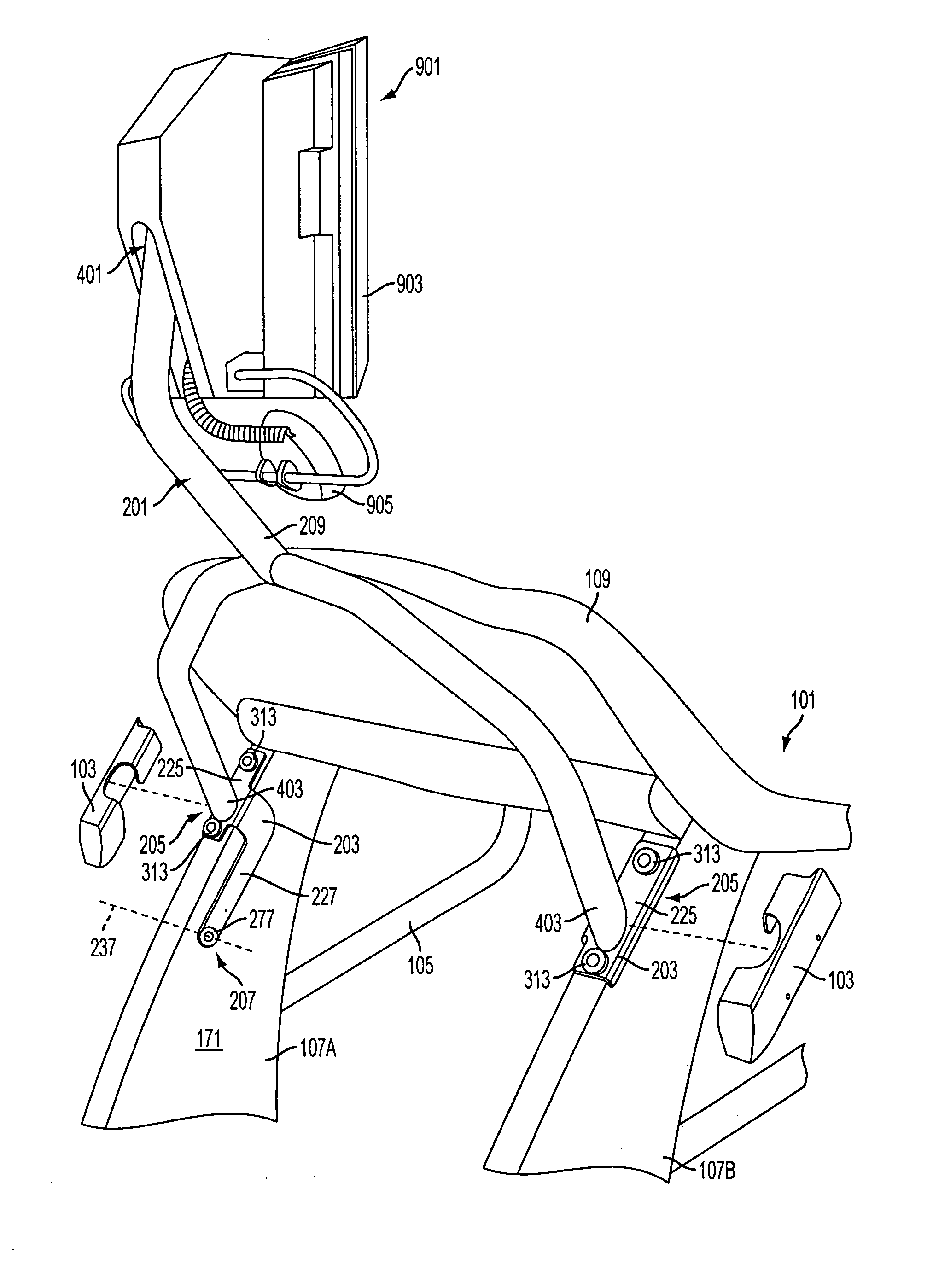
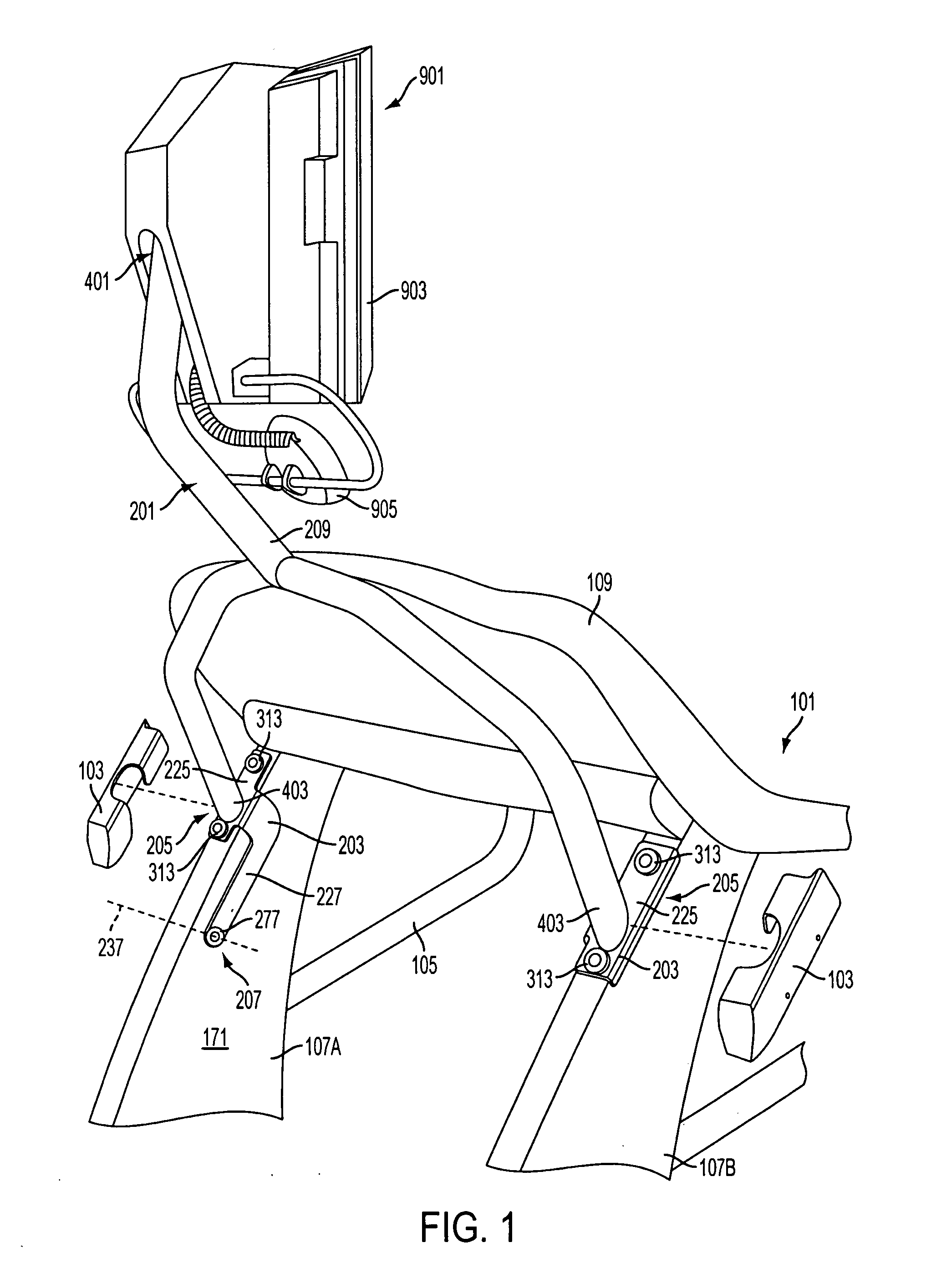
mount televisions to individual exercise machines, this mounting has brought a second issue to light.
When exercise machines are used they will often bounce or move in response to the user's movement on them.
Therefore, each foot strike produces an
impact on the machine which jars the machine during its operation.
While a lot of this
impact can be absorbed by the structure of the machine, electronic devices mounted to a
treadmill frame have traditionally been exposed to a rather large amount of shock and vibration.
Regardless of which method is used, the television will generally experience significant vibration and abrupt motion transitions due to the impact type of motion from the user's feet.
Damage to devices generally occurs not because the device is moving, but is caused instead by the rate of acceleration or deceleration imposed on it (relative to its
inertia).
However, if the electronic device is sharply impacted or is otherwise suddenly accelerated or decelerated, their can be internal strain on electronic components as rigid internal structures attempt to transfer the motion.
Because of this fact, many electronic components which are mounted directly to exercise devices, particularly to treadmills, have their useable life significantly decreased.


 Login to View More
  Login to View More