Abnormal Cannabidiols as agents for lowering intraocular pressure
Active Publication Date: 2007-10-25
ALLERGAN INC
View PDF7 Cites 0 Cited by
Summary
Abstract
Description
Claims
Application Information
AI Technical Summary
This helps you quickly interpret patents by identifying the three key elements:
Problems solved by technology
Method used
Benefits of technology
Benefits of technology
[0011] We have found that Abnormal Cannabidiols are potent ocular hypotensive agents. We have further found that Abnormal Cannabidiols and homologues and derivatives thereof, are especially useful in the treatment of glaucoma and surprisingly, cause no or significantly lower ocular surface hyperemia than the other compounds that are useful in lowering intraocular pressure, e.g. PGF2α and lower alkyl esters thereof.
[0012] The present invention relates to methods of treating ocular hypertension and glaucoma which comprises administering an effecti
Problems solved by technology
In chronic open-angle glaucoma, the anterior chamber and its anatomic structures appear normal, but drainage of the aqueous humor is impeded.
Dil
Method used
the structure of the environmentally friendly knitted fabric provided by the present invention; figure 2 Flow chart of the yarn wrapping machine for environmentally friendly knitted fabrics and storage devices; image 3 Is the parameter map of the yarn covering machine
View more
Image
Smart Image Click on the blue labels to locate them in the text.
Viewing Examples
Smart Image
Click on the blue label to locate the original text in one second.
Reading with bidirectional positioning of images and text.
Smart Image
Examples
Experimental program
Comparison scheme
Effect test
example 1
Intraocular Pressure
[0042] Intraocular pressure was measured by applanation pneumatonometry in conscious animals. The test compound was administered topically to one eye while vehicle was given to the fellow eye in a masked fashion. Laser-induced unilaterally ocular hypertensive Cynomolgus monkeys (females) were dosed once and the IOP was measured over the course of 24 hours.
[0043] The results are shown in the Table, below wherein the stars indicating the potency of the compound. That is, one star indicates no potency, three stars indicates a very potent compound.
Example No.EfficacyVehicle*5***16 (c) Tetrahydropyridine derivative**20 Piperidinedione derivative***9 (b) Cyclohexane derivative***
example 2
Determination of Abnormal Cannabidiol Activity
[0044] Abnormal Cannabidiol receptor activity may be measured in accordance with the procedure disclosed in (Wagner J A et al., Hypertension 33 [part II], 429 (1999); Jarai Z et al., PNAS 96, 14136 (1999), which is hereby incorporated by reference in its entirety.
[0045] When measured according to this assay all of the compounds of the Examples, below, are found to be active.
Experimental Details for Synthesis of Abnormal Cannabidiols
[0046] General Route
example 3
Synthesis of 4-(6-Isopropenyl-3-methylcyclohex-2-enyl)-5-methylbenzene-1,3-diol
[0047] (4R)-1-Methyl-4-isopropenylcyclohex-2-ene-1-ol (300 mg, 2 mmoles) was dissolved in toluene (20 ml) and 5-methylresorcinol (248 mg, 2 mmoles) was added in diethyl ether (5 ml). Oxalic acid dihydrate (252 mg, 2 mmoles) was added and the reaction mixture heated with stirring at 80° for 5 hours. The reaction mixture was allowed to cool and diluted with diethyl ether (30 ml). The ether solution washed twice with aqueous sodium bicarbonate and dried over anhydrous magnesium sulphate. The solvents were evaporated under reduced pressure to give the crude product as a brown oil (800 mg). The product was purified using a silica column eluted with ethyl acetate:isohexane 1:9 going to ethyl acetate:isohexane 2:8.
[0048] The product was isolated as a yellow gum (106 mg)
the structure of the environmentally friendly knitted fabric provided by the present invention; figure 2 Flow chart of the yarn wrapping machine for environmentally friendly knitted fabrics and storage devices; image 3 Is the parameter map of the yarn covering machine
Login to View More
PUM
Property
Measurement
Unit
Electrical conductance
aaaaa
aaaaa
Fraction
aaaaa
aaaaa
Fraction
aaaaa
aaaaa
Login to View More
Abstract
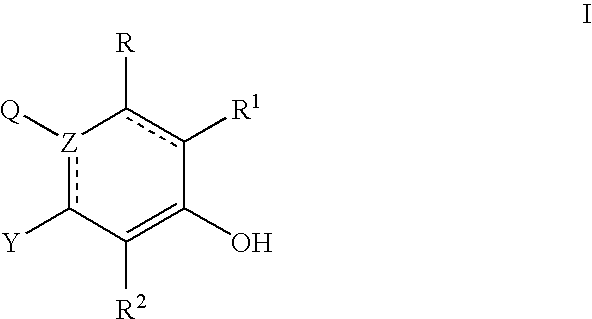
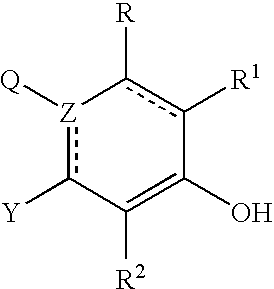
The present invention provides a method of treating glaucoma or ocular hypertension which comprises applying to the eye of a person in need thereof an amount sufficient to treat glaucoma or ocular hypertension of a compound of formula I
wherein Y, Q, Z, R, R1 and R2 are as defined in the specification.
The present invention further comprises pharmaceutical compositions, e.g. ophthalmic compositions, including said compound of formula I.
Description
BACKGROUND OF THE INVENTION [0001] 1. Field of the Invention [0002] The present invention relates to the use of Abnormal Cannabidiols to lower the intraocular pressure of mammals and thus are useful in treating glaucoma. [0003] 2. Background of the Related Art [0004] Ocular hypotensive agents are useful in the treatment of a number of various ocular hypertensive conditions, such as post-surgical and post-laser trabeculectomy ocular hypertensive episodes, glaucoma, and as presurgical adjuncts. [0005] Glaucoma is a disease of the eye characterized by increased intraocular pressure. On the basis of its etiology, glaucoma has been classified as primary or secondary. For example, primary glaucoma in adults (congenital glaucoma) may be either open-angle or acute or chronic angle-closure. Secondary glaucoma results from pre-existing ocular diseases such as uveitis, intraocular tumor or an enlarged cataract. [0006] The underlying causes of primary glaucoma are not yet known. The increased i...
Claims
the structure of the environmentally friendly knitted fabric provided by the present invention; figure 2 Flow chart of the yarn wrapping machine for environmentally friendly knitted fabrics and storage devices; image 3 Is the parameter map of the yarn covering machine
Login to View More
Application Information
Patent Timeline
Application Date:The date an application was filed.
Publication Date:The date a patent or application was officially published.
First Publication Date:The earliest publication date of a patent with the same application number.
Issue Date:Publication date of the patent grant document.
PCT Entry Date:The Entry date of PCT National Phase.
Estimated Expiry Date:The statutory expiry date of a patent right according to the Patent Law, and it is the longest term of protection that the patent right can achieve without the termination of the patent right due to other reasons(Term extension factor has been taken into account ).
Invalid Date:Actual expiry date is based on effective date or publication date of legal transaction data of invalid patent.



 Login to View More