
Method for monitoring blood flow and metabolic uptake in tissue with radiolabeled alkanoic acid
a technology of radiolabeled alkanoic acid and blood flow, which is applied in the field of new products, can solve the problems of imposing limitations on counting statistics, affecting the formation of triglycerides, and the loss of labeling of sup>11/sup>c-fas labeled with sup>11/sup>c on the carboxyl group,
- Summary
- Abstract
- Description
- Claims
- Application Information
AI Technical Summary
Benefits of technology
Problems solved by technology
Method used
Image

Examples
example 1
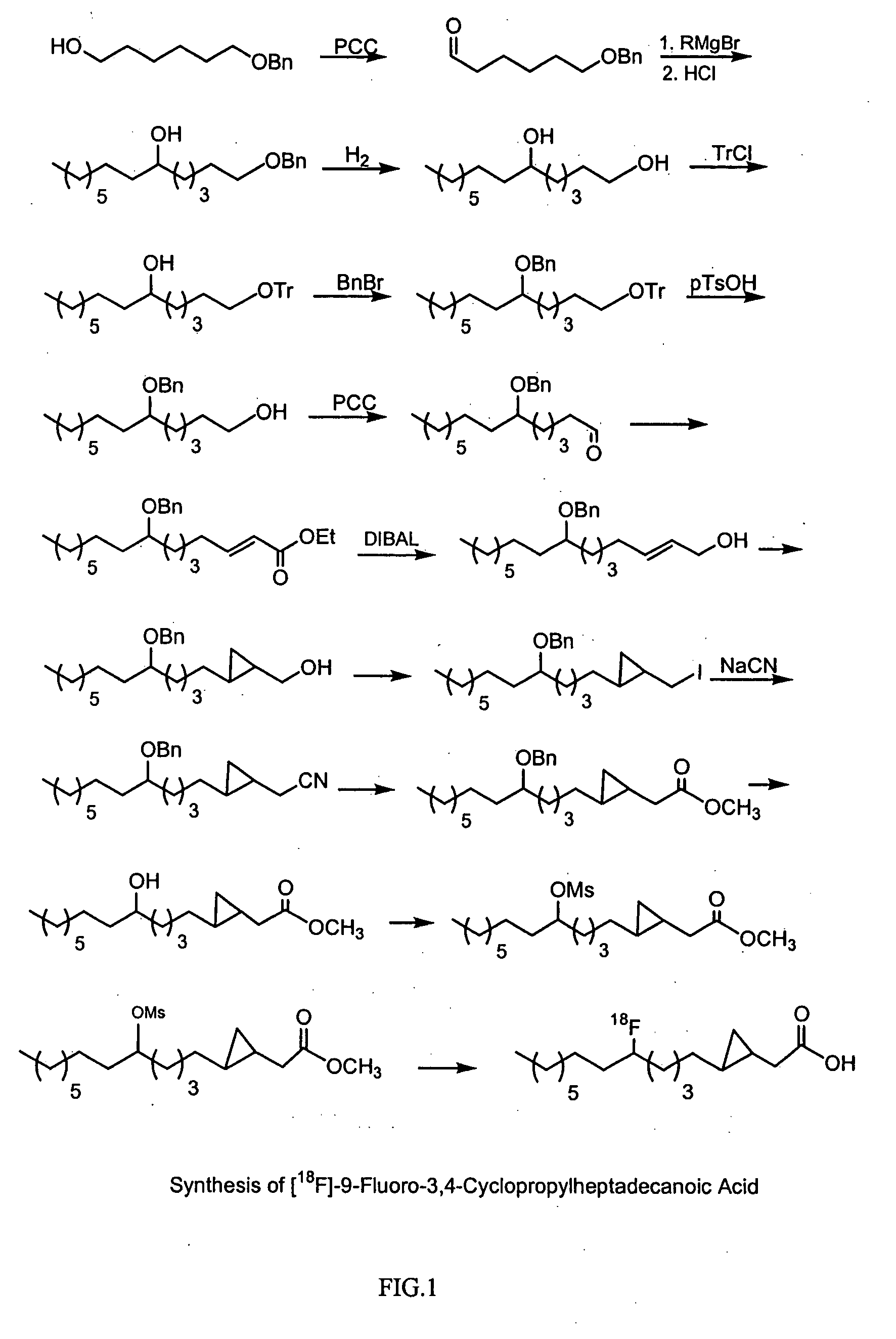
Synthesis of 18F-labeled 3,4-cyclopropyl-heptadecanoic acid ([18F]-FCPHA)
[0187]Synthesis of [18F]-FCPHA was performed using the following method. PCC (pyridinium chlorochromate; 24.8 g, 115.2 mmol) was slowly added in portions to a solution of 6-benzyloxy-1-hexanol (20 g, 96 mmol) in 200 ml of methylene chloride at room temperature (25° C., RT). The black mixture was stirred for 2 hours, and filtered through 50 g of silica gel. The solvent was removed and the crude oil was separated chromatographically on silica gel using a mixture of hexane:ethyl acetate at a ratio of 90:10. This yielded the aldehyde equivalent, 6-benzyloxy-1-hexanal, at a scale of 14 g (70%).
[0188]Under a nitrogen atmosphere, octyl bromide (12 g, 115 mmol) in anhydrous ether (60 mL) was added to magnesium metal (2.8 g, 116 mmol) in 10 ml of ether at a rate as to maintain gentle reflux. After addition, the reaction mixture was stirred for 1 hour and then 6-benzyloxyhexanal (12 g, 58 mmol) in 20 ml of ether was adde...
example 2
Biodistribution of 18F-labeled 3,4-cyclopropyl-heptadecanoic acid([18F]-FCPHA)
[0198]The initial myocardial behavior of [18F]-FCPHA was essentially similar to that of normal FAs, as evidenced that this analog concentrates in the same metabolic pools and has the same subcellular distribution in the rat heart, where it is found in the mitochondria. Male Sprague-Dawley rats weighing approximately 300-350 grams, were injected without anesthesia with 40 μCi of [18F]-FCPHA in a total volume of 200 μl. The radiolabeled FA was injected into the tail vein and the rats subsequently sacrificed at 5 minutes and 60 minutes post-injection. The organs were excised and counted in a gamma counter. Accumulation of the FA in various organs in % DPG (dose per gram) is detailed in Table 1.
TABLE 1Accumulation of 18F-FCPHA in Rat TissueTissue% DPG (5 min)% DPG (60 min)Heart1.55 ± 0.661.43 ± 0.14Lung0.47 ± 0.120.33 ± 0.16Liver1.34 ± 0.260.87 ± 0.15Bone0.16 ± 0.030.70 ± 0.39Blood0.064 ± 0.0080.080 ± 0.019Spl...
example 3
Comparison of the biodistribution of R,R and S,S diastereomers with racemic mixtures of 11C or 14C-labeled 3-methyl-heptadecanoic acid
[0199]The following data compare the biodistribution of 1-[11C]-3(S)-methylheptadecanoic acid (the ‘S’ isomer) and 1-[11C]-3(R)-methylheptadecanoic acid (the ‘R’ isomer). Also compared is the racemic mixture, 1-[14C]-3(R,S)-methylheptadecanoic acid, labeled with 14C. Measurement of the % DPE (dose per gram) at 5 minutes and 30 minutes revealed that the ‘S’ isomer has higher heart uptake and higher heart-to-blood ratios, indicating that the ‘S’ isomer is preferable than the ‘R’ isomer or the racemic mixture as a potential heart imaging agent. Biodistribution was performed in six rats for each compound and time point. The 5-minute distribution data are contained in Table 5, while the 30-minute data are contained in Table 6. These unexpected results imply that during β-oxidation, enoyl-CoA hydratase is stereo-specific and only recognizes the ‘S’ isomer. ...
PUM
 Login to View More
 Abstract
Description
Claims
Application Information
 Login to View More