Check patentability & draft patents in minutes with Patsnap Eureka AI!

Fitting a cochlear implant

a cochlea hair cell and implant technology, applied in the field of fitting of cochlear implants, can solve the problems of pain and possible injury to the recipient, inability to derive suitable benefits from conventional hearing aid systems, and inability to fit cochlea hair cells

Active Publication Date: 2010-10-21
COCHLEAR LIMITED
View PDF20 Cites 29 Cited by
  • Summary
  • Abstract
  • Description
  • Claims
  • Application Information

AI Technical Summary

Problems solved by technology

People who are profoundly deaf due to the absence or destruction of cochlea hair cells are unable to derive suitable benefit from conventional hearing aid systems.
If the C level is set too high, then the recipient may be overstimulated, leading to pain and possible injury to the recipient.
This post-operative configuration or fitting process can be extremely time consuming.
In locations where there is a lack of adequate audiological infrastructure and / or trained clinicians, the cochlear implant may not be optimally fitted for some recipients.
Additionally, since this post-operative configuration process relies on subjective measurements, children, pre-lingually deaf or congenitally deaf recipients are often unable to provide an accurate impression of the hearing sensation resulting from the stimulation test pulses.
This further complicates the fitting process, potentially resulting in a cochlear implant that is not optimally fitted.
However, while this approach has the effect of reducing the time required for the clinical fitting of a cochlear implant, it clearly suffers from a number of disadvantages.
The primary disadvantage is the assumption that the shape of the profile determined at a first level (typically an objectively measured or clinically determined threshold level) will relate to the shape of the profile at a second level at a different overall mean or stimulus level.

Method used

the structure of the environmentally friendly knitted fabric provided by the present invention; figure 2 Flow chart of the yarn wrapping machine for environmentally friendly knitted fabrics and storage devices; image 3 Is the parameter map of the yarn covering machine
View more

Image

Smart Image Click on the blue labels to locate them in the text.
Viewing Examples
Smart Image
  • Fitting a cochlear implant
  • Fitting a cochlear implant
  • Fitting a cochlear implant

Examples

Experimental program
Comparison scheme
Effect test

Embodiment Construction

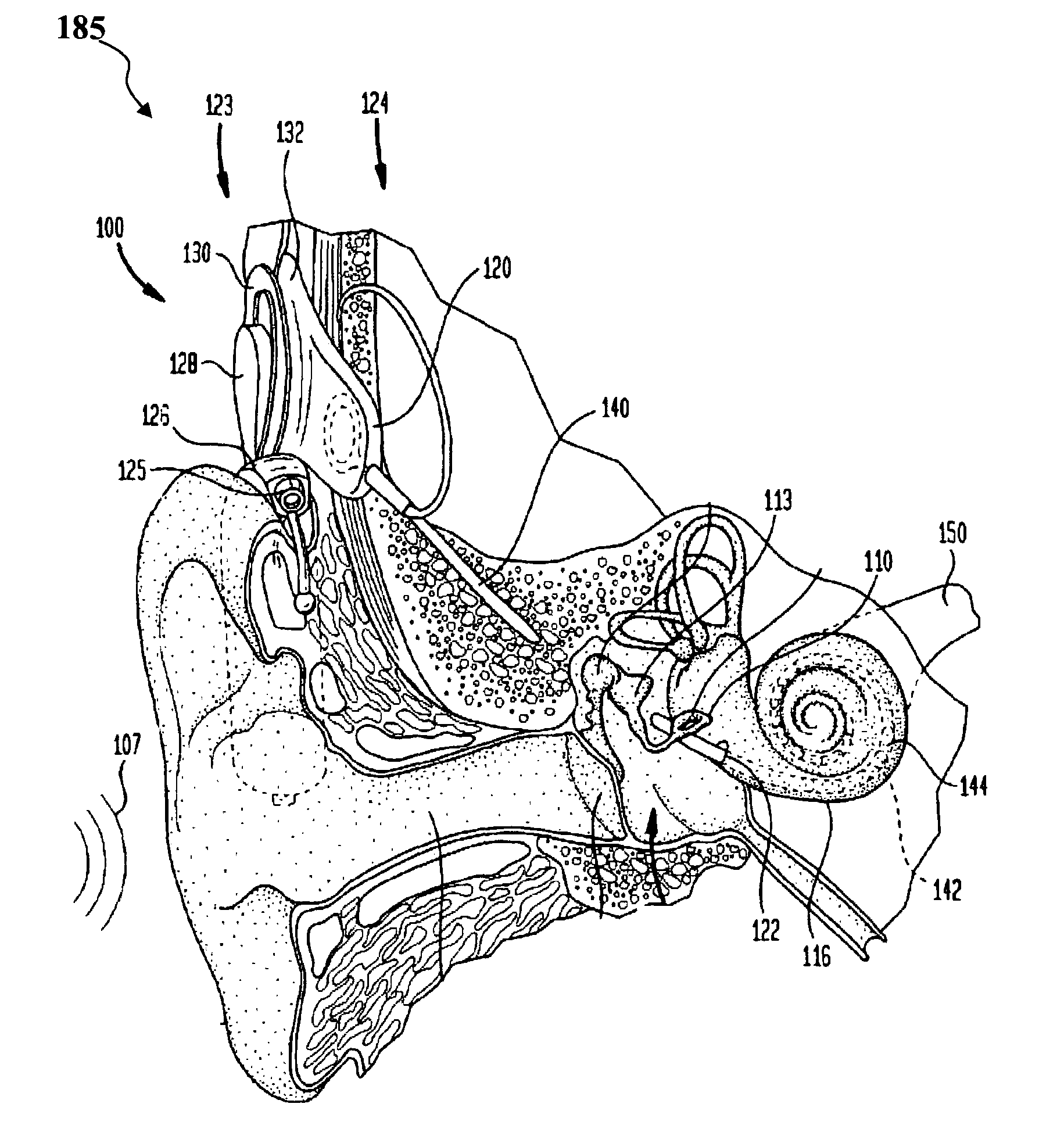
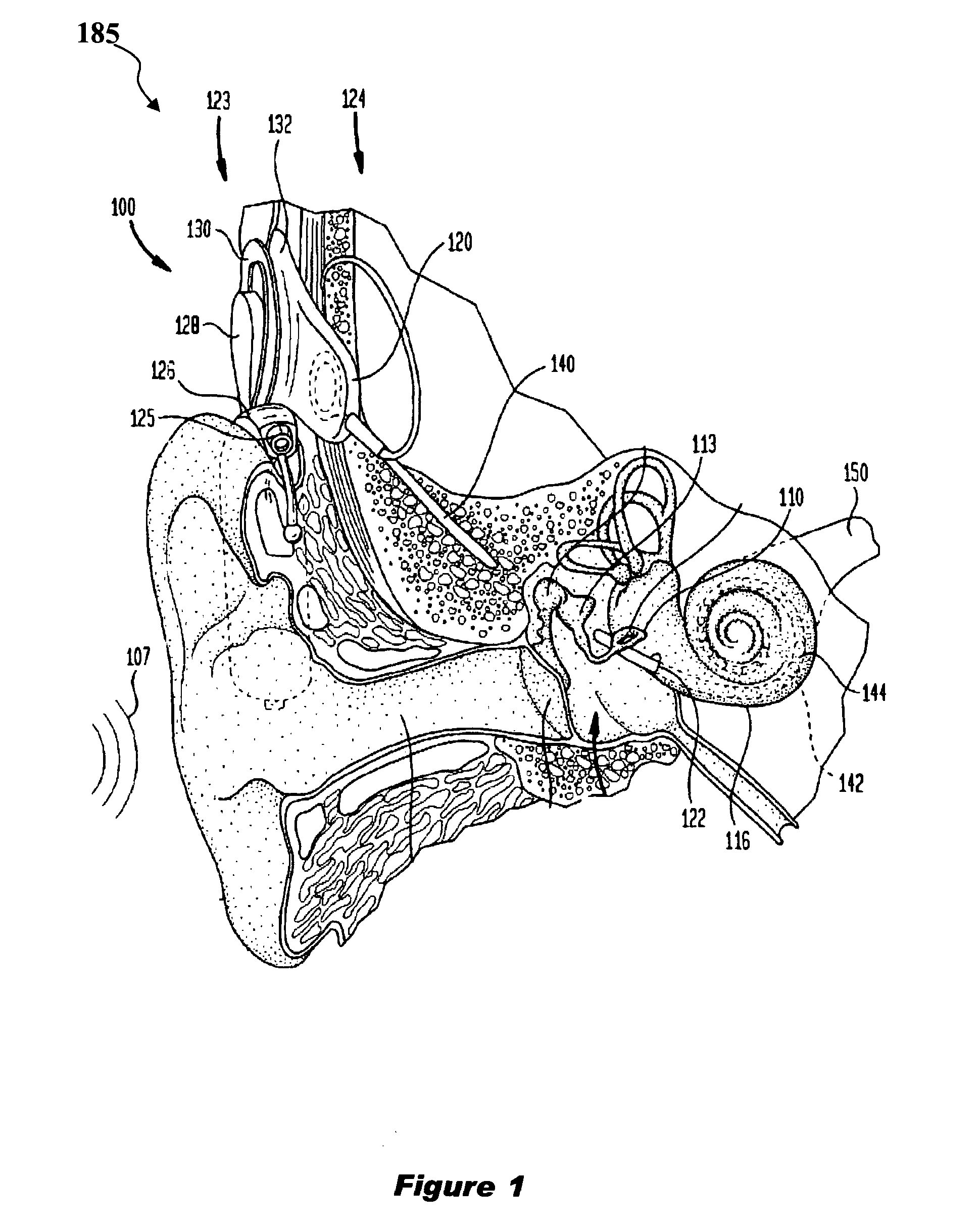
[0035]Referring to FIG. 1, cochlear implant system 185 comprises external component assembly 100 and internal (or implanted) component assembly 124. External assembly 100 comprises a behind the ear (BTE) speech processing unit 126 connected to a transmission coil 130. The BTE unit includes a microphone 125 for detecting sound which is then processed by electronics within the BTE unit to generate coded signals. The coded signals are provided to an external transmitter unit 128, along with power from a power source such as a battery (not shown).

[0036]The internal component assembly 124 includes a receiver unit 132 having an internal coil (not shown) that receives and transmits power and coded signals from external assembly 100 to a stimulator unit 120 to apply the coded signal along an electrode assembly 140. Electrode assembly 140 enters cochlea 116 at cochleostomy region 122 and has one or more electrodes 142, positioned to be substantially aligned with portions of cochlea 116.

[0037...

the structure of the environmentally friendly knitted fabric provided by the present invention; figure 2 Flow chart of the yarn wrapping machine for environmentally friendly knitted fabrics and storage devices; image 3 Is the parameter map of the yarn covering machine
Login to View More

PUM

No PUM Login to View More

Abstract

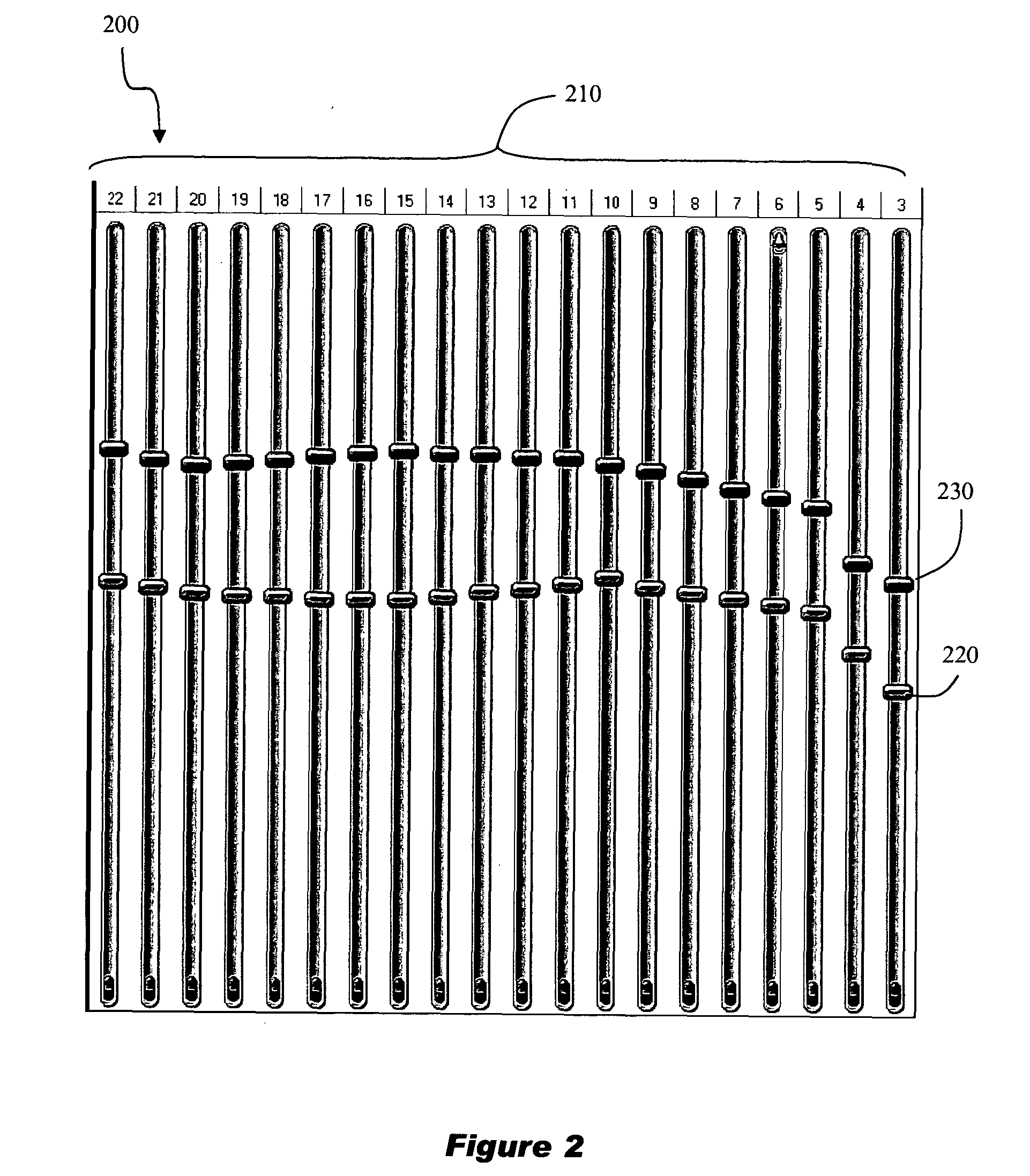
A method and system for fitting a medical implant to a recipient is disclosed. The medical implant is operative to stimulate a physiological system of the recipient over a plurality of stimulation channels. The method includes the steps of determining an initial stimulation profile for the plurality of stimulation channels and then determining a fitting stimulation profile by modifying the form or shape of the initial stimulation profile.

Description

CROSS-REFERENCE TO RELATED APPLICATIONS[0001]The present application is a National Stage Application of International Application No. PCT / AU2008 / 001865, filed Dec. 17, 2008 entitled “Method and System For Fitting a Cochlear Implant”, which claims priority from Australian Provisional Patent Application No. 2007906933 entitled “Method and System for Fitting a Cochlear Implant”, filed 18 Dec. 2007, which is hereby incorporated by reference herein.BACKGROUND[0002]1. Field of the Invention[0003]The present invention relates generally to the configuration of a medical implant that stimulates a physiological system of a recipient, and more particularly, to fitting of a cochlear implant.[0004]2. Related Art[0005]There are many medical implants that deliver electrical stimulation to a recipient for a variety of therapeutic benefits. For example, cochlear implants, such as those manufactured by Cochlear Limited, Sydney, Australia, have been developed to provide persons suffering from sensorin...

Claims

the structure of the environmentally friendly knitted fabric provided by the present invention; figure 2 Flow chart of the yarn wrapping machine for environmentally friendly knitted fabrics and storage devices; image 3 Is the parameter map of the yarn covering machine
Login to View More

Application Information

Patent Timeline
no application Login to View More
Patent Type & Authority Applications(United States)
IPC IPC(8): A61F11/04A61N1/372
CPCA61N1/37252A61N1/36032A61N1/36038A61N1/36039A61F2/18A61F11/00
Inventor BOTROS, ANDREW
Owner COCHLEAR LIMITED
Features
  • R&D
  • Intellectual Property
  • Life Sciences
  • Materials
  • Tech Scout
Why Patsnap Eureka
  • Unparalleled Data Quality
  • Higher Quality Content
  • 60% Fewer Hallucinations
Social media
Patsnap Eureka Blog
Learn More