
RNA Interference for the Treatment of Heart Failure
a technology of rna interference and heart failure, which is applied in the direction of viruses/bacteriophages, cardiovascular disorders, drug compositions, etc., can solve the problems of limited therapeutic usefulness of this approach, heart failure is an inability to match cardiac output to physiological demand, and the economic and human toll will continue to increase, so as to improve survival, reduce the expression of phospholamban (plb) mrna, and reduce the amount of plb protein
- Summary
- Abstract
- Description
- Claims
- Application Information
AI Technical Summary
Benefits of technology
Problems solved by technology
Method used
Image

Examples
example 1
Materials and Methods
Development of Recombinant Adenoviral and AAV Vectors
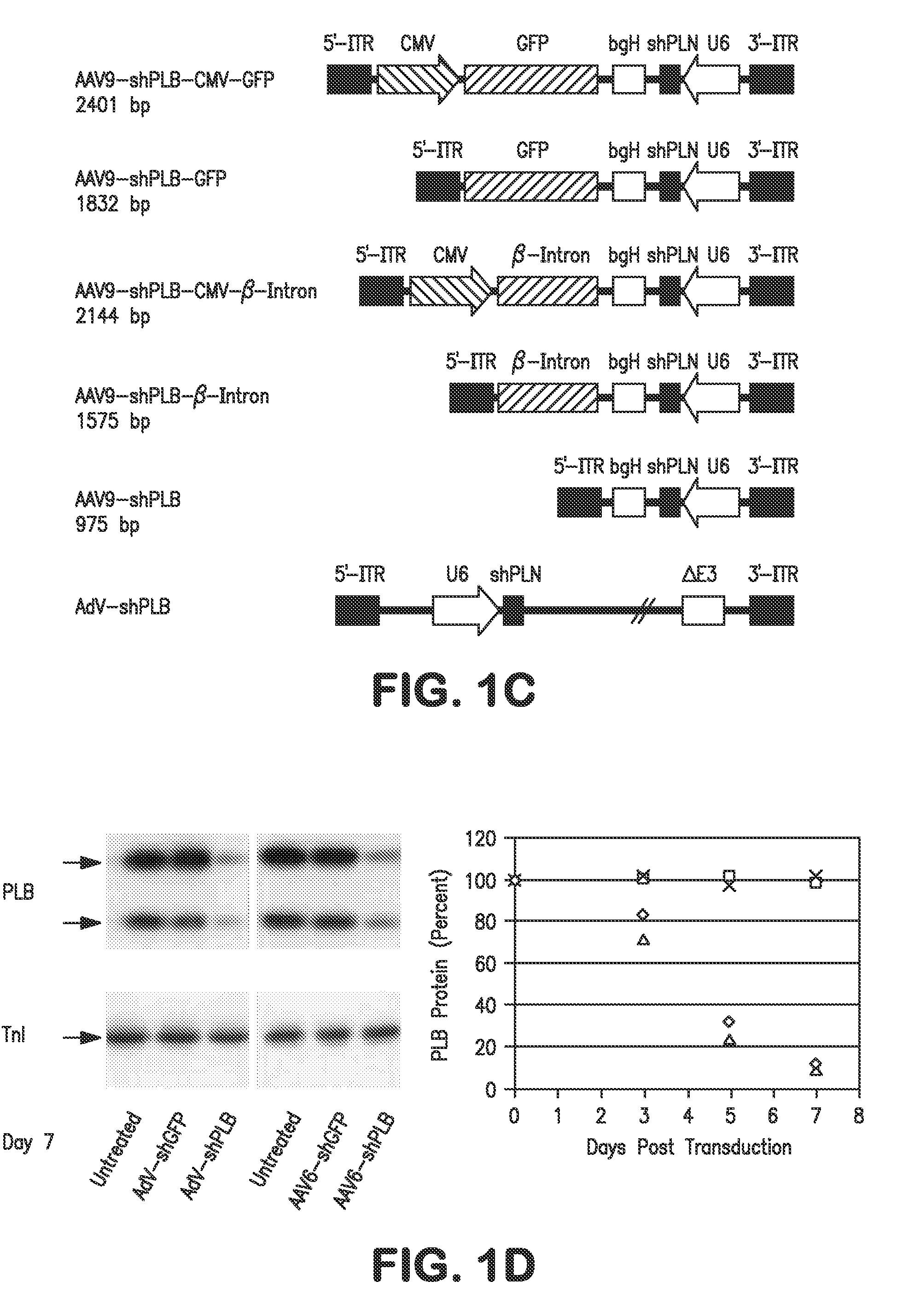
[0162]Recombinant adeno-associated virus (rAAV) vectors were developed for the in vitro studies as pseudotyped rAAV2.6 and for the in vivo work as rAAV2.9. Both contained identical AAV2 vector genomes with the indicated shRNA expression cassettes and were processed identically with the exception of using the plasmid AAV6cap for rAAV2.6 and AAV9cap for rAAV2.9, respectively. Throughout all in vitro and in vivo studies only self-complementary (“dimeric”) rAAV genomes were used due to their enhanced performance as compared to single-stranded (“monomeric”) rAAV vectors. Starting from an shRNA expression cassette previously used in an adenoviral (AdV) vector AdV-shPLB, which efficiently and stably silenced PLB expression in cultured primary neonatal rat cardiomyocytes (PNCMs), AdV and rAAV vectors co-expressing shRNA and GFP as a marker was sought to be developed which would allow vector tracking during the experim...
example 2
Optimization of RNAi Vector Systems
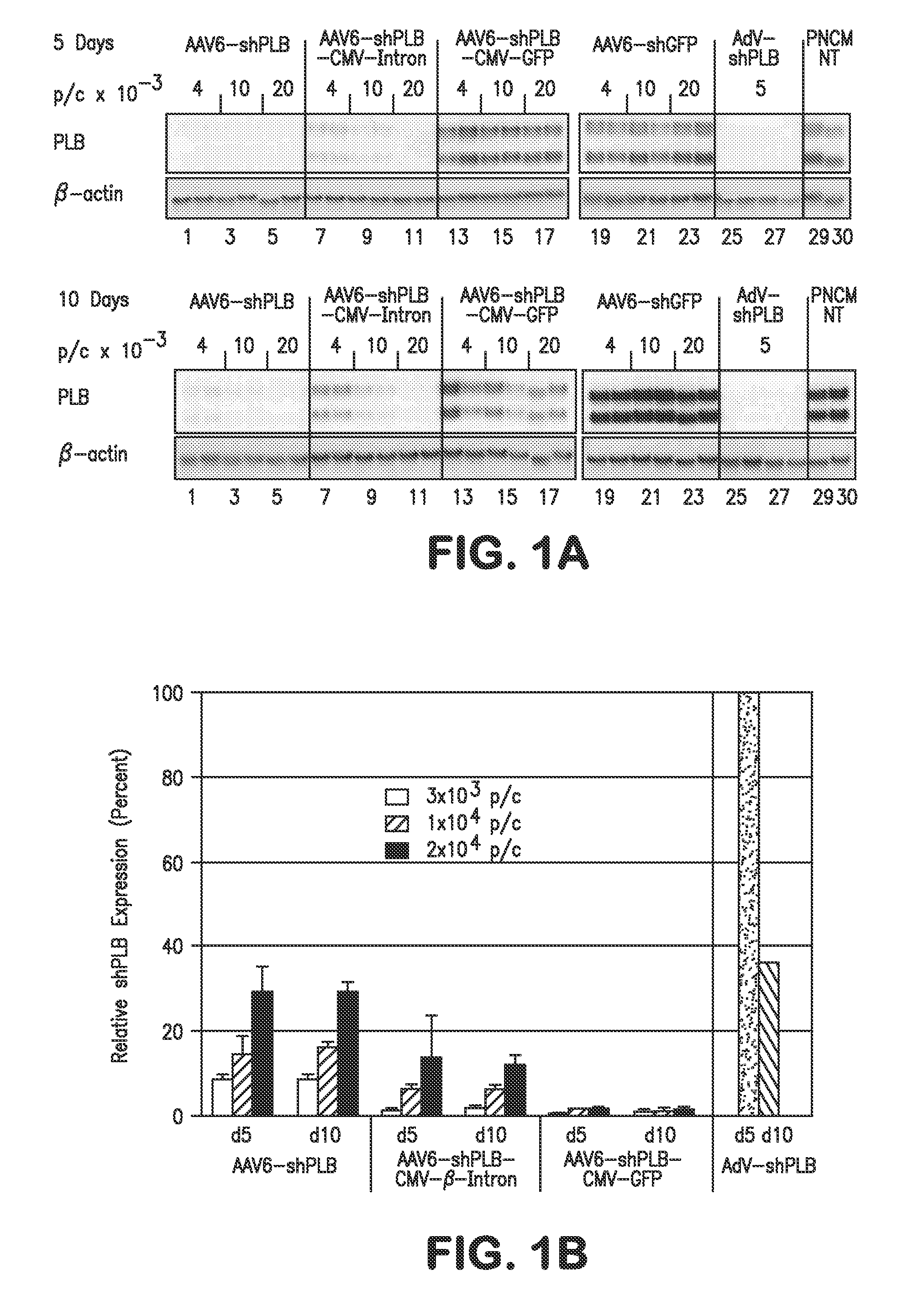
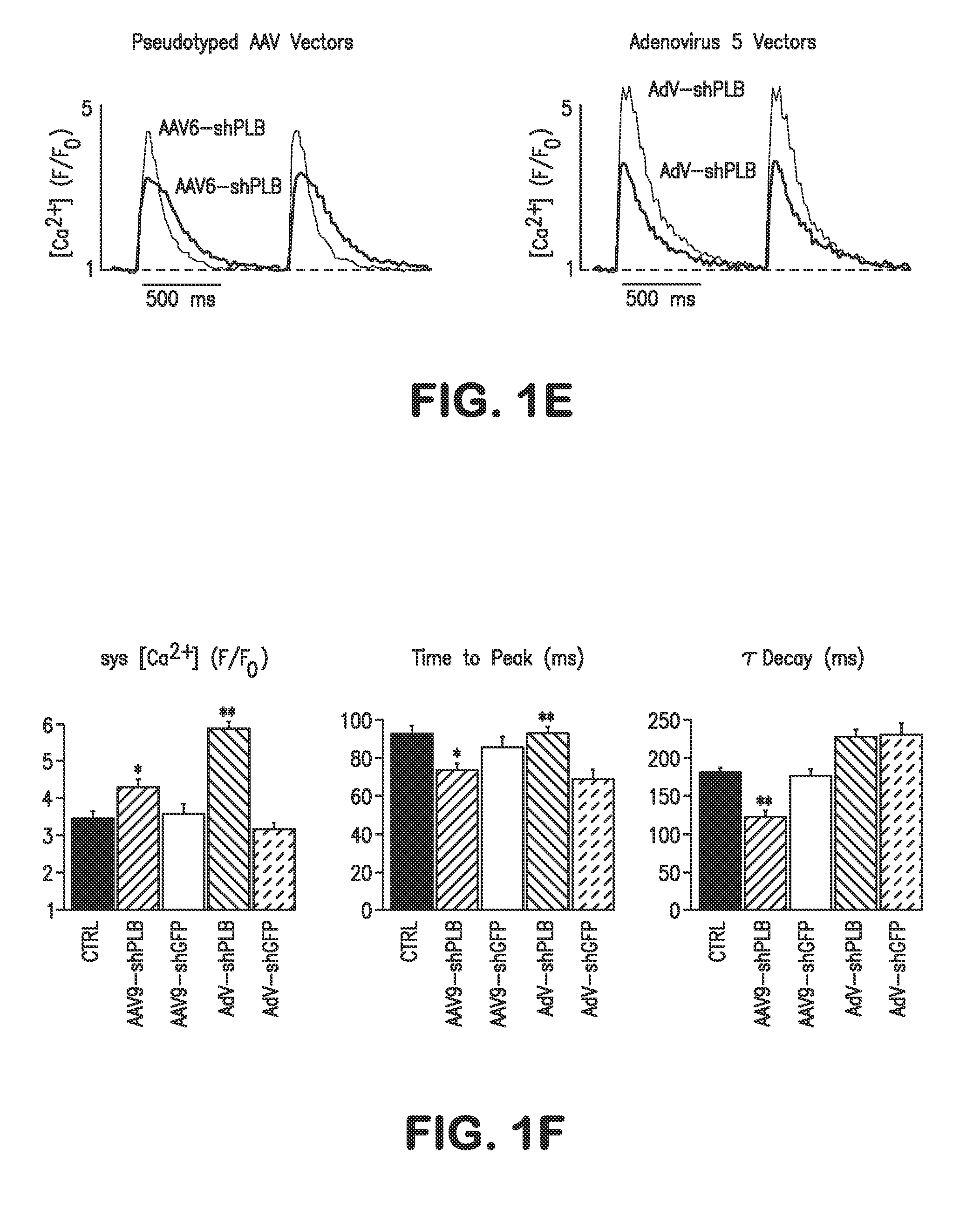
[0181]The determinants of the silencing efficacy of viral RNAi vectors were investigated since it was observed that AAV-shPLB vectors with apparently minor structural differences showed grossly different shRNA production rates and target silencing in PNCMs in vitro (FIG. 1). For these initial studies in PNCMs the AAV2.6 pseudotype was used which has higher tranduction efficacy than AAV2.9 in vitro. For the later RNAi therapeutic investigations reported in FIGS. 2 and 3 only AAV2.9 was employed which displays superior cardiac transduction in vivo. The in vitro experiments showed that co-expression of a GFP marker protein to tag cells harboring the shPLB vector nearly abolished shPLB production (FIG. 1B) and PLB silencing (FIG. 1A). The presence of a CMV promoter in the expression cassette containing the U6 promotor used for shRNA transcription reduced shRNA production strongly if GFP was driven by the CMV, but also if CMV was linked to a β-intron (F...
example 3
Efficacy of RNAi Therapy In Vivo
[0183]Transaortic constriction led to severe HF in rats after 30 weeks. The experimental protocol for in vivo RNAi therapy is outlined in FIG. 2. Fluorescent imaging and immunohistological analysis of a GFP vector of the same type (rAAV9) as used for the RNAi therapies showed grossly homogeneous cardiac GFP expression one month after i.v. injection at macroscopical and microscopical scale and may be assumed to approximate the cardiac shRNA expression levels generated by the RNAi vectors (FIGS. 2B-2D). Direct measurement of shPLB production in vivo is unfeasible with current technology. FIGS. 2F and 2G show significantly decreased cardiac PLB protein after treatment with either AdV-shPLB or rAAV9-shPLB. SERCA2a protein was decreased in failing hearts, whereas shPLB therapy was accompanied by an increase in cardiac SERCA2a protein. NCX was not significantly changed.
[0184]Treatment by aortic root injection of the AdV-shPLB as compared to the AdV-shGFP co...
PUM
| Property | Measurement | Unit |
|---|---|---|
| Fraction | aaaaa | aaaaa |
| Fraction | aaaaa | aaaaa |
Abstract
Description
Claims
Application Information
 Login to View More