This kind of LLT lamps always fails a safety test, which measures through lamp leakage current.
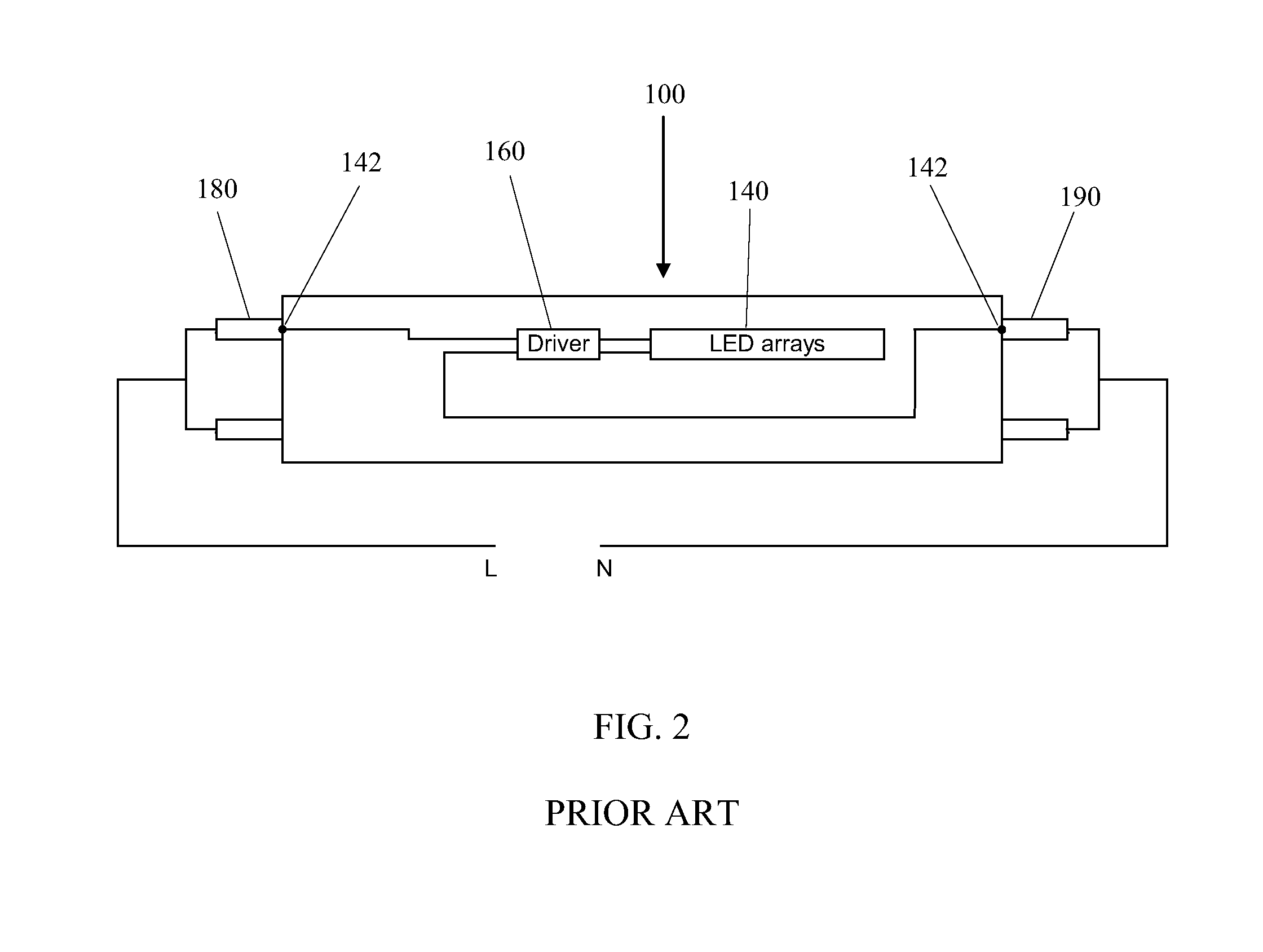
Because the line and the neutral of the AC mains apply to both opposite ends of the tube when connected, the measurement of current leakage from one end to the other consistently results in a substantial current flow, which may present a risk of shock during re-lamping.
Appliances such as toasters and other appliances with exposed heating filaments present the same kind of
hazard.
As mentioned, without protection, shock
hazard will occur for an LLT lamp, which is at least 2 feet long; it is very difficult for a person to insert the two opposite bi-pins at the two ends of the LLT lamp into the two opposite sockets at two sides of the luminaire fixture at the same time.
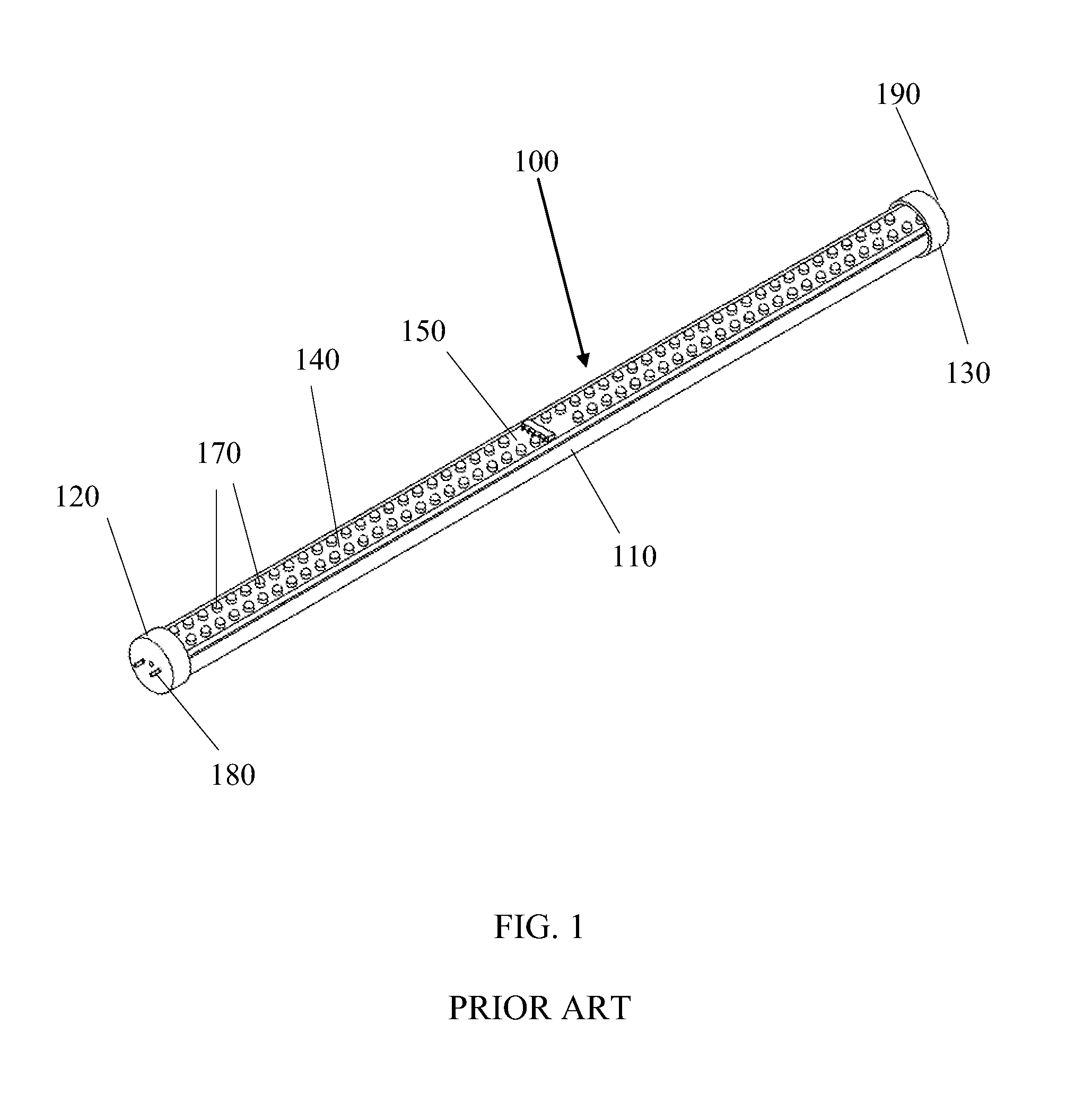
At this time, if the person who replaces the LLT lamp 100 touches the exposed bi-pin 190, which is energized, he or she will get
electric shock because the current flows to earth through his or her body—a shock
hazard.
Almost all the LLT lamps currently available on the market are without any protections for such
electric shock.
However, such a single protection approach cannot completely eliminate the possibility of shock risk.
As long as shock risk exists, the
consumer product safety remains the most important issue.
In this case, however, the retrofit and rewiring of the existing fixture to enable such LLT lamp may involve two new electrical sockets replacement in the fixture and needs much longer time to complete the rewiring because conventional fluorescent tube is double-ended, and its fixture and lamp holder sockets are wired in a double-ended manner.
The new sockets, rewiring, and installation costs together will be too high for consumers to replace conventional fluorescent tubes economically.
But this introduces shock and fire hazards.
This definitely will burn the connections on the bi-pin, possibly causing fire, and trip the
circuit breaker.
Due to this potential shock and
fire risk for this kind of LLT lamp modification used with an existing fluorescent tube fixture, UL requires that the lamp base bi-pin used for mechanical support only not be interconnected or connected to dead
metal parts of the lamp base.
Similar hazards occur for double-ended lamps.
Such lamps will never pass UL leakage current test and present the shock risk during re-lamping, as mentioned above.
In addition, such non-UL compliant LLT lamps have their bi-pins internally connected.
Furthermore, because LLT lamps have a very long service life, consumers who do not know single-ended and double-ended configurations may try to install their LLT lamps in another fixture with unknown wiring configuration several years later while original installation / wiring instructions may not be found.
In this case, there exist fire and shock hazards.
This presents a shock hazard.
However, such lamps are non-operable because no power supplies to the driver when used with single-ended fixtures.
Even worse, when the two adjacent pins of the bi-pin on either one of the two ends in the double-ended LLT lamp are abnormally interconnected, the lamps may present
fire hazard as mentioned above.



 Login to View More
  Login to View More