
Systems and methods for forming and maintaining a high performance frc
a high-performance, frc technology, applied in nuclear reactors, greenhouse gas reduction, nuclear engineering, etc., can solve the problems of dramatic fast particle loss via collisionless stochastic diffusion, need to use external multipoles to control rotational instabilities, etc., to facilitate formation and maintenance, improve the confinement of particles, energy and flux, and stability control without negative side effects
- Summary
- Abstract
- Description
- Claims
- Application Information
AI Technical Summary
Benefits of technology
Problems solved by technology
Method used
Image

Examples
Embodiment Construction
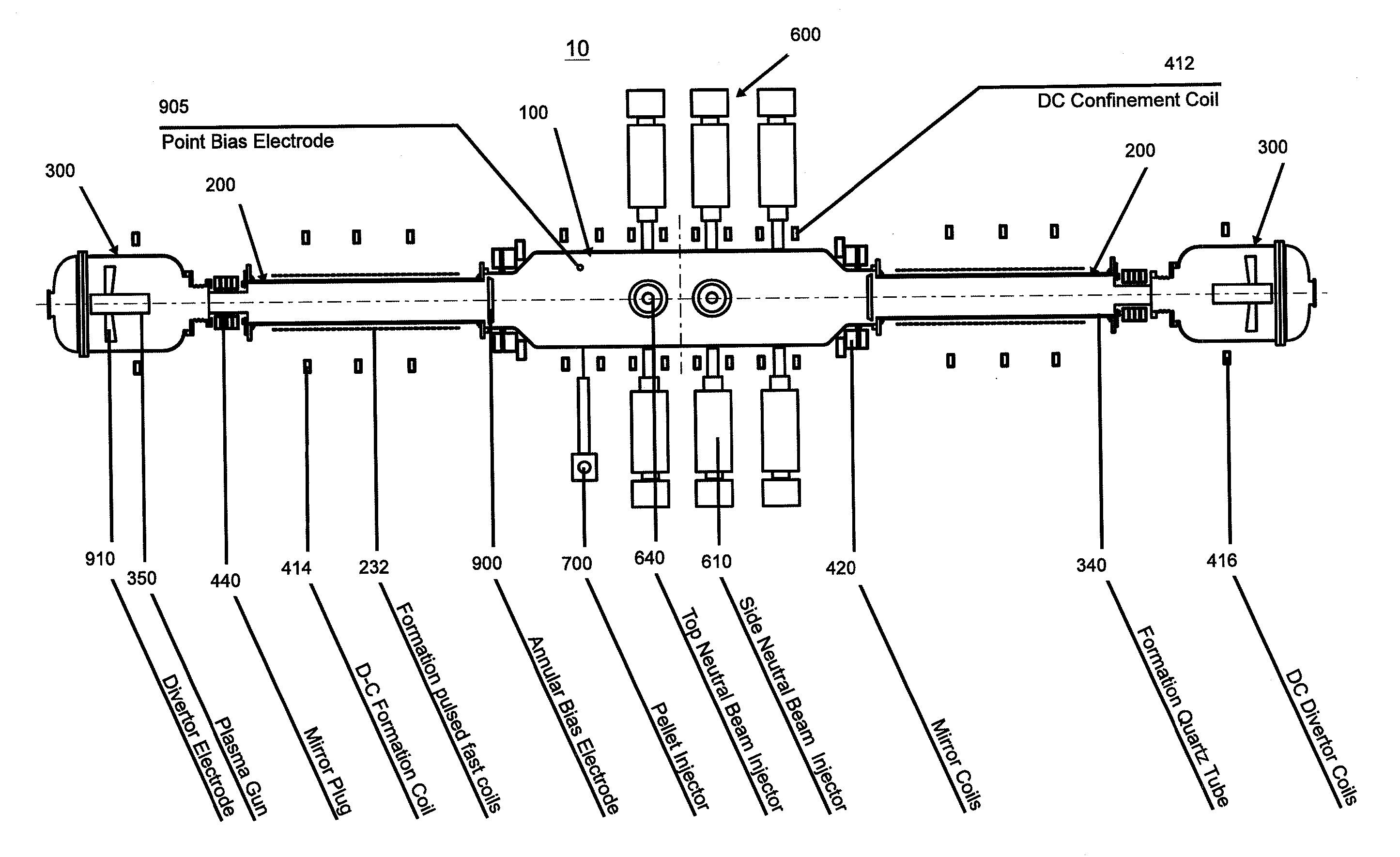
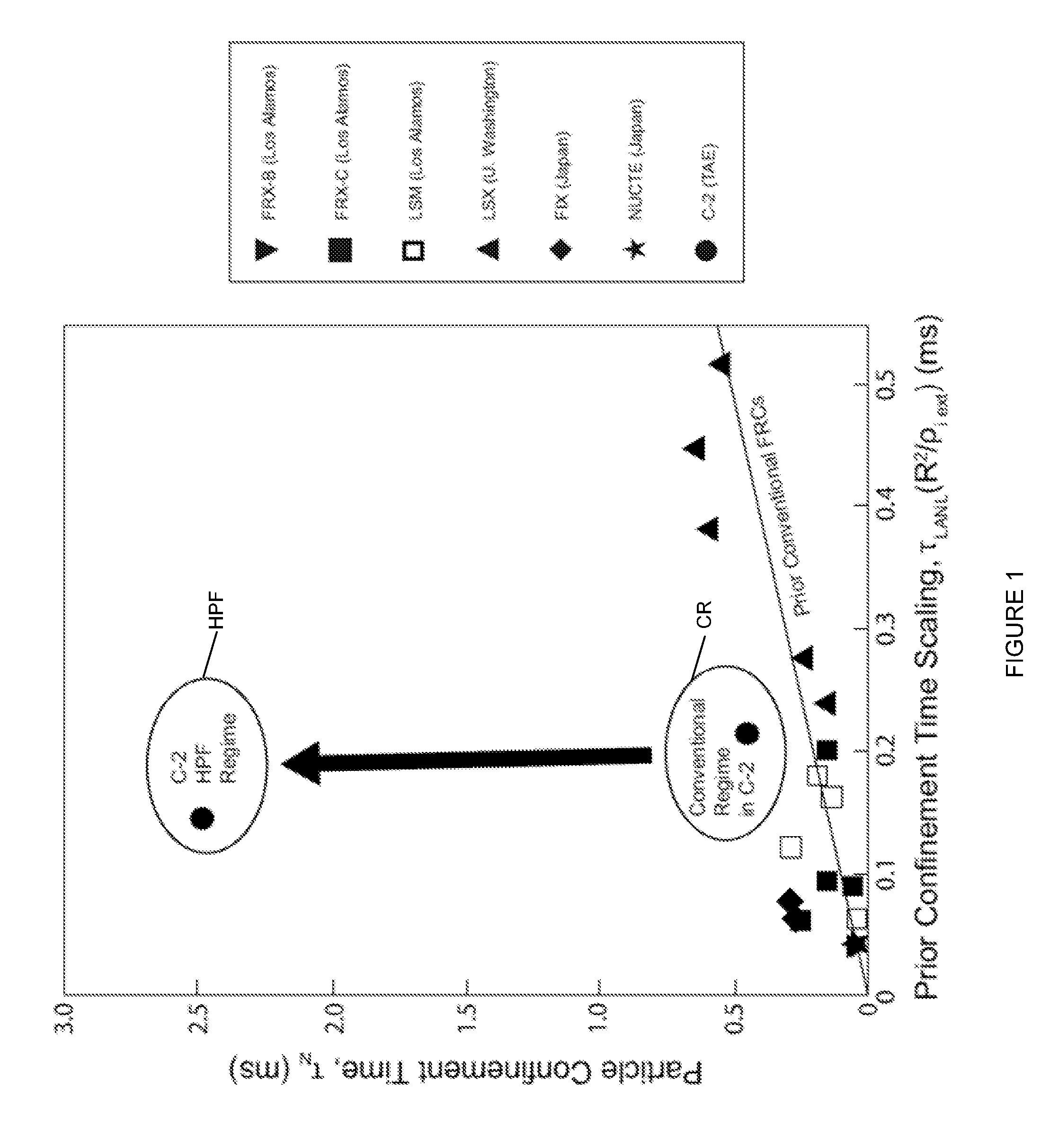
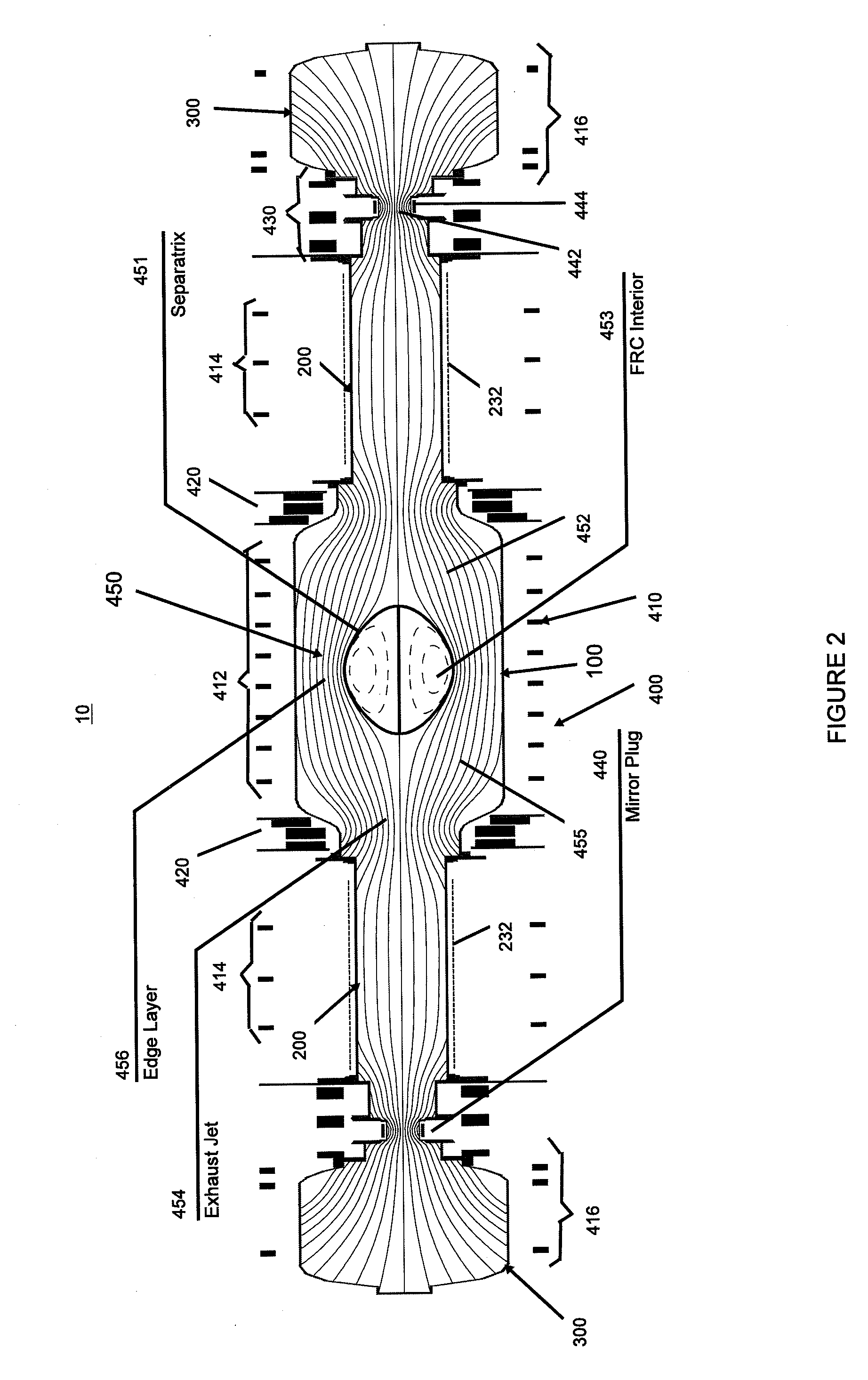
[0035]The present embodiments provided herein are directed to systems and methods that facilitate forming and maintaining High Performance Field Reversed Configurations (FRCs) with superior stability as well as superior particle, energy and flux confinement over conventional FRCs. Various ancillary systems and operating modes have been explored to assess whether there is a superior confinement regime in FRCs. These efforts have led to breakthrough discoveries and the development of a High Performance FRC paradigm described herein. In accordance with this new paradigm, the present systems and methods combine a host of novel ideas and means to dramatically improve FRC confinement as illustrated in FIG. 1 as well as provide stability control without negative side-effects. As discussed in greater detail below, FIG. 1 depicts particle confinement in an FRC system 10 described below (see FIGS. 2 and 3), operating in accordance a High Performance FRC regime (HPF) for forming and maintainin...
PUM
 Login to View More
 Abstract
Description
Claims
Application Information
 Login to View More