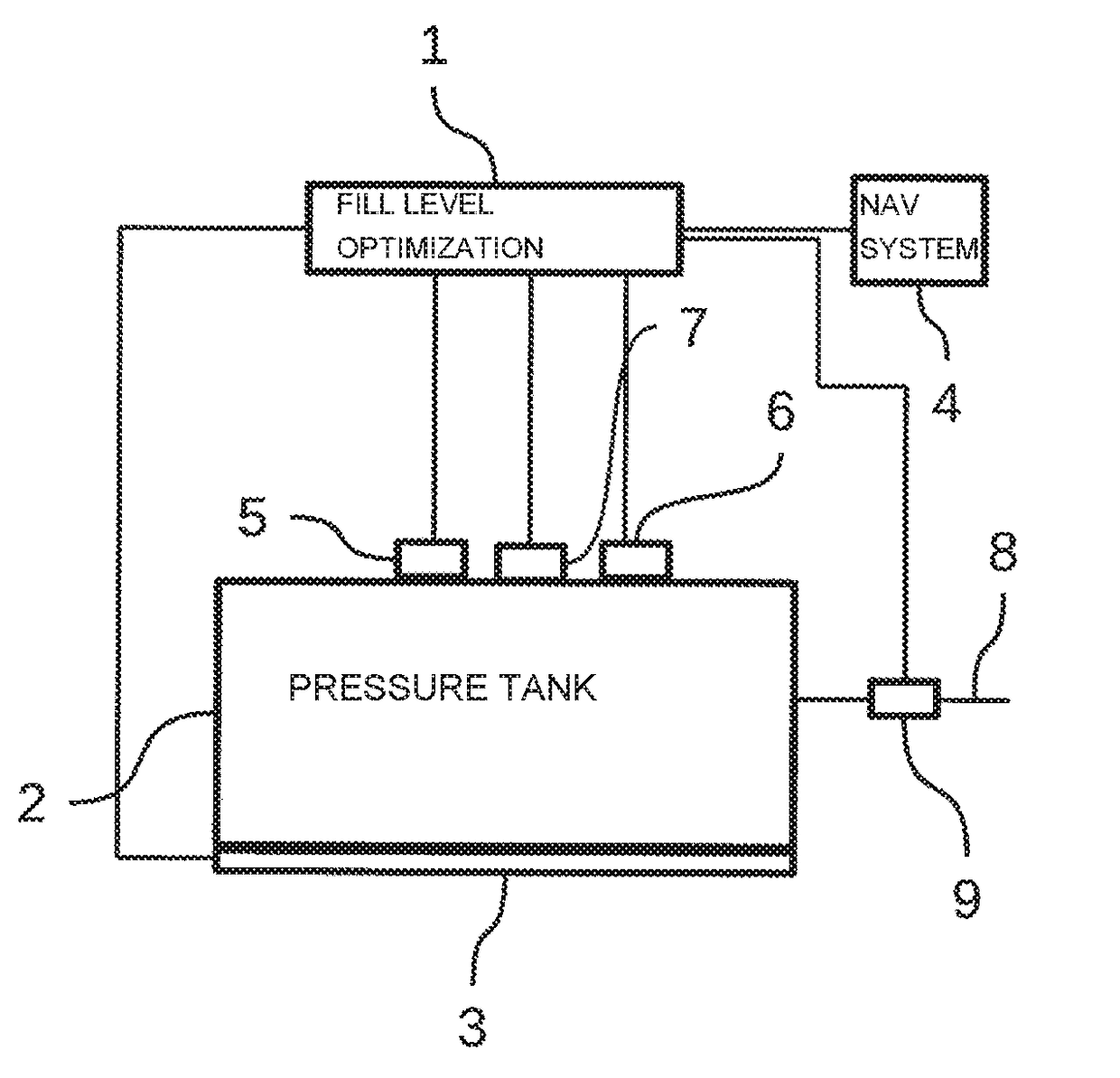
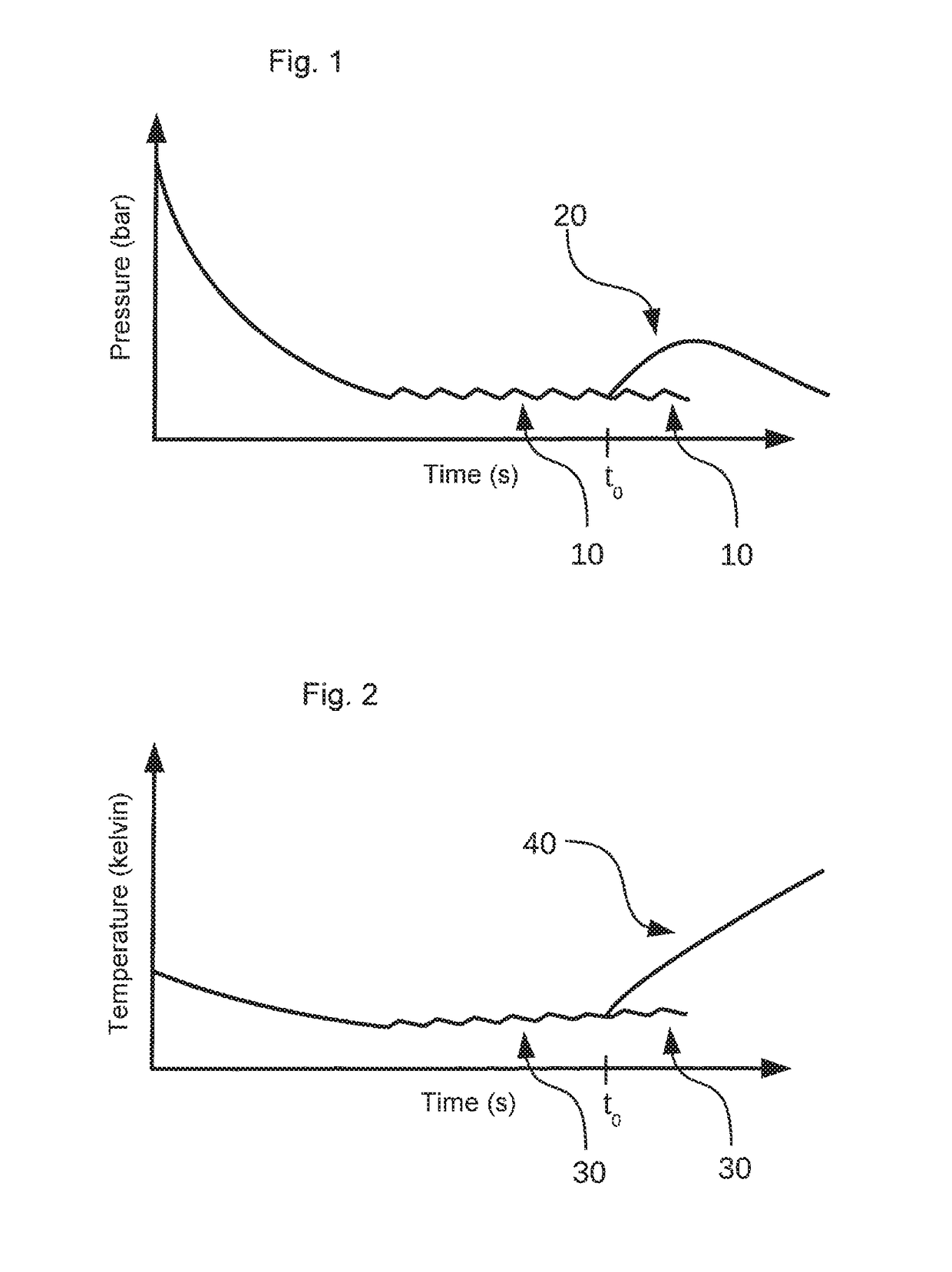
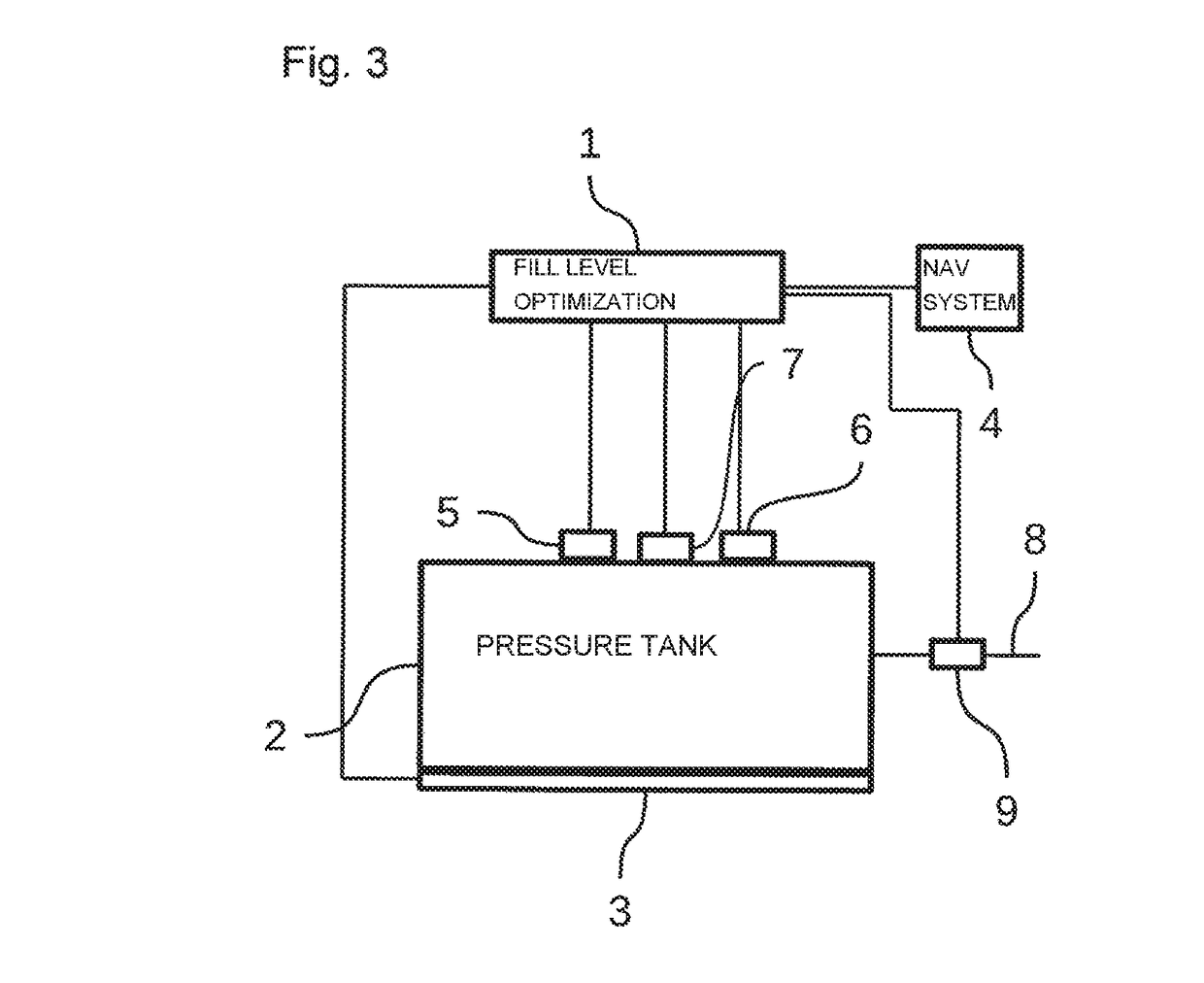
[0007]The object is achieved by a method for optimizing the filling level, which is able to be reached during a refilling procedure, of a cryogenic pressure tank in a motor vehicle, wherein a heating device for heating a gas in the pressure tank has at least two modes, namely a regular operation mode, in which the heating device heats the gas in the pressure tank such that a predefined pressure of the gas in the pressure tank is reached, and a continuous operation mode, in which the heating device heats the gas in the pressure tank continuously such that the pressure of the gas in the pressure tank rises beyond the predefined pressure. The method comprises the steps of: detecting the density of the gas in the pressure tank; comparing the detected density of the gas in the pressure tank with a predefined density value; and, if during the comparison it is determined that the detected density drops below the predefined density value, then, depending on at least one item of route information of the motor vehicle, in particular depending on a determined route to the destination of the motor vehicle and on the refueling stations for refilling the pressure tank with gas which are available on the determined route to the destination, either operating the heating device in the regular operation mode or switching the heating device from the regular operation mode into the continuous operation mode.
[0008]An advantage of said method is that the heating device is switched into the continuous operation mode (in addition) depending on the route information and is not only switched into the continuous operation mode depending on the density of the gas in the pressure tank. Consequently, in comparison with a conventional method, the continuous operation mode can be activated in a delayed manner or not at all, even if a predefined density is or has been undershot. Operating or leaving the heating device in the regular operation mode for a (longer) time results in the gas in the pressure tank remaining cold for longer. As a result, the reachable filling level of the pressure tank with gas, that is to say the quantity of gas which is kept available or stored in the pressure tank, is optimized or increased when or after a maximum possible refilling procedure is carried out. Consequently, the range of the motor vehicle increases after a refilling procedure is carried out. Depending on route information, a decision is made as to whether it is necessary to switch the heating device into the continuous operation mode in order thus to increase the (residual) range with the available gas in the pressure tank. Depending on the reachability of refueling stations, in particular gas refueling stations, on the way to the destination, that is to say refueling stations along the route to the destination and/or refueling stations which are able to be reached by means of a slight detour from the route to the destination, in comparison with conventional methods, the continuous operation mode is activated later or not at all (the heating device is then operated further in the regular operation mode, in this case). Consequently, the gas in the pressure tank remains cool(er) or has a lower temperature. Thus, when refilling the pressure tank (refueling), it is possible for a higher density of gas in the pressure tank or a higher filling level to be reached. As a result, after a (maximum) refilling procedure is carried out, which is determined inter alia by the maximum possible pressure in the pressure tank (before a safety valve opens), more gas is available after the refilling into the pressure tank.
[0009]According to a further embodiment, the decision as to whether the heating device is operated in the regular operation mode, or whether the heating device is switched from the regular operation mode into the continuous operation mode, is additionally dependent on a selected refueling management mode which is selectable from multiple different refueling management modes, wherein the different refueling management modes weight differently multiple goals, such as for example travel time of the motor vehicle to the destination, number of required refueling procedures for refilling the pressure tank until reaching the destination, maximum range of the motor vehicle with the gas in the pressure tank after a maximum possible refilling procedure of the


 Login to View More
  Login to View More