Unlock instant, AI-driven research and patent intelligence for your innovation.

Scheduling method and device

a scheduling method and a technology for narrow band transmission, applied in the field of transmission schemes, can solve the problems of excessive signaling redundancy or waste of resources, the above method cannot flexibly use the second time frequency resource, and the overhead of the first signaling is a slight increase in the cost of the first signaling, so as to improve the transmission efficiency and reduce the overhead of scheduling the signaling of the harq-ack and the uplink data

Active Publication Date: 2019-01-03
SISVEL INT
View PDF4 Cites 6 Cited by
  • Summary
  • Abstract
  • Description
  • Claims
  • Application Information

AI Technical Summary

Benefits of technology

The patent describes a method where a device transmits on a specific part of time using a specific frequency resource. The first signaling does not explicitly indicate the target resource, which saves signaling overhead. As a result, the method avoids collisions between acknowledgements and data, and maximizes the use of physical layer resources.

Problems solved by technology

Based on the above scheme, a problem required to be solved is that how to achieve the co-existence of the data transmitted on the physical layer data channel and the HARQ-ACK, i.e. avoiding the collision of both.
The above intuitive scheme may result in excessive signaling redundancy or waste of resources.
However, when the second time frequency resource is idle, the above method can not flexibly use the second time frequency resource.
Compared to not fully occupying the second time frequency resource, the above method improves the resource utilization efficiency, and the cost thereof is a slight increase in the overhead of the first signaling.

Method used

the structure of the environmentally friendly knitted fabric provided by the present invention; figure 2 Flow chart of the yarn wrapping machine for environmentally friendly knitted fabrics and storage devices; image 3 Is the parameter map of the yarn covering machine
View more

Image

Smart Image Click on the blue labels to locate them in the text.
Viewing Examples
Smart Image
  • Scheduling method and device
  • Scheduling method and device
  • Scheduling method and device

Examples

Experimental program
Comparison scheme
Effect test

embodiment i

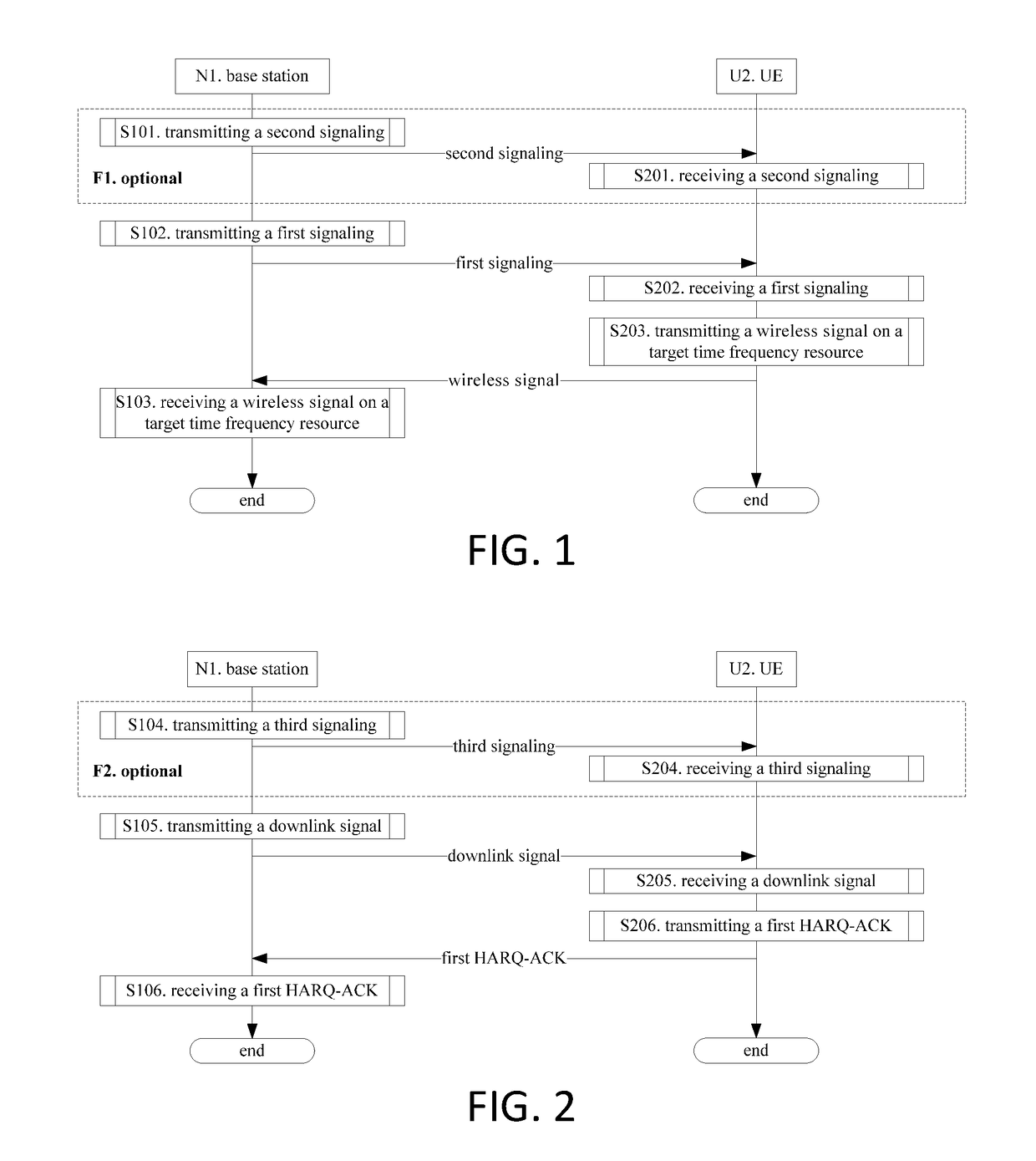
[0124]Embodiment I illustrates a flowchart of an uplink transmission of a wireless signal, as shown in FIG. 1. In FIG. 1, a base station N1 is a maintenance base station of a serving cell of UE U2, and the step identified by a square frame F1 is optional.

[0125]For the base station N1, in step S101, the method involves transmitting a second signaling. In step S102, the method involves transmitting a first signaling, and in step S103, the method involves receiving a wireless signal on a target time frequency resource.

[0126]For the UE U2, in step S201, the method involves receiving a second signaling. In step S202, the method involves receiving a first signaling, and in step S203, the method involves transmitting a wireless signal on a target time frequency resource.

[0127]In Embodiment I, the second signaling indicates a third time frequency resource, and the second time frequency resource is a part where the third time frequency resource and the first time frequency resource overlap e...

embodiment ii

[0131]Embodiment II illustrates a flowchart of an uplink HARQ-ACK transmission, as shown in FIG. 2. In FIG. 2, a base station N1 is a maintenance base station of a serving cell of UE U2, and the step identified by a square frame F1 is optional.

[0132]For the base station N1, in step S104, the method involves transmitting a third signaling, in step S105, the method involves transmitting a downlink signal, and in step S106, the method involves receiving a first HARQ-ACK.

[0133]For the UE U2, in step S204, the method involves receiving a third signaling, in step S205, the method involves receiving a downlink signal, and in step S206, the method involves transmitting a first HARQ-ACK.

[0134]In Embodiment II, the first HARQ-ACK indicates whether the downlink signal is correctly decoded, and the first HARQ-ACK is transmitted in a third time frequency resource. In the present disclosure, the second signaling is a higher layer signaling, and the third signaling includes the scheduling informat...

embodiment iii

[0138]Embodiment III illustrates a first time frequency resource and a second time frequency resource in a given time window, as shown in FIG. 3. In FIG. 3, a thick line frame identifies a time frequency resource occupied by the first time frequency resource in one time window, and a backslash identifies a time frequency resource occupied by the second time frequency resource in one time window.

[0139]In Embodiment III, the first time frequency resource occupies an entire narrow band in the given time window and occupies an entire time window in a time domain. The second time frequency resource occupies the entire narrow band in the given time window and occupies a part of OFDM symbols of the given time window in a time domain.

[0140]In a first exemplary embodiment of Embodiment III, a bandwidth of the narrow band does not exceed 180 kHz.

[0141]In a second exemplary embodiment of Embodiment III, a duration of the time window is T ms, and the T is a positive integer.

[0142]In a third exe...

the structure of the environmentally friendly knitted fabric provided by the present invention; figure 2 Flow chart of the yarn wrapping machine for environmentally friendly knitted fabrics and storage devices; image 3 Is the parameter map of the yarn covering machine
Login to View More

PUM

No PUM Login to View More

Abstract

The present disclosure discloses a scheduling method and device. AUE receives a first signaling firstly and transmits a wireless signal on a target time frequency resource. The first signaling indicates a first time frequency resource, and the first time frequency resource includes a second time frequency resource. The target time frequency resource includes a time frequency resource of the first time frequency resource except the second time frequency resource. The target and the second time frequency resources are orthogonal. The first time frequency resource includes T1 sub frames in a time domain, and includes P1 sub carriers in a frequency domain. The second time frequency resource includes T2 sub frames of T1 sub frames and P1 sub carriers in a time domain. T1 and P1 are a positive integer, T2 is smaller than T1. A position of the second time frequency resource in the first time frequency resource is fixed.

Description

CROSS-REFERENCE TO RELATED APPLICATIONS[0001]This application is a continuation of International Application No. PCT / CN2017 / 071289, filed on Jan. 16, 2017, and claims benefit to Chinese Patent Application No. CN 201610029099.7, filed on Jan. 17, 2016, all of which are hereby incorporated by reference for all purposes.BACKGROUNDTechnical Field[0002]The present disclosure is related to a transmitting scheme in a radio communication system, and more particular to an uplink scheduling method and device for supporting a narrow band transmission.Related Art[0003]In the #69th 3GPP (3rd Generation Partner Project) RAN (Radio Access Network) plenary, NB-IOT (NarrowBand Internet of Things) was established. The NB-IOT supports three different operation modes (RP-151621).[0004]1. Stand-alone operation: deployed on a spectrum used by GERAN system;[0005]2. Guard band operation: deployed on a non-use resource block of the guard band of LTE (Long Term Evolution) carrier;[0006]3. In-band operation: ...

Claims

the structure of the environmentally friendly knitted fabric provided by the present invention; figure 2 Flow chart of the yarn wrapping machine for environmentally friendly knitted fabrics and storage devices; image 3 Is the parameter map of the yarn covering machine
Login to View More

Application Information

Patent Timeline
no application Login to View More
Patent Type & Authority Applications(United States)
IPC IPC(8): H04W72/12
CPCH04W72/1268H04W72/1289H04L1/1607H04L1/1671H04L1/1861H04L5/0053H04L5/0055H04W72/21H04L5/0005H04L5/0091H04W72/23
Inventor ZHANG, XIAOBO
Owner SISVEL INT