

Scalable artificial intelligence model generation systems and methods for healthcare
a technology of artificial intelligence and model generation, applied in the field of improved medical systems, can solve the problems of less staff, less skilled staff, and difficulty in effective management and use of imaging and information systems for examination, diagnosis, and treatment of patients
- Summary
- Abstract
- Description
- Claims
- Application Information
AI Technical Summary
Benefits of technology
Problems solved by technology
Method used
Image

Examples
example deep
[0050 Learning Network Systems
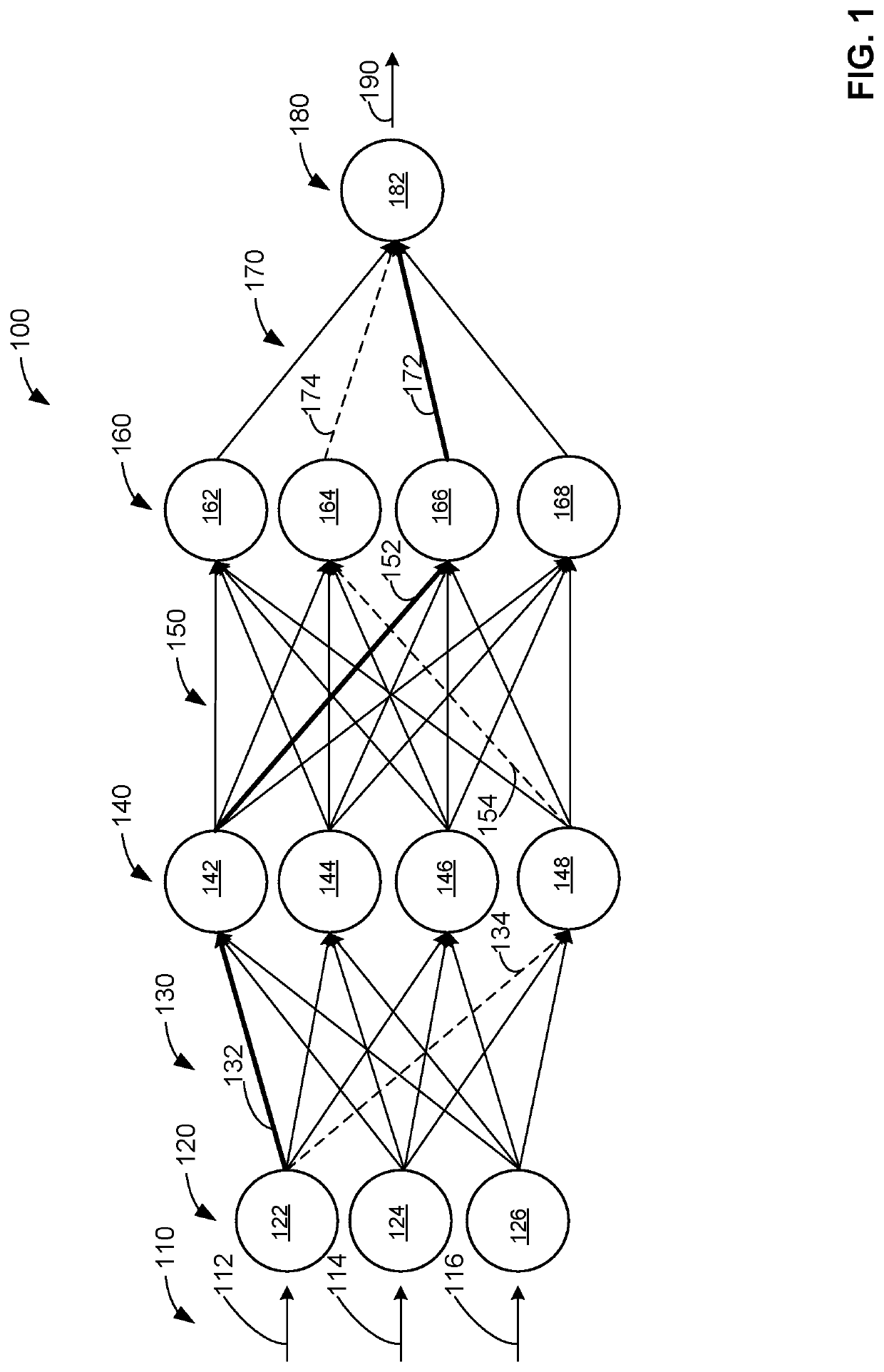
[0051]FIG. 1 is a representation of an example deep learning neural network 100. The example deep neural network (DNN) 100 includes layers 120, 140, 160, and 180. The layers 120 and 140 are connected with neural connections 130. The layers 140 and 160 are connected with neural connections 150. The layers 160 and 180 are connected with neural connections 170. Data flows forward via inputs 112, 114, 116 from the input layer 120 to the output layer180 and to an output 190.
[0052]The layer 120 is an input layer that, in the example of FIG. 1, includes a plurality of nodes 122, 124, 126. The layers 140 and 160 are hidden layers and include, the example of FIG. 1, nodes 142, 144, 146, 148, 162, 164, 166, 168. The neural network 100 may include more or less hidden layers 140 and 160 than shown. The layer 180 is an output layer and includes, in the example of FIG. 1, a node 182 with an output 190. Each input 112-116 corresponds to a node 122-126 of the input lay...
PUM
 Login to View More
 Abstract
Description
Claims
Application Information
 Login to View More