
Application of methylmalonic acid in the preparation of nematode insecticides
a technology of insecticides and methylmalonic acid, applied in the field of agricultural microbiology, can solve the problems of inhibiting survival and activity in extremely humid and dry environments, and difficult to prevent and control, and achieves the effects of low toxicity, good sustainability, and high efficiency
- Summary
- Abstract
- Description
- Claims
- Application Information
AI Technical Summary
Benefits of technology
Problems solved by technology
Method used
Image

Examples
example 1
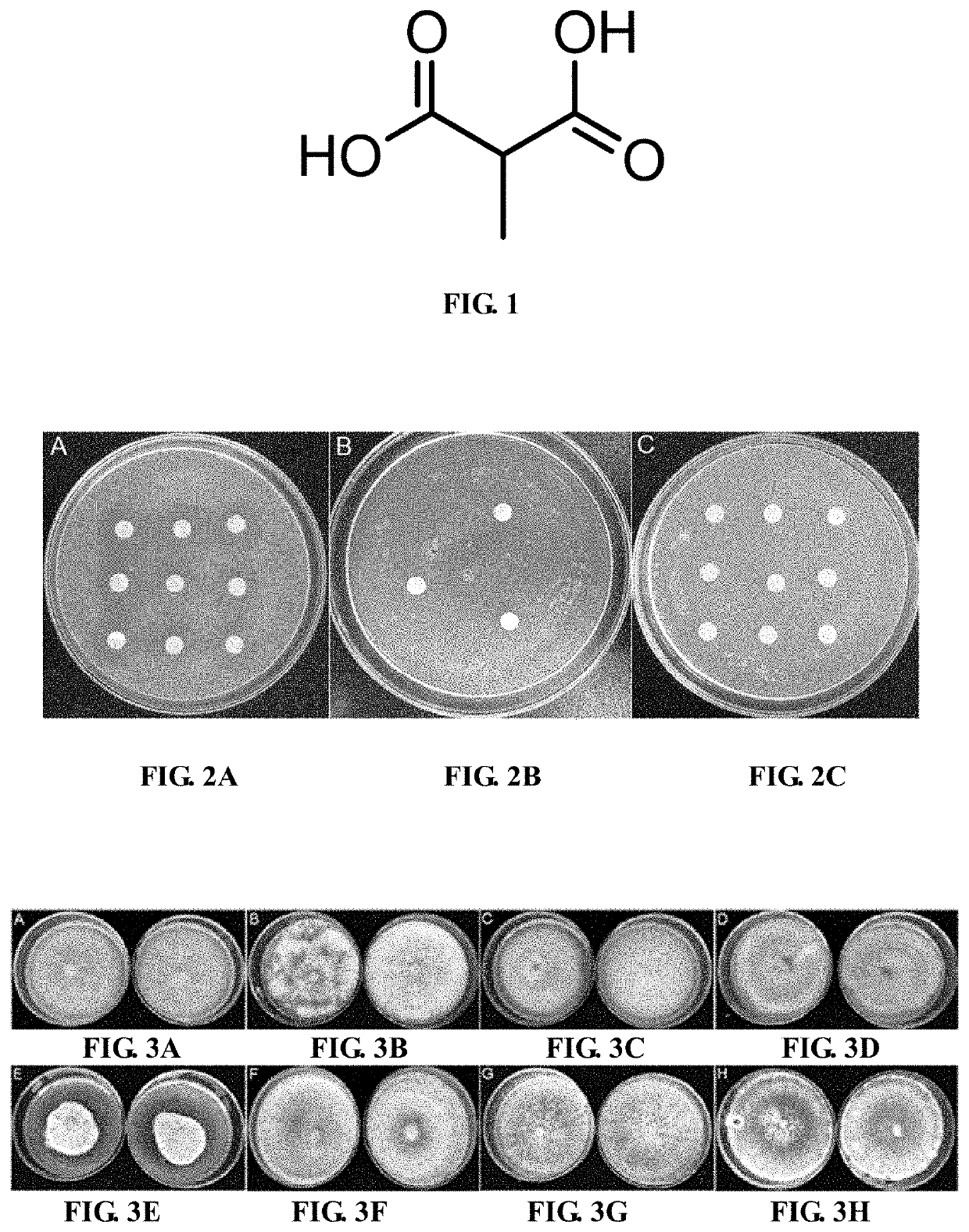
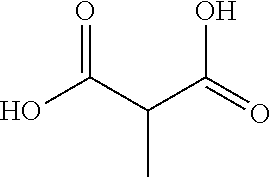
[0021]In the example, structural verification of nematicidal methylmalonic acid is conducted as follows: Methylmalonic acid was purchased from Sigma. Nuclear Magnetic Resonance (NMR) was used to detect the structure of the methylmalonic acid. Among others, hydrogen spectra (H NMR) and carbon spectra (13C NMR) are respectively determined by using deuterium water (D2O) as a solvent, with the NMR data shown in Table 1-1.
TABLE 1-1Two-dimensional NMR spectra data of methylmalonic acidNo.δH(J in Hz)6c1174.2 s23.41(1H, dd, J = 13.7, 7.2)45.9 d3174.2 s4~1.19 (3H, overlapped)12.8 q
example 2
[0022]Application of methylmalonic acid in the preparation of insecticides against root-knot nematodes, with an application process as follows:
[0023]Roots and knots infected by the nematodes were picked from the roots of tomatoes. Egg masses were placed in a 96-well plate for incubation at 20° C. to observe the hatching of the root-knot nematodes. The nematodes were washed with sterile water; 20 μL of 1 mg / mL methylmalonic acid aqueous solution was added to the 96-well plate, and at the same time, purified water was added; the final concentrations of the methylmalonic acid in the well plate was adjusted to 1000, 100, 25, 16.67, 12.5, 10.1 m / mL in order; and 40 nematodes were added to each well; a bioassay system was 200 μL in total, with the purified water as a control, and 3 times repeated for each group. They were cultured in an incubator at 16° C. A LC50 value of the methylmalonic acid against the Meloidogyne incognita was 13.11 m / mL as shown in Table 2-1.
TABLE 2-1Insecticidal ac...
example 3
[0025]Application of methylmalonic acid in the preparation of insecticides against Caenorhabditis elegans, with an application process as follows:
[0026]20 μL of 1 mg / mL methylmalonic acid aqueous solution was added to the 96-well plate, and at the same time, purified water was added; the final concentrations of the methylmalonic acid in the well plate was adjusted to 1000, 100, 25, 16.67, 12.5, 10.1 m / mL in order; 40 nematodes were added to each well; and a bioassay system was 200 μL in total, with the purified water as a control. The process was repeated 3 times for each group. They were cultured in an incubator at 16° C. A LC50 value of the methylmalonic acid against the Caenorhabditis elegans was 1.20 m / mL as shown in Table 3-1.
TABLE 3-1Insecticidal activity of methylmalonic acid against Caenorhabditis elegansMedial LethalDoseLethalityLogarithmicProbabilityConfidenceConcentration(pg / mL)Rate (%)DoseUnitRegression EquationInterval(LC50, ug / mL)100097.53.0006.965Y = 4.9250 + 0.9343X0...
PUM
 Login to View More
 Abstract
Description
Claims
Application Information
 Login to View More