
Gene therapy approaches to supply apolipoprotein A-I agonists and their use to treat dyslipidemic disorders
a technology of apolipoprotein a-i and agonists, which is applied in the field of gene therapy approaches to supply apolipoprotein a-i agonists and their use to treat dyslipidemic disorders, can solve the problems of insufficient data indicating a pltp role in rct, increased disc formation rate of pltp, and side effects, so as to achieve high levels of apoa-i expression and increase production efficiency
- Summary
- Abstract
- Description
- Claims
- Application Information
AI Technical Summary
Benefits of technology
Problems solved by technology
Method used
Image

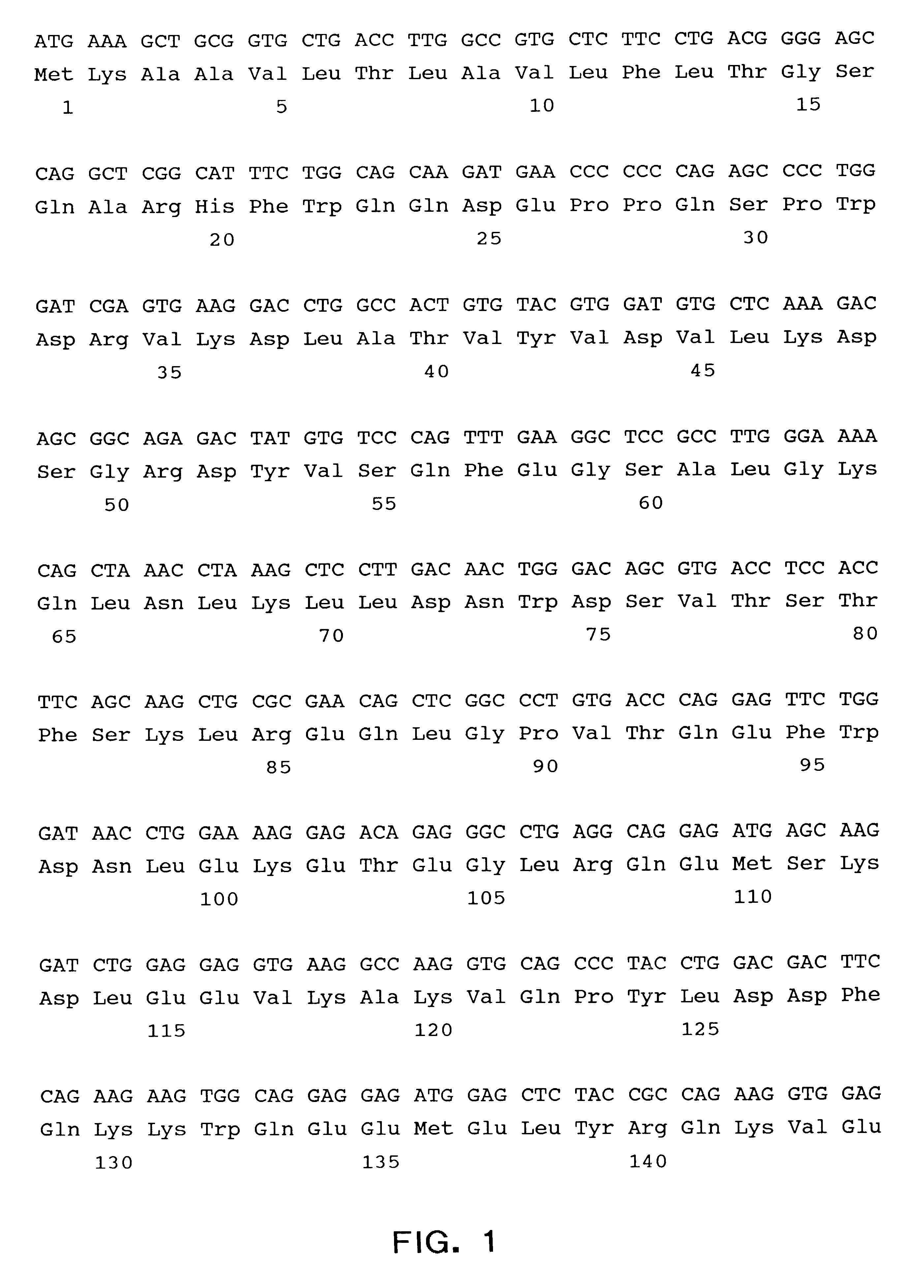
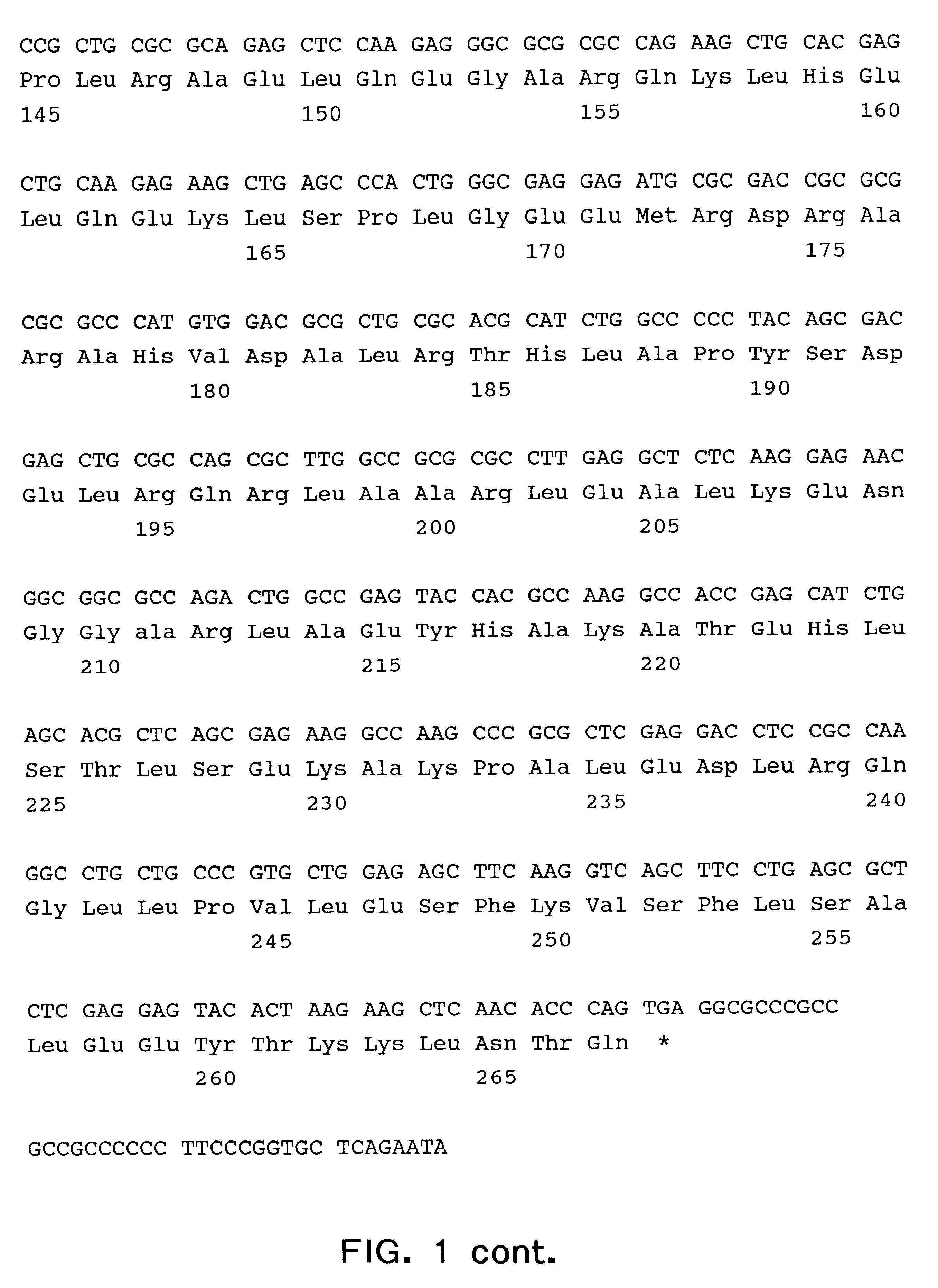
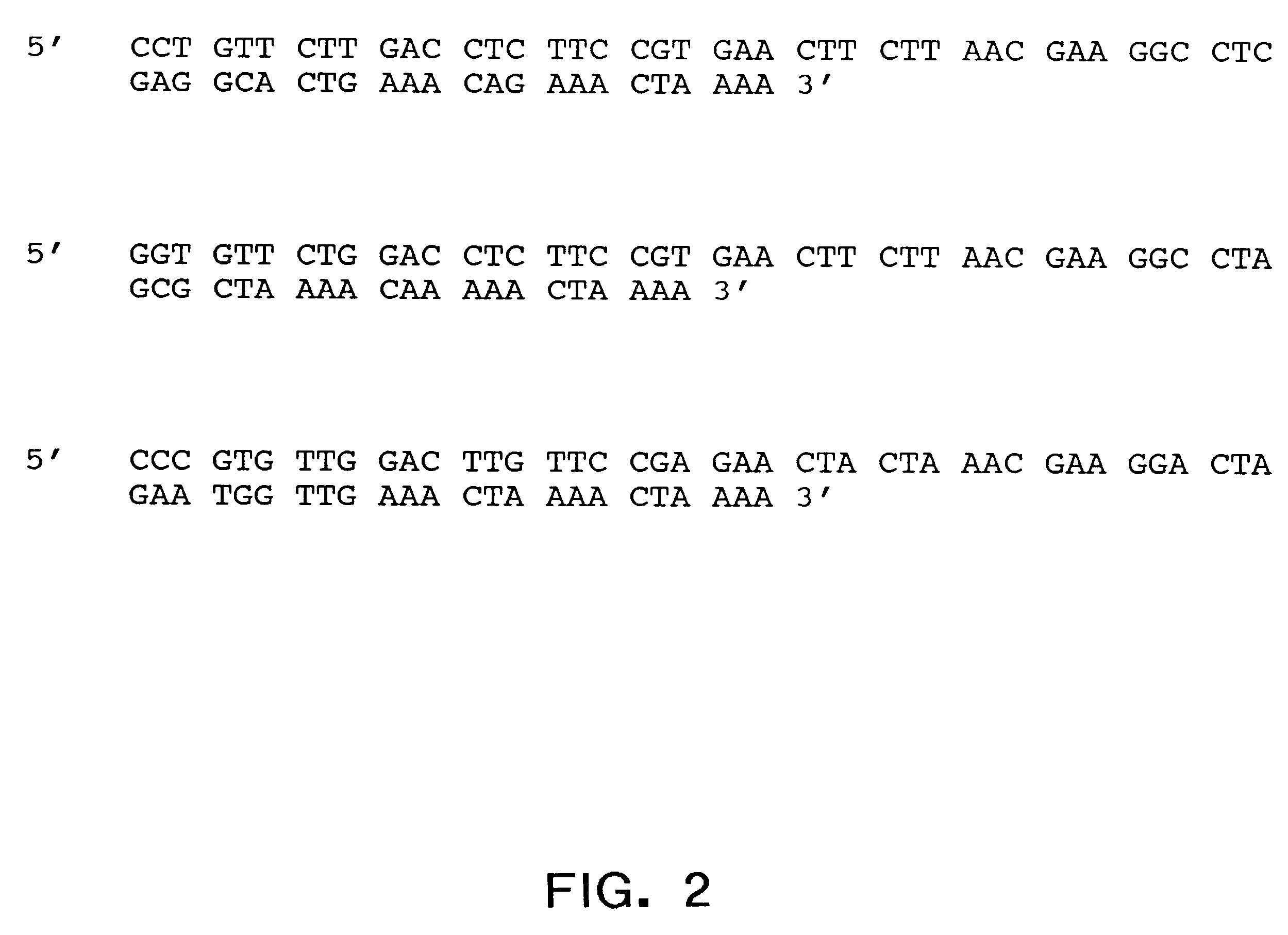
Examples
Embodiment Construction
The ApoA-I agonists encoded by the nucleotide sequences of the present invention can be further defined by way of preferred embodiments.
In one preferred embodiment, the nucleotide sequences of the invention encode ApoA-I agonists composed of core peptides of structure (I) containing 22 amino acid residues in which:
X.sub.1 is Pro (P), Gly (G) or Ala (A);
X.sub.2 is Val (V) or Leu (L);
X.sub.3 is Leu (L);
X.sub.4 is Asp (D) or Glu (E);
X.sub.5 is Leu (L) or Phe (F);
X.sub.6 is Leu (L) or Phe (F);
X.sub.7 is Lys (K) or Arg (R);
X.sub.8 is Glu (E);
X.sub.9 is Leu (L);
X.sub.10 is Leu (L) or Trp (W);
X.sub.11 is Asn (N) or Gln (Q);
X.sub.12 is Glu (E);
X.sub.13 is Leu (L);
X.sub.14 is Leu (L) or Trp (W);
X.sub.15 is Glu (E);
X.sub.16 is Ala (A) or Trp (W);
X.sub.17 is Leu (L);
one of X.sub.18 or X.sub.19 is Gln (Q) and the other is Lys (K);
X.sub.20 is Lys (K);
X.sub.21 is Leu (L); and
X.sub.22 is Lys (K).
In yet another preferred embodiment, the nucleotide sequences of the present invention encode ApoA-I ag...
PUM
| Property | Measurement | Unit |
|---|---|---|
| Mass | aaaaa | aaaaa |
| Molar density | aaaaa | aaaaa |
| Molar density | aaaaa | aaaaa |
Abstract
Description
Claims
Application Information
 Login to View More