Supercharge Your Innovation With Domain-Expert AI Agents!

Stackable self-aligning container

a self-aligning container and stacking technology, applied in the field of stackable cardboard boxes, can solve the problems of ineffectiveness, tabs being folded over or crushed, and not fully addressing certain stacking problems

Inactive Publication Date: 2003-11-04
CONAGRA GROCERY PROD CO
View PDF12 Cites 23 Cited by
  • Summary
  • Abstract
  • Description
  • Claims
  • Application Information

AI Technical Summary

Benefits of technology

The solution allows for precise alignment without high precision, maintains stack stability even with worn tabs, and increases crush strength and load-bearing capacity, preventing tab drift and ensuring a secure interlock.

Problems solved by technology

While these known types of stack stabilizing systems can maintain alignment of a stack of boxes, they do not completely address certain stacking problems.
A slight misalignment between a tab and slot often results in the tab being folded over or crushed and therefore rendered ineffective.
The tab solutions may also fail to compensate for the destabilizing effect of a worn tab.
In previously known boxes with slot and tab arrangements, a slight misalignment of the tab and slot will often result in the tab being bent or crushed.
In the case of boxes with reinforced tabs, misalignment results in the boxes stacking unevenly with protruding tabs, preventing a positive interlock of box bottoms and tops.
A drifting tab will allow a stack of boxes to move out of plumb and thereby destabilizes the entire stack.

Method used

the structure of the environmentally friendly knitted fabric provided by the present invention; figure 2 Flow chart of the yarn wrapping machine for environmentally friendly knitted fabrics and storage devices; image 3 Is the parameter map of the yarn covering machine
View more

Image

Smart Image Click on the blue labels to locate them in the text.
Viewing Examples
Smart Image
  • Stackable self-aligning container
  • Stackable self-aligning container
  • Stackable self-aligning container

Examples

Experimental program
Comparison scheme
Effect test

Embodiment Construction

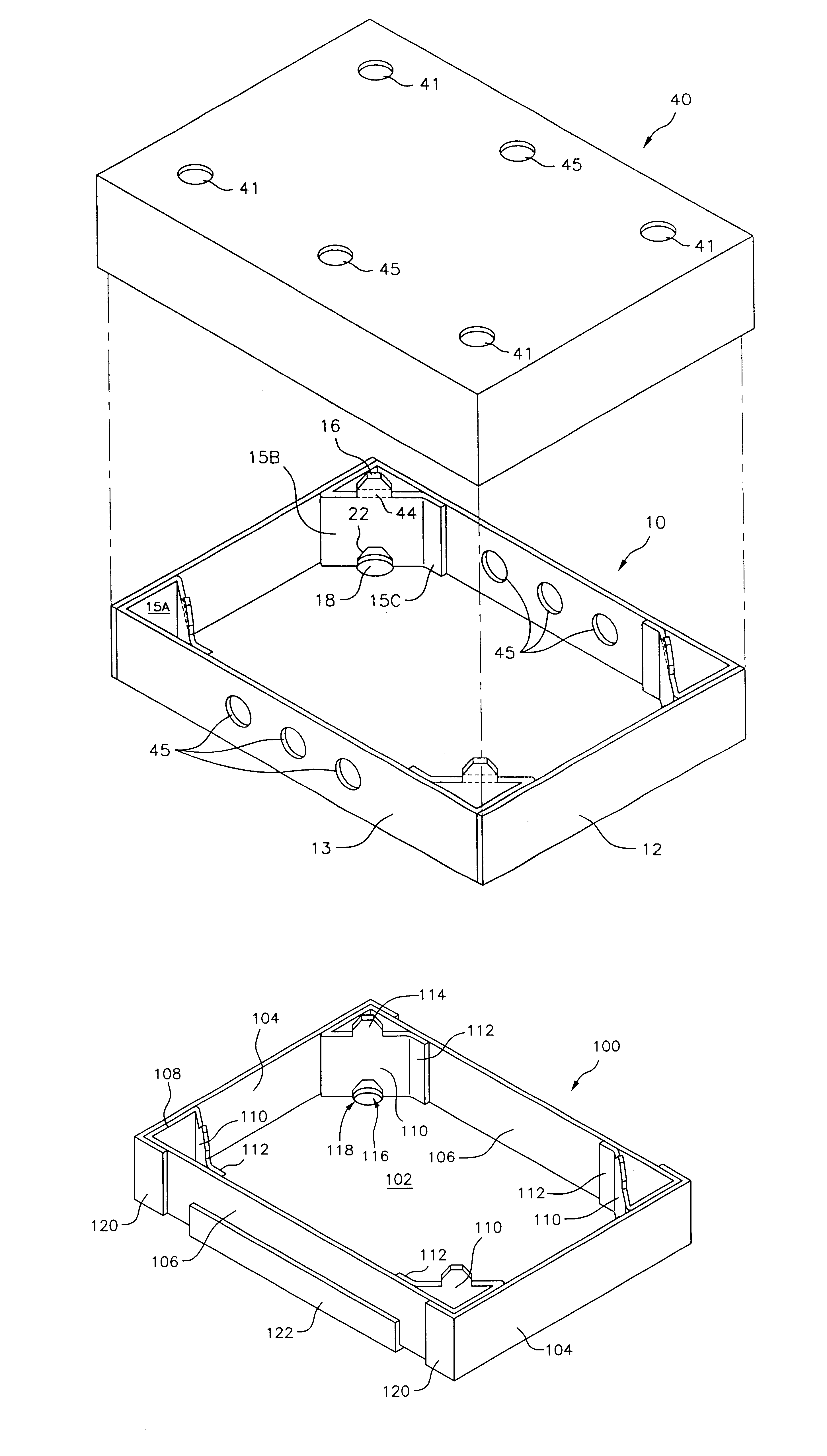
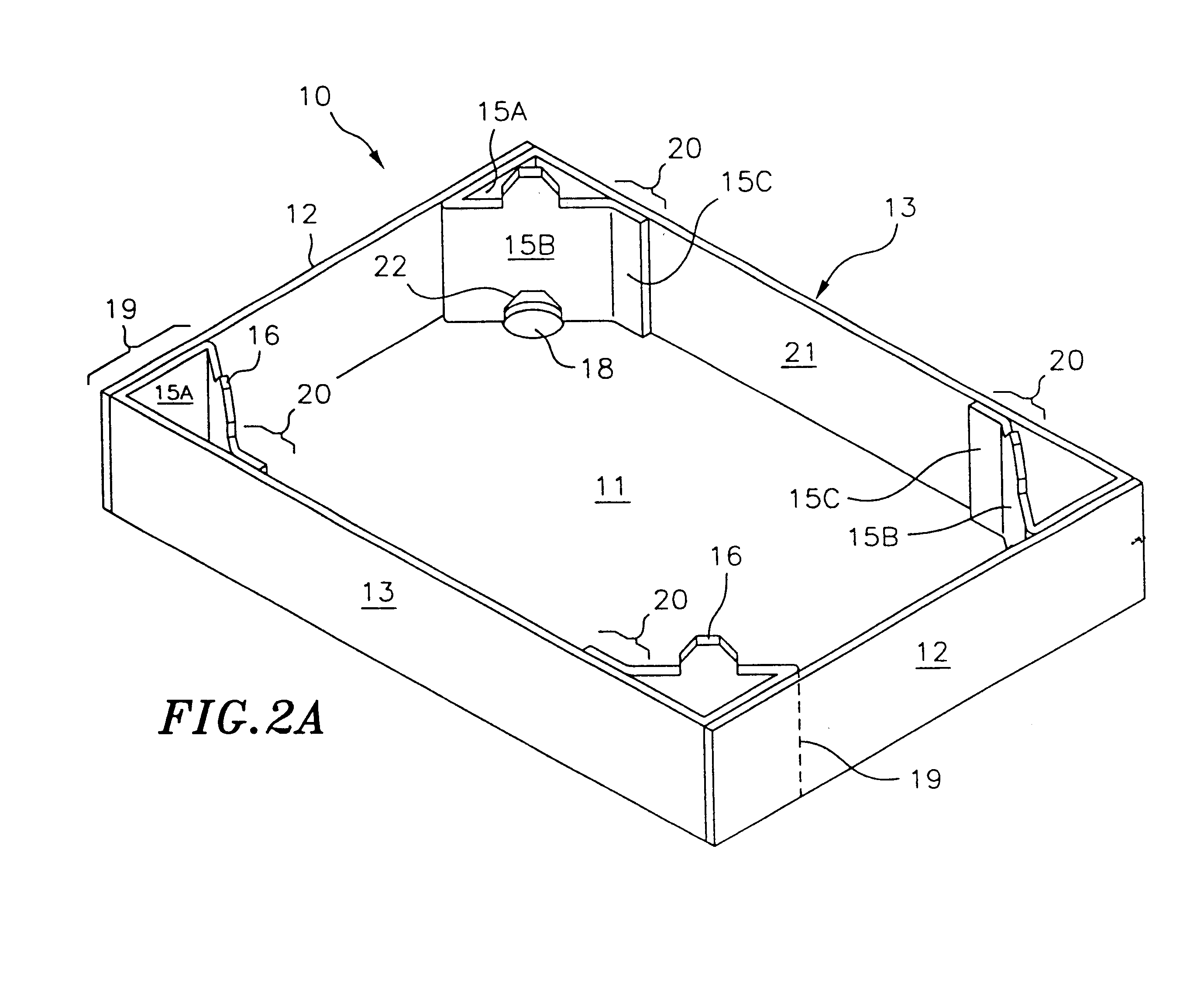
In one preferred embodiment of the invention, an open container (FIG. 2) generally designated 10, is formed by folding a single flat die-cut and scored sheet of corrugated cardboard (FIG. 1). Extending from a bottom panel 11 are two opposing end walls 12 and two opposing sidewalls 13A. Extending from the end of each sidewall 13B is a corner flap 14, which has score marks "S" dividing it into three contiguous parallel corner panels. The first corner panel 15A extends from the end of the sidewall 13B to the middle corner panel 15B, which extends to the end corner panel 15C. An interlocking tab 16 extends from each middle corner panel 15B. Each tab 16 has straight sides that taper inwardly toward the top so that it has, in general, the shape of a triangle that has been truncated nears its apex so as to have a short flat horizontal top surface.

The container 10 is constructed (FIG. 2) around each of its corners 17. The first corner panel 15A is affixed to an end wall 12. The middle corne...

the structure of the environmentally friendly knitted fabric provided by the present invention; figure 2 Flow chart of the yarn wrapping machine for environmentally friendly knitted fabrics and storage devices; image 3 Is the parameter map of the yarn covering machine
Login to View More

PUM

No PUM Login to View More

Abstract

A box or container, formed from a single blank, with a group of protruding tabs and corresponding bottom apertures which act together to urge, and maintain, the alignment of an upper box on top of a lower box during the stacking of similar boxes.

Description

The present invention relates to the field of containers. More particularly, the present invention relates to stackable cardboard containers with stacking guides that are self-aligning.DESCRIPTION OF THE PRIOR ARTThree general types of stackable cardboard boxes with interlocking and stack stabilizing features, primarily used for the packaging and transportation of perishables such as fruits and vegetables, are known in the art. The first type has tabs, extended from a side or end wall, that fit into a corresponding slot or pocket. Examples may be found in U.S. Pat. No. 5,452,848 issued to Mur Gimeno and U.S. Pat. No. 3,940,053 issued to Putman and Wytko. A second type of box maintains stability in a stack by resting each corner of an upper box into the extended corner catches of a lower box. Examples are found in U.S. Pat. No. 4,053,098 issued to Baptist and U.S. Pat. No. 5,549,242 issued to Gimeno.A third type of stack stabilizing solution is described in U.S. Pat. No. 5,487,505 is...

Claims

the structure of the environmentally friendly knitted fabric provided by the present invention; figure 2 Flow chart of the yarn wrapping machine for environmentally friendly knitted fabrics and storage devices; image 3 Is the parameter map of the yarn covering machine
Login to View More

Application Information

Patent Timeline
no application Login to View More
Patent Type & Authority Patents(United States)
IPC IPC(8): B65D5/00B65D5/42
CPCB65D5/0025B65D5/4295Y10S229/915Y10S229/918
Inventor BENNETT, JAMES A.HEATH, BRADLEYHAMABATA, JODY
Owner CONAGRA GROCERY PROD CO
Features
  • R&D
  • Intellectual Property
  • Life Sciences
  • Materials
  • Tech Scout
Why Patsnap Eureka
  • Unparalleled Data Quality
  • Higher Quality Content
  • 60% Fewer Hallucinations
Social media
Patsnap Eureka Blog
Learn More