[0014]The present invention is made in view of the above-mentioned circumstances. Therefore, the present invention provides a laser module that can maintain weldability of a lens holder and improve machinability and further prevents a burr from being induced so as to improve optical accuracy, to improve reading accuracy of a bar code, to improve productivity and to reduce a manufacturing cost.
[0016]According to this arrangement, it is possible to maintain the weldability of the lens holder and to improve the machinability. Consequently,
cutting operation at the high accuracy and positioning between the light emitting element and the housing and between the housing and the light projection lens at high accuracies are made possible. Thus, optical accuracy of the laser module can be improved. Also, since the burr is not induced, it is possible to avoid quality defect caused by the burr invading into the
optical path and deterioration in reading accuracy of the bar code caused by the bad influence of the burr on the beam property. Moreover, since the second process for removing the burr is not required, the productivity as well as the yield is improved at the same time. Hence, the manufacturing cost can be reduced.
[0018]According to the arrangement, since the inner cylinder is made of the
brass, the good machinability is obtained and the burr is not induced. Thus, it is possible to perform the
cutting operation of high accuracy on the engaged portion of the light emitting element, the light projection lens retaining portion and the beam emitter (for example, a slit). Also, since the outer cylinder is made of the stainless steel, the good weldability is maintained. Hence, the housing and the lens holder can be positioned at high accuracy by the
welding operation. Moreover, since both of the
brass and the stainless steel are superior in corrosive resistivity, it is possible to avoid deterioration in positioning accuracy caused by
corrosion and the bad influence caused by
rust.
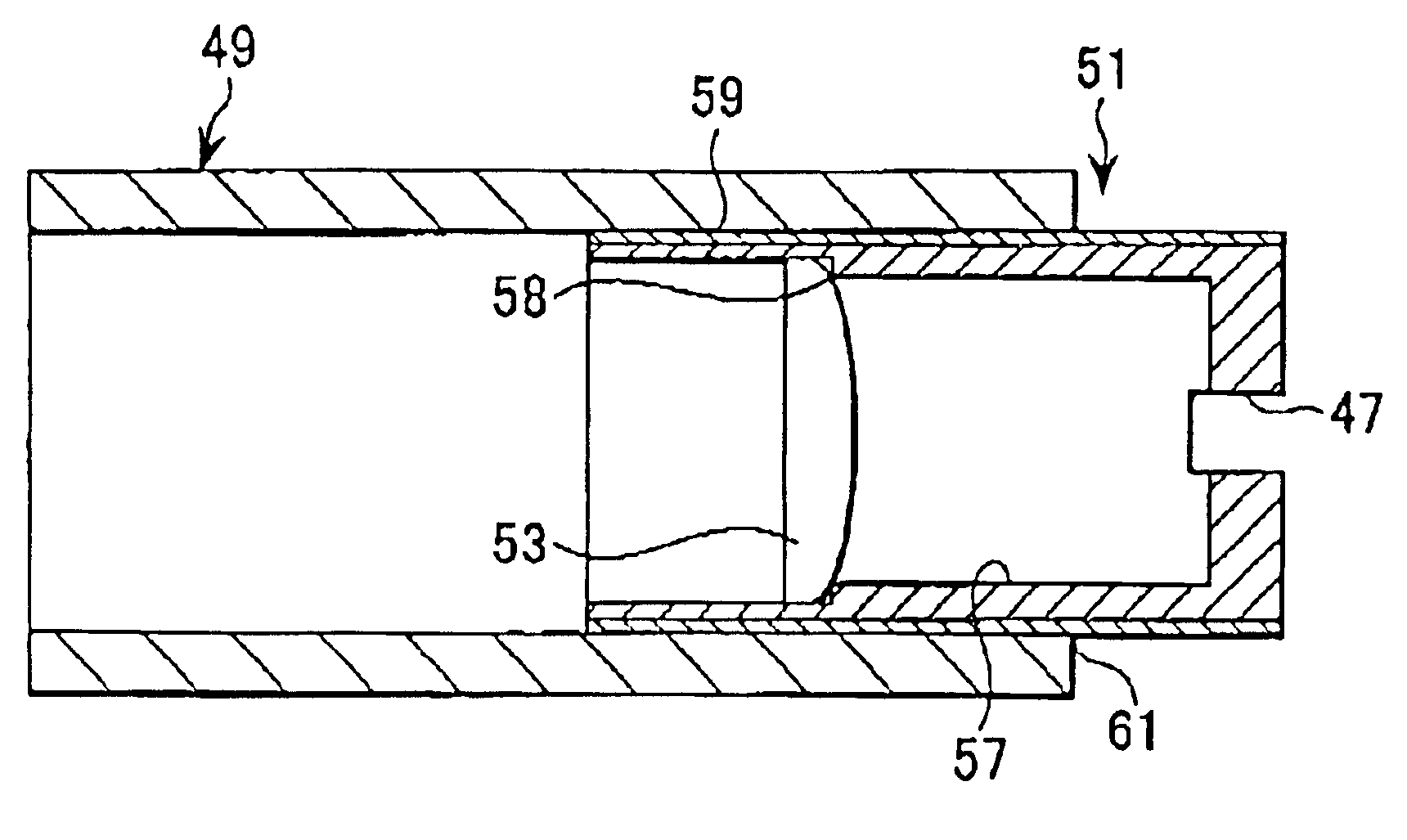
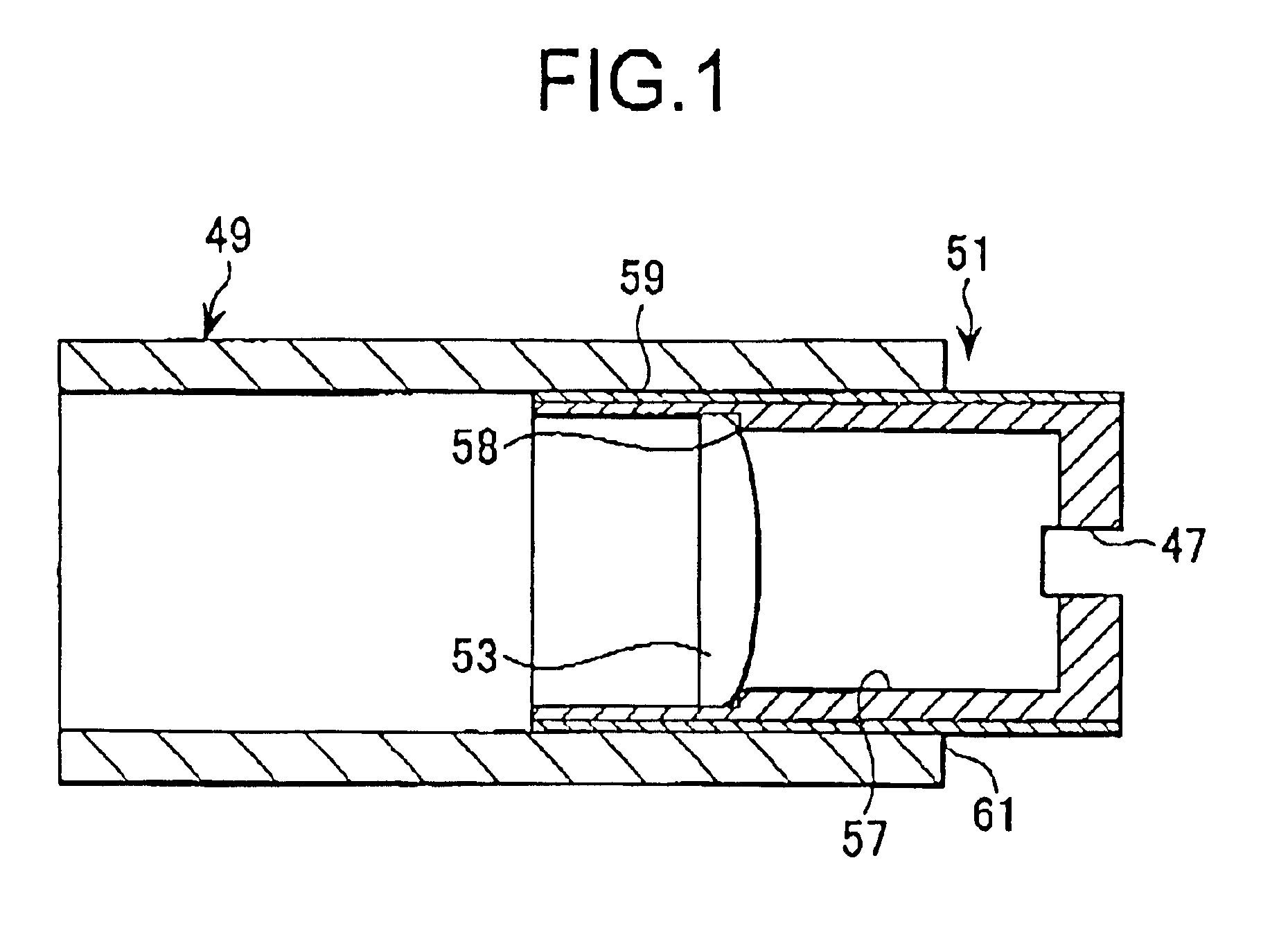
[0020]In this laser module for the bar code reader, since the part of the outer cylinder is locally pressed to be a protrusion, it protrudes into the material of the inner cylinder. In short, it is at a situation that the protrusion protruding from the outer cylinder is embedded in the inner cylinder. Consequently, the inner cylinder and the outer cylinder, which are engaged with each other, are not relatively moved in a central axis direction and a circumferential direction even in view of structure. Thus, engaging strength between the inner cylinder and the outer cylinder is made stronger.
[0022]According to this arrangement, the weldability of the lens holder can be maintained and the machinability thereof can be improved. Accordingly,
cutting operation at high accuracy, and positioning at high accuracy between the light emitting element and the housing as well as between the housing and the light projection lens are made possible. Thus, the optical accuracy can be improved. Also, since the burr is not induced, it is possible to avoid quality defect caused by the burr invading into the
optical path and reduction in reading accuracy of the bar code caused by the bad influence of the burr on the beam property. Moreover, since the second process for removing the burr is not required,
mass productivity is increased, and the yield is improved at the same time. Hence, the manufacturing cost can be reduced.
[0024]According to the arrangement, in the laser module, the housing and the inner cylinder are made of different kinds of the metals. Therefore, even if the
metal used for the inner cylinder is the metal having the low beam
absorption rate of the laser
welding, when the
nickel plating covers the periphery of this inner cylinder, the beam
absorption rate of the inner cylinder can be increased (the beam
absorption rate of the inner cylinder is made closer to the beam absorption rate of the housing) to thereby reduce the difference between the beam absorption rates of both the metals. Hence, the weldability can be improved even if the housing and the inner cylinder are made of the different kinds of the metals in which the beam absorption rates are different.


 Login to View More
  Login to View More