Vehicle with compliant drive train

a technology of drive train and vehicle, applied in the field of legged vehicles, can solve the problems of many large motors, high torque for single legs, and heavy motors, and achieve the effects of simple design, reduced vehicle weight, and high mobility

US6964309B2Inactive Publication Date: 2005-11-15BIOROBOTS
22 Cites 62 Cited by

Patent Information

Authority / Receiving Office
US · United States
Patent Type
Patents(United States)
Current Assignee / Owner
Publication Date
2005-11-15
Estimated Expiration
Not applicable · inactive patent

Smart Images

  • Figure 1
    Figure 1
  • Figure 2
    Figure 2
  • Figure 3
    Figure 3
Patent Text Reader

Abstract

A vehicle that is propelled by as few as one actuator through a compliant drive train can move quickly on relatively smooth terrain and can climb obstacles. The body of the vehicle may consist of a single segment or multiple segments connected by articulating joints. The driving appendages can take different forms including legs or specialized legs with multiple spokes attached to a rotating hub. The driving appendages can be propelled by as few as one actuator. The driving appendages are each serially connected to their actuator(s) by a compliant device. The compliant devices permit relative motion between driving appendages that share the same actuator. A springably biased compliant device maintains nominal-desired phasing among driving appendages until one of them is forcibly perturbed. The phasing of the driving appendages, or gait, adapts to the terrain. Mechanical stops limit the excursion of the compliant device such that a new desirable leg phasing is reached for climbing large obstacles. The elasticity of the compliant device restores the phasing of the driving appendages to their nominal state when the perturbation is removed. Compliance in the driving appendages and feet smooth the cyclic motion of the body. Compliant feet conform to the terrain and provide improved traction. Steering mechanisms rotate the plane of action of the driving appendages.
Need to check novelty before this filing date? Find Prior Art

Description

CROSS-REFERENCE TO RELATED APPLICATION

[0001] This application is entitled to the benefit of Provisional Patent Application Ser. No. 60 / 295,778 filed Jun. 4, 2001. “An Insect-Inspired Unmanned Ground Vehicle with Improved Mobility,” Roger D. Quinn et al.STATEMENT REGARDING FEDERALLY SPONSORED RESEARCH OR DEVELOPMENT

[0002] This invention was sponsored by DARPA under contract DAAN02-98-C-4027. DARPA has released the rights to this invention to the inventors.REFERENCE TO SEQUENCE LISTING, A TABLE, OR A COMPUTER PROGRAM LISTING COMPACT DISK APPENDIX

[0003] Not applicableBACKGROUND OF THE INVENTION

[0004] 1. Field

[0005] Generally, this invention relates to mobile vehicles and more specifically to legged vehicles. This invention also may be used to improve the mobility of vehicles that use wheels, tracks and other driving appendages.

[0006] Classifications:

[0007] 180 / 8.1 Motor Vehicles / Stepper

[0008] 180 / 8.6 Motor Vehicles / Stepper with Alternatively Lifted Feet or Skid

[0009] 2. Prior Art

[0010] Many task...

Examples

Embodiment Construction

: DESIGN

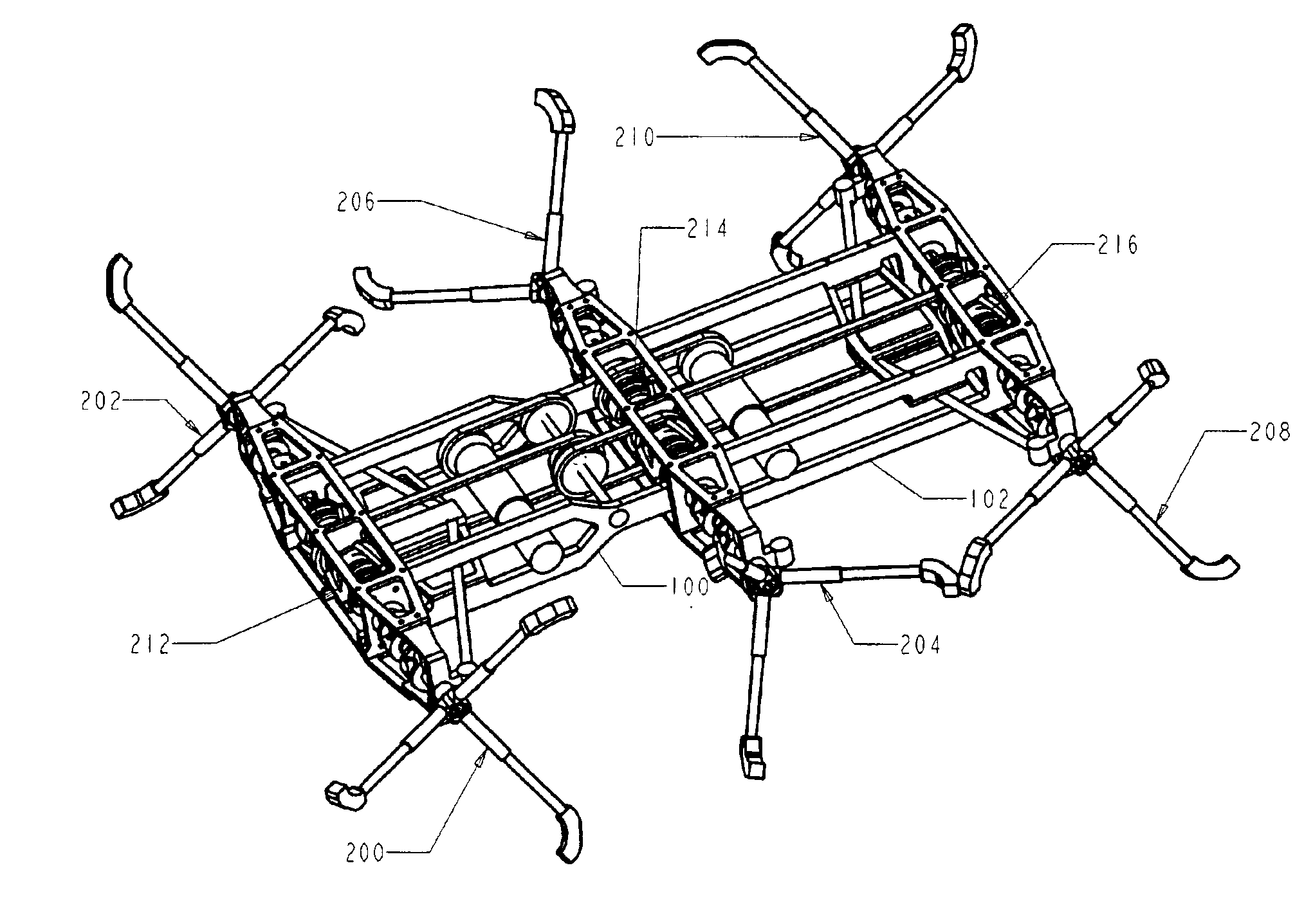
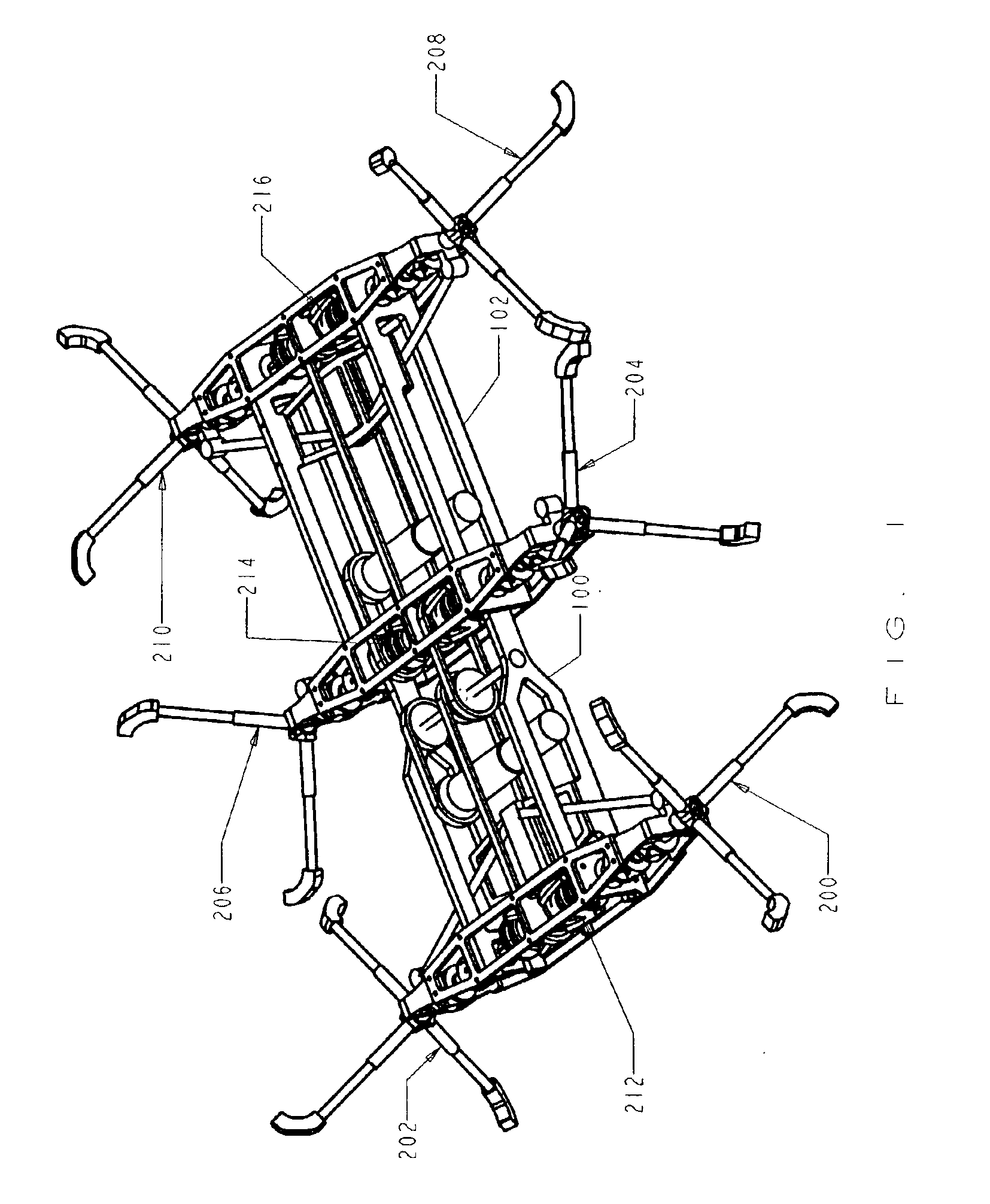
[0158]A vehicle that embodies the invention is shown in FIG. 1.

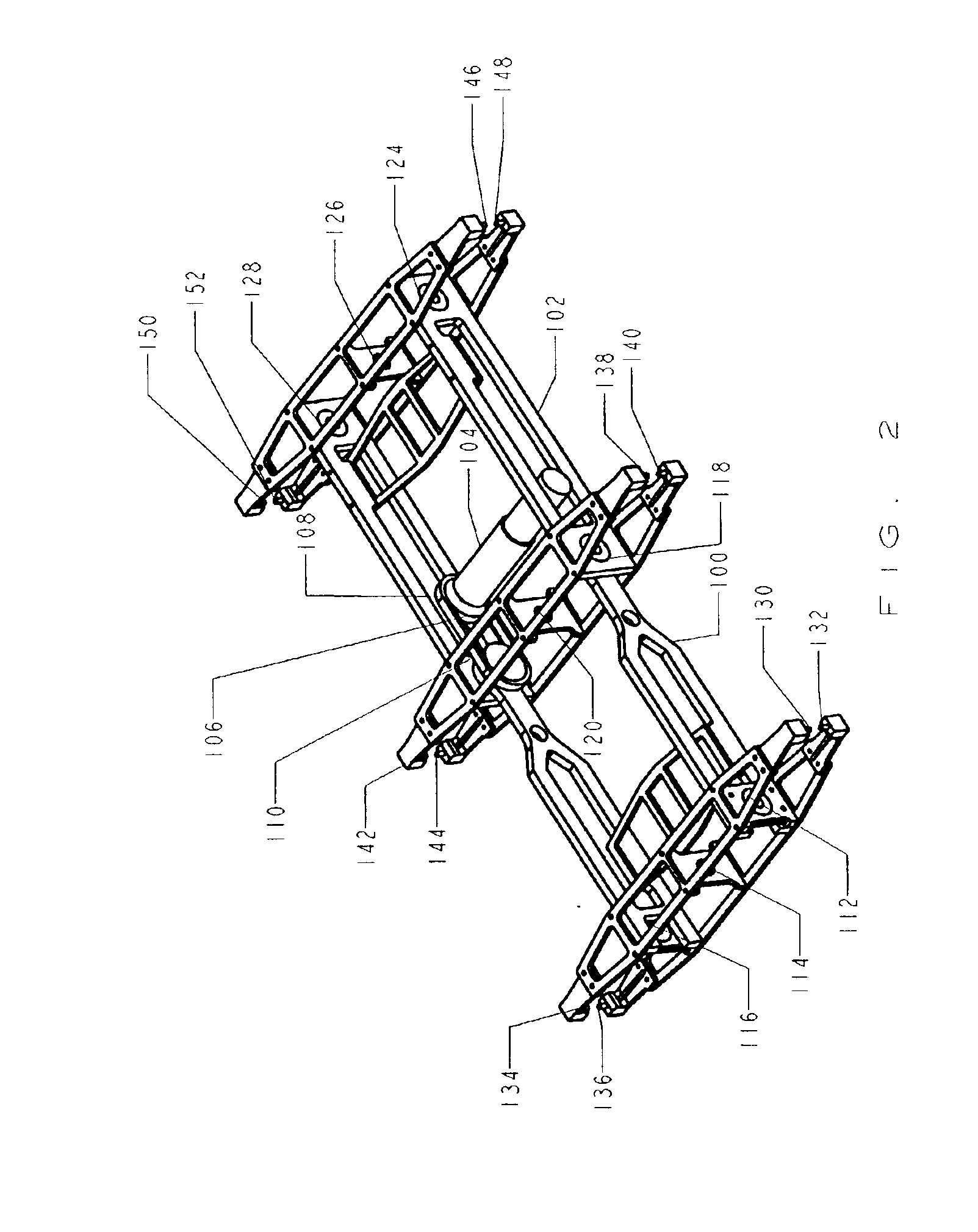
[0159]Body: FIG. 2

[0160]The body of the vehicle, shown in FIG. 2, consists of a rigid front segment 100 and a rigid rear segment 102 that are articulated about an axis that coincides with the centerline of the middle axle 214 of the vehicle. A body-joint motor 104 with integral transmission, mounted on the rear segment of the body, rotates the body joint. A drive sprocket 106 is mounted on the output shaft of the transmission. A chain 108 connects the drive sprocket to a driven sprocket 110, which is attached to the front segment of the body. The centerline of the driven sprocket corresponds to the centerline of the middle axle. The motor rotates the front segment up or down relative to the rear segment.

[0161]Drive Train: FIG. 3A and 3B

[0162]A drive-motor 218 with integral transmission drives front 212, middle 214 and rear 216 axle assemblies through the drive train shown in FIGS. 3A and 3B. The front axle assemb...