

Cross-linked polybenzimidazole membrane for gas separation
a cross-linked polybenzimidazole and gas separation technology, applied in the direction of membranes, separation processes, membranes, etc., can solve the problems of low permeability or inadequate selectivity, large effort directed at identification, and little information available about gas separation using cross-linked polybenzimidazol
- Summary
- Abstract
- Description
- Claims
- Application Information
AI Technical Summary
Problems solved by technology
Method used
Image

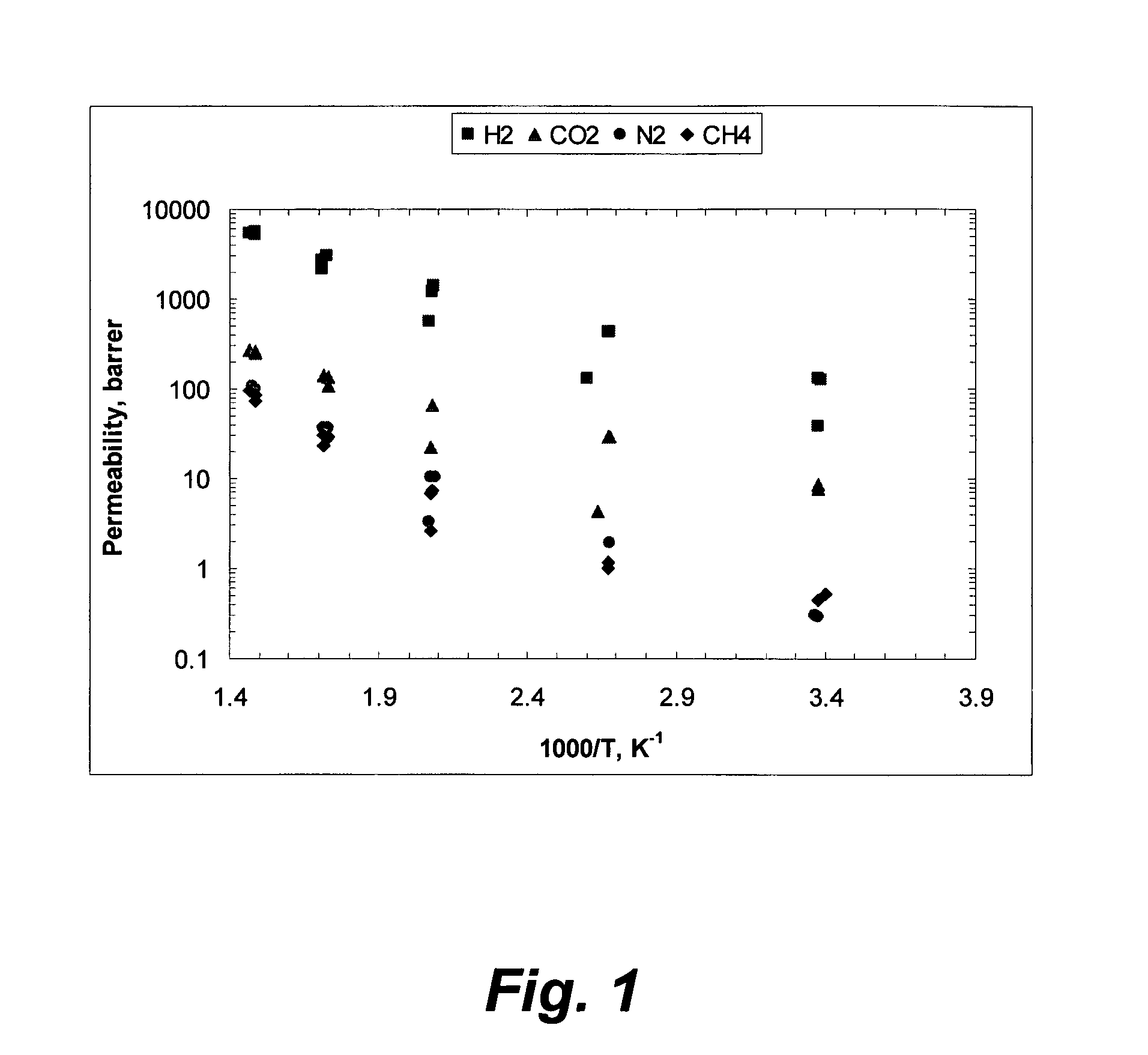
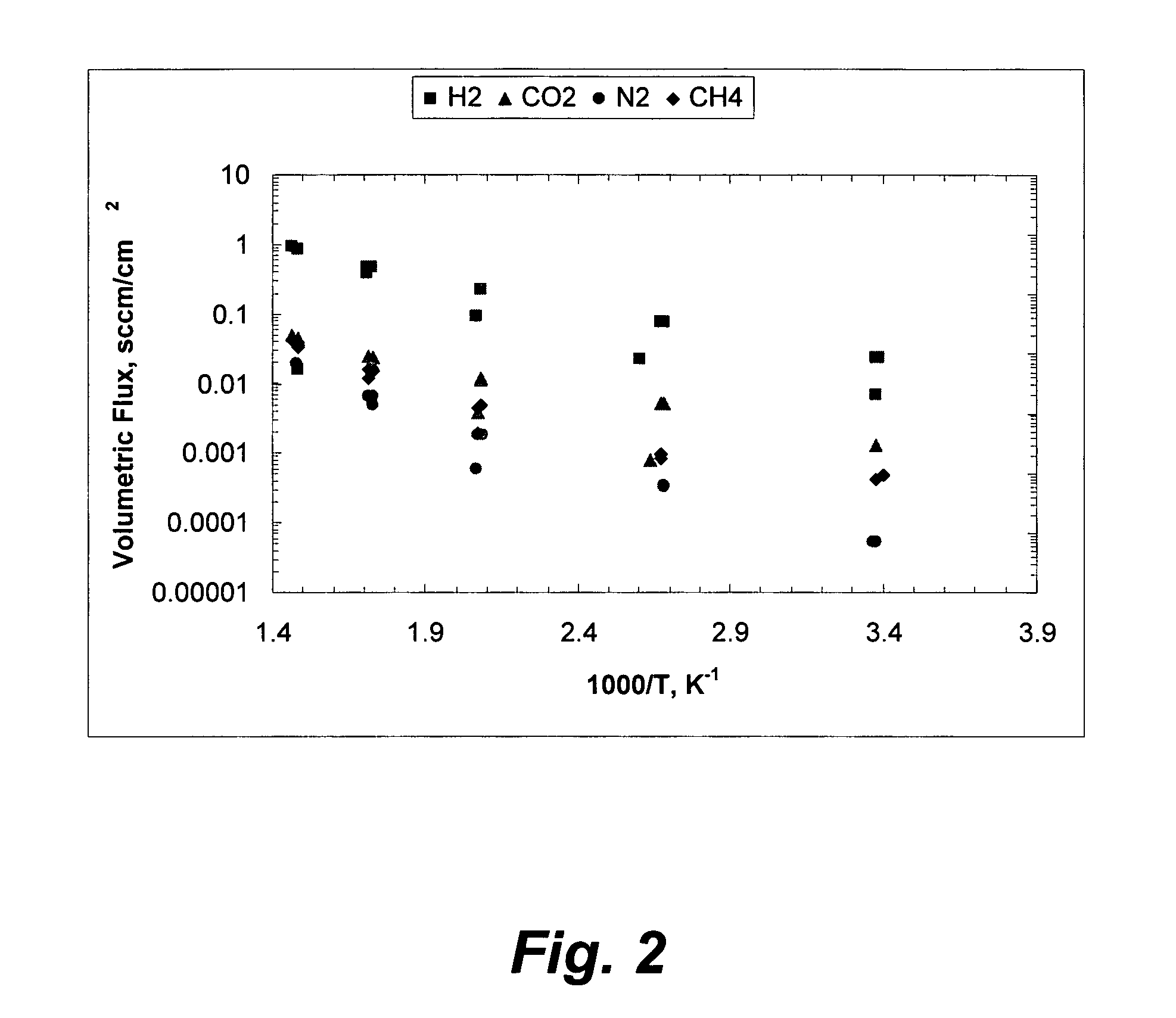
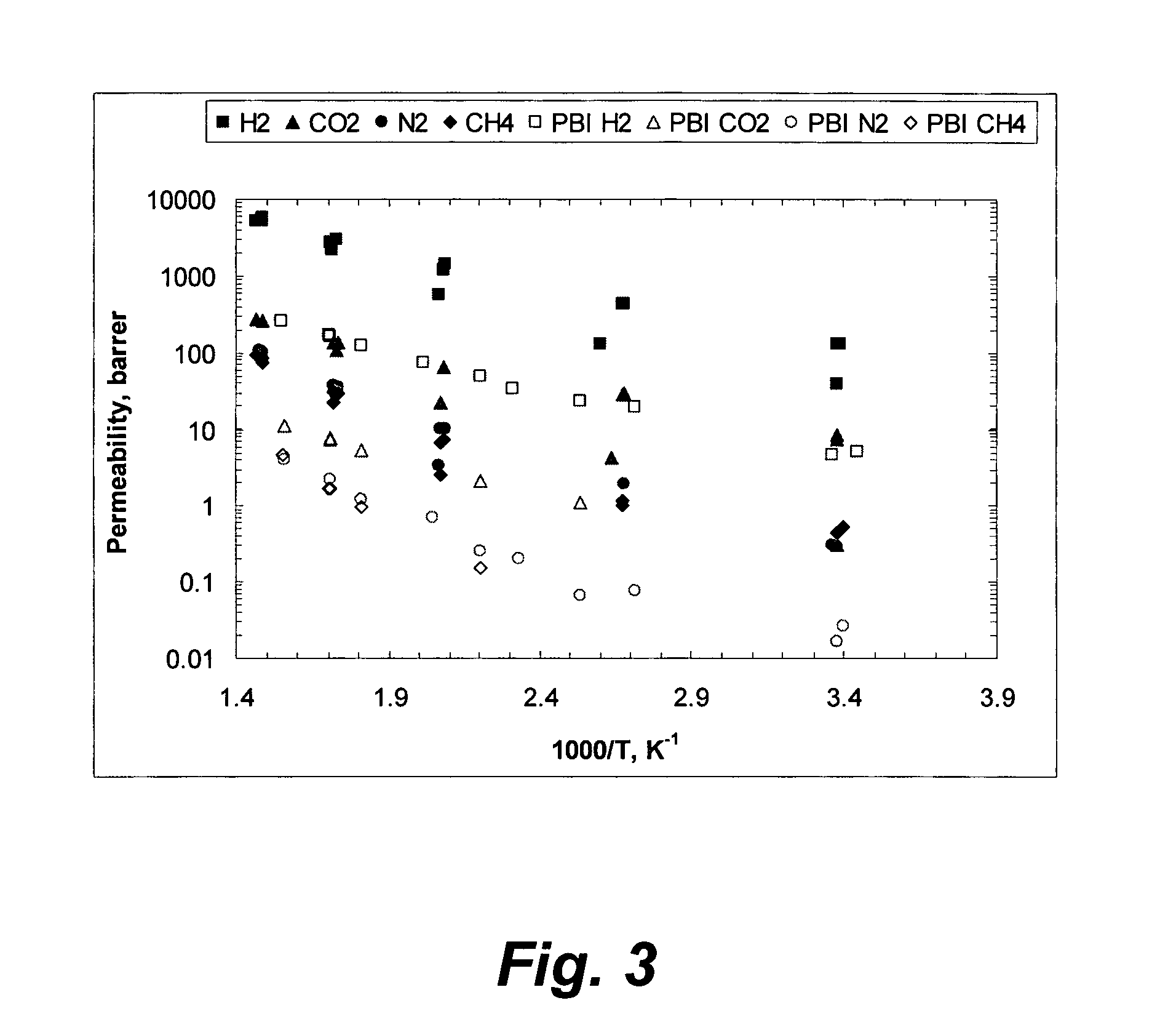
Examples
example
[0043]Ten grams of a membrane casting solution containing 20 weight percent (wt 15%) of a cross-linking agent was prepared by dissolving 0.8 gram of poly-2,2′-(m-phenylene)-5,5′bibenzimidazole (CELANESE CORPORATION, {overscore (M)}n=20×103, 0.78 μm-diameter polymer particles) and 0.2 gram of 3,4-dichloro-tetrahydro-thiophene-1,1-dioxide in 9 grams of N,N-dimethylacetamide. For this EXAMPLE, assuming complete reaction, the composition containing 20 weight percent of the cross-linking agent and 80 percent of the polymer would produce a 40 percent crosslinked neutral polymer product (slightly less than one equivalent of cross-linking agent per two imidazoles). The reaction between the polymer and crosslinking agent is shown below.
[0044]A 40 microliter (μl) aliquot of the solution was evenly spread on a stainless steel substrate (PALL CORPORATION). After drying at room temperature for 15 min, the resulting supported polymer film was heated to a temperature of 50 degrees Celsius for 60 ...
PUM
| Property | Measurement | Unit |
|---|---|---|
| temperature | aaaaa | aaaaa |
| temperatures | aaaaa | aaaaa |
| temperature | aaaaa | aaaaa |
Abstract
Description
Claims
Application Information
 Login to View More