
Imaging forming apparatus
a technology of image forming apparatus and forming apparatus, which is applied in the direction of electrographic process apparatus, instruments, optics, etc., can solve the problems of affecting the transfer operation of the other body, so as to prevent such interference, improve productivity, and improve productivity.
- Summary
- Abstract
- Description
- Claims
- Application Information
AI Technical Summary
Benefits of technology
Problems solved by technology
Method used
Image

Examples
first embodiment
[First Embodiment]
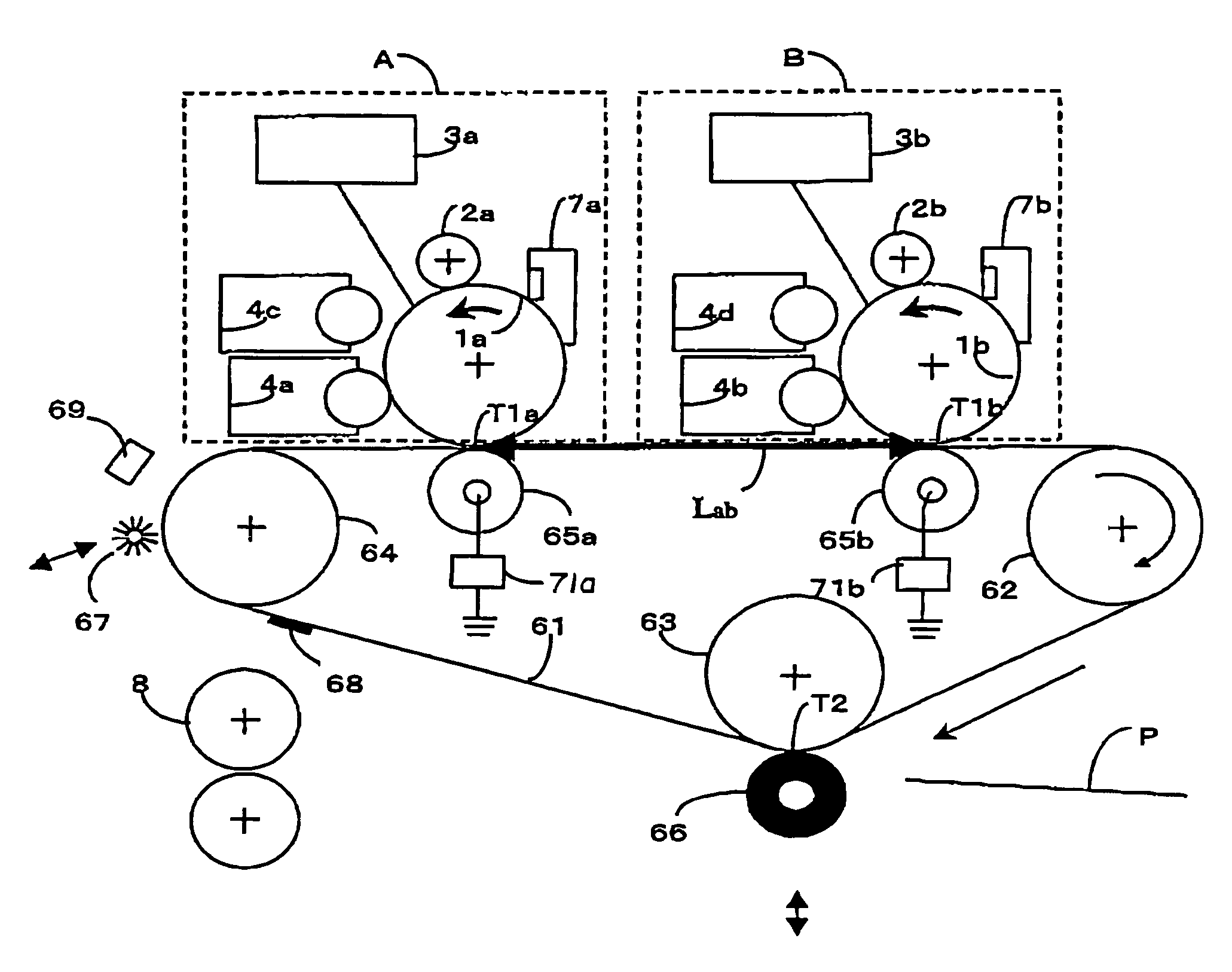
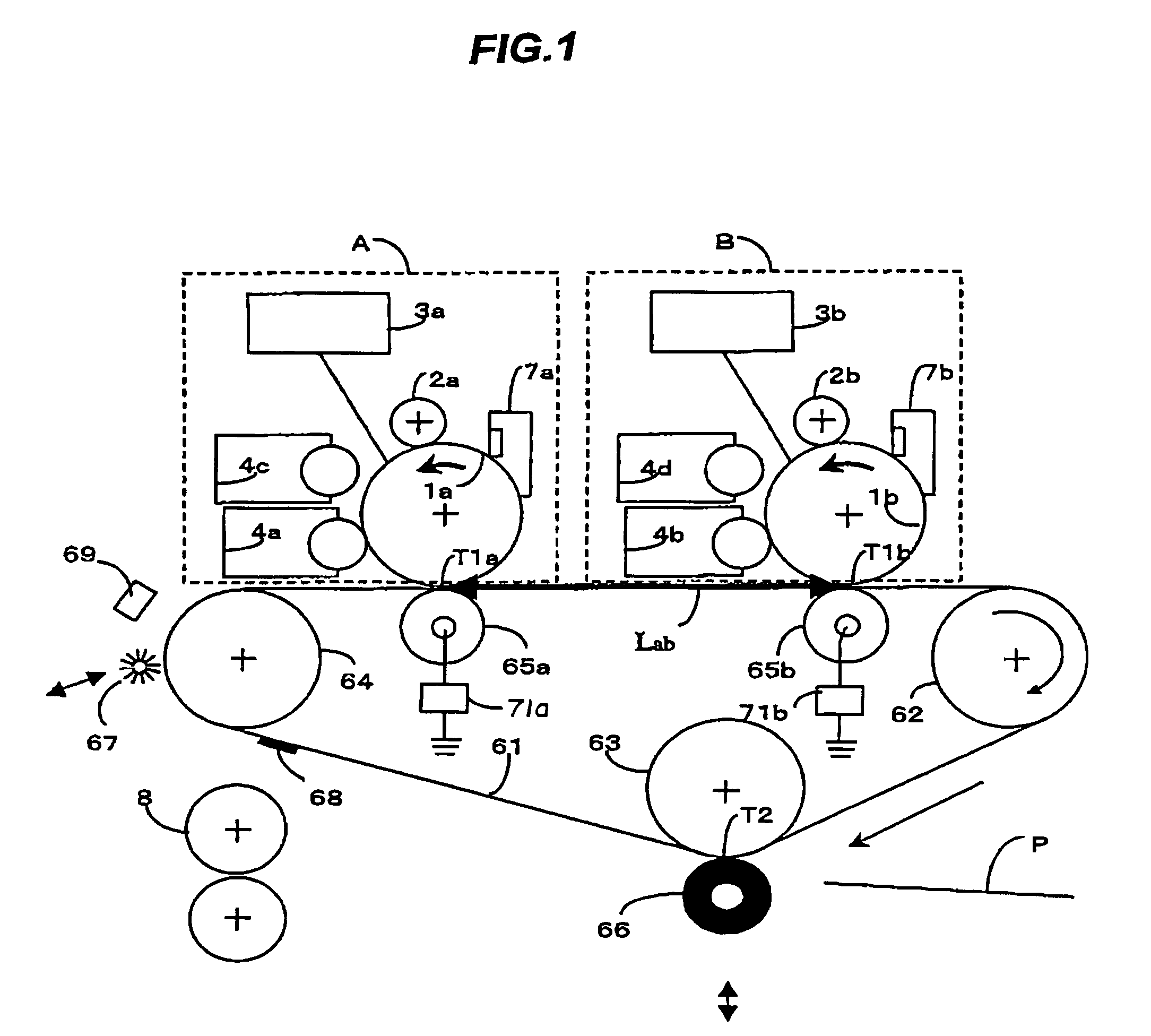
[0027]FIG. 1 is for a first embodiment of the invention. The embodiment is described with reference to the drawings.
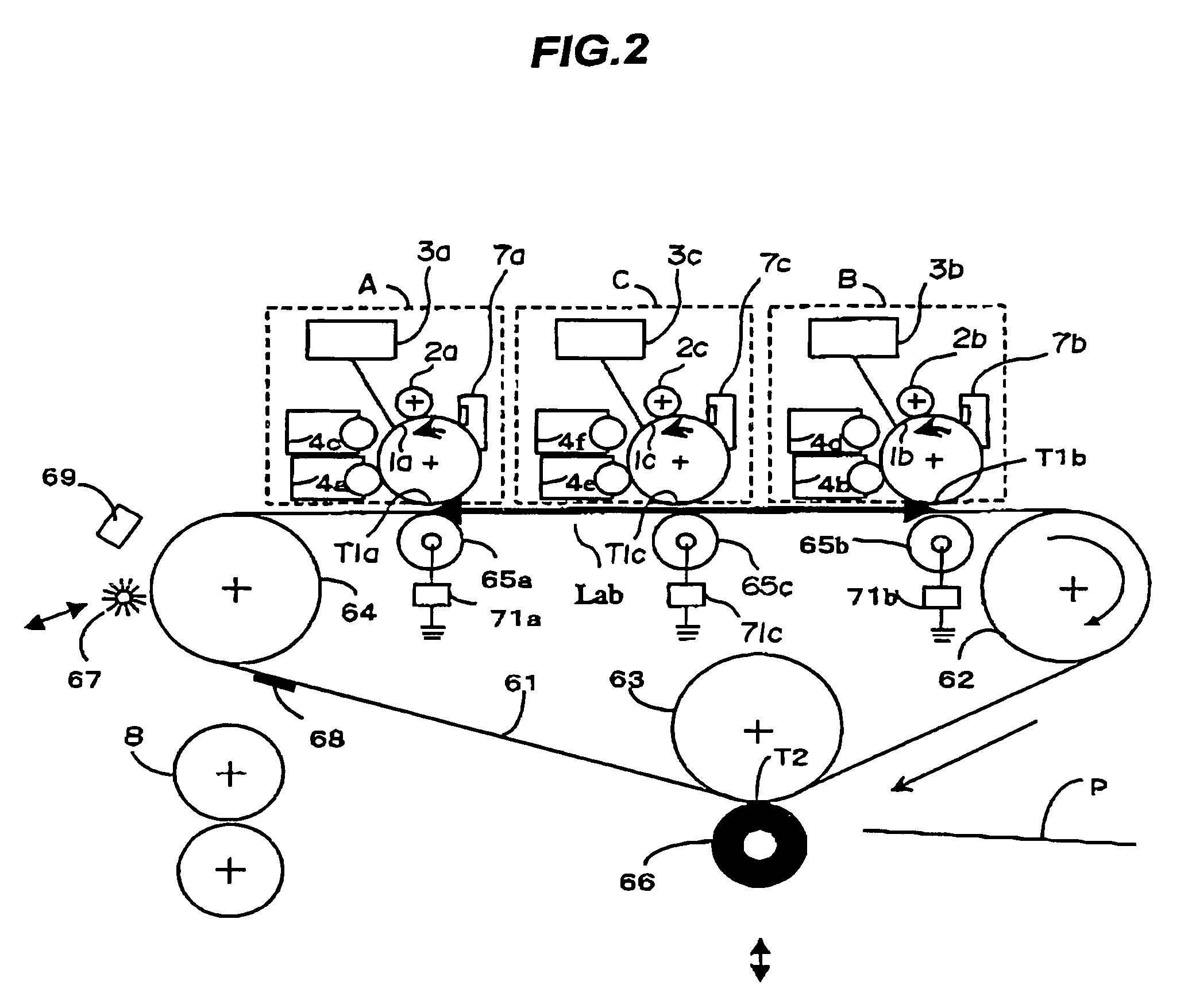
[0028]Around an intermediate transfer belt 61, disposed are a first image production section A and a second image production section B, each of which is constituted of a photosensitive drum, a charging device, a charging roller, two switchable developing devices, and a cleaning device.
[0029]In the first image production section A, the photosensitive drum 1a is charged with the charging roller 2a, and the exposing device 3a exposes images of the first color yellow. The latent image formed on the photosensitive drum 1a is developed by the developing device 4a corresponding to the first color yellow. It is to be noted that the developing devices 4a, 4c are interchangeably used according to a drive means not shown. The developed yellow toner image is transferred to an intermediate transfer belt 61 by a primary transfer roller 65a (at a first transfer posi...
second embodiment
[Second Embodiment]
[0047]In the first embodiment, the apparatus is structured so that Lr−Lm >Lab . . . (1) is satisfied to prevent the transfer biases applied to the primary transfer rollers 65a, 65b from interfering with each other.
[0048]Meanwhile, in a case that the relations among the Lr, the Lm, and the Lab, are:
Lr−Lm≦Lab (2),
the following is a method for preventing the primary transfer biases from interfering with each other. As described in the first embodiment, as a method to match and overlap the position of the toner images of the respective colors on the intermediate transfer belt 61, a mark 68 formed on the intermediate transfer belt 61 is read out by an optical sensor 69, and the read signal I-top (Image top) is made as reference, thereby writing the respective images on the photosensitive drums 1a, 1b after the prescribed timings.
[0049]In this embodiment, the timing from reception of the I-top signal to actual image exposure by laser beam on the photosensitive drums 1a...
third embodiment
[Third Embodiment]
[0052]Next, a situation that the transfer material most frequently used and the transfer material larger than the material, both are used as described in the first embodiment, is described.
[0053]With respect to the transfer material most frequently used, as described in the first embodiment, the apparatus is structured as Formula (1) is satisfied, and during the successive printing operation, the image area is always set at the same position on the intermediate transfer belt 61. In other words, where the time needed for one rotation of the intermediate transfer belt 61 is set as T, the interval of the respective printing during the successive printing operation is desirably set as T, and with respect to the transfer materials larger than that material, it is designed so that Formula (2) and Formula (3) are satisfied and that the image area is shifted downward on the intermediate transfer belt 61 according to the printing sheet number.
[0054]With this control, the pr...
PUM
 Login to View More
 Abstract
Description
Claims
Application Information
 Login to View More