
Sterilization indicator test packs
a technology of sterilization indicators and test packs, applied in the field of sterilization indicators, can solve the problems of premature inactivation of enzymes in sterilization indicators, complicated efficient regulation of inventory, and inability to detect the degree of sterilization
- Summary
- Abstract
- Description
- Claims
- Application Information
AI Technical Summary
Benefits of technology
Problems solved by technology
Method used
Image

Examples
example 1
[0101]This example provides that sterilization indicators made with spores that have been treated with the chemicals in Table 1 demonstrate improved accuracy when compared to indicators made with untreated spores. The chemicals in Table 1 are polyglycerol alkyl esters or ethoxylated glycerol esters.
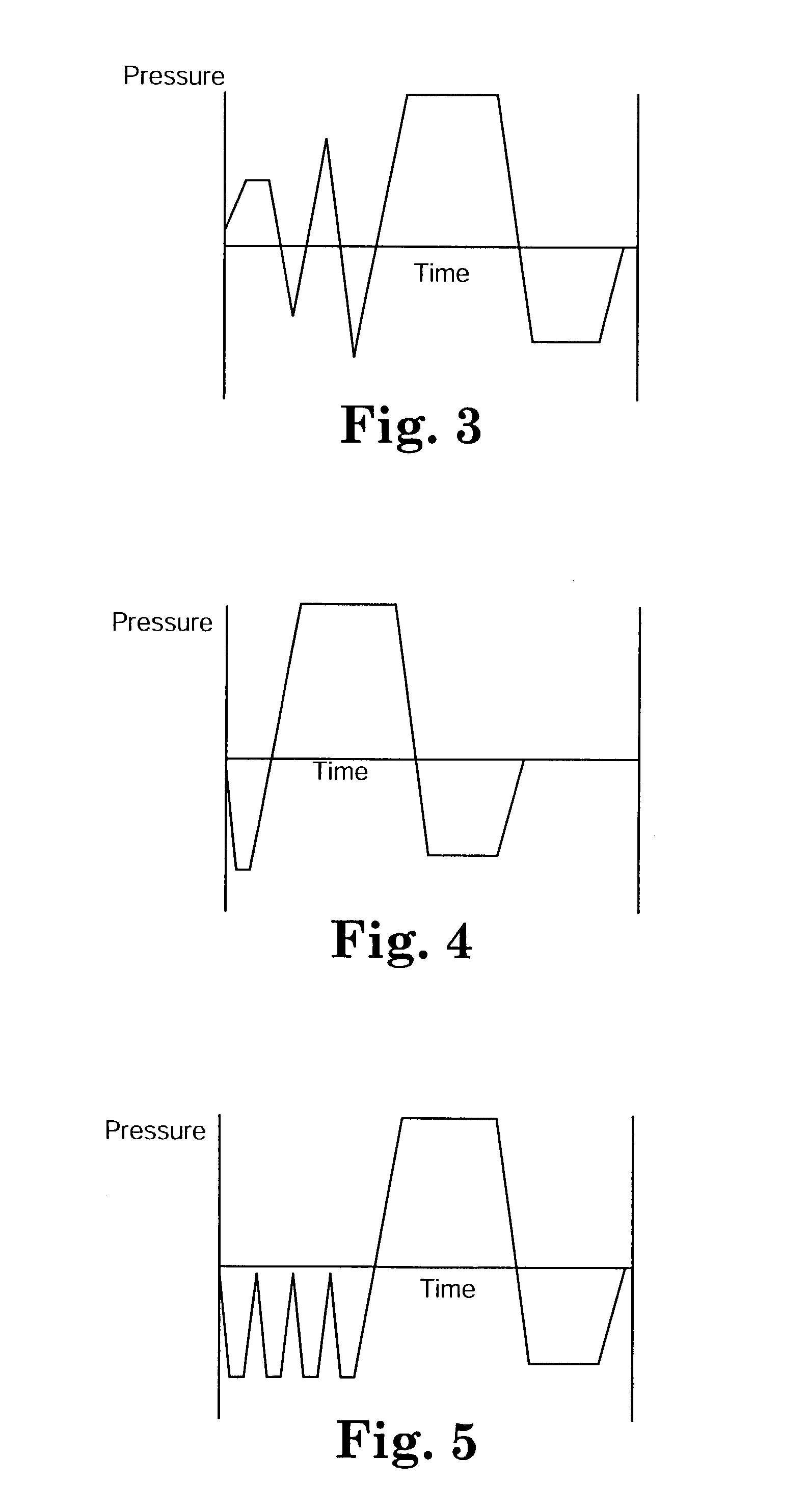
[0102]Sterilization indicators were made as described above with each of the chemicals and concentrations described in Table 1. Control indicators were made using untreated spores. The indicators were placed in metal instrument trays and exposed at 121° C. in a Getinge Steam Sterilizer (Getinge International, Inc., 1100 Towbin Ave., Lakewood, N.J.) using a 4-pulse prevacuum cycle at 121° C. with a vacuum level of 0.075–0.085 bar and a steam pulse to 1.00 bar for each pulse. Indicators were exposed in the sterilizer for between 7 and 13 minutes. This cycle is depicted in the time-pressure diagram in FIG. 5. After exposure the inner containers containing the enzyme substrate and nutrient me...
example 2
[0106]This example provides evidence of the effect that treating spores with polyglycerol compounds without alkyl esters or ethers has on the accuracy of sterilization indicators made with the treated spores when compared to indicators made with untreated spores.
[0107]Sterilization indicators were made as described above with each of the chemicals and concentrations described in Table 2. Control indicators were made using untreated spores. The indicators were placed in metal instrument trays and exposed at 121° C. in a Getinge Steam Sterilizer (Getinge International, Inc., 1100 Towbin Ave., Lakewood, N.J.) using a 4-pulse prevacuum cycle at 121° C. with a vacuum level of 0.075–0.085 bar and a steam pulse to 1.00 bar for each pulse. Indicators were exposed in the sterilizer for between 7 and 13 minutes. This cycle is depicted in the time-pressure diagram in FIG. 5. After exposure the inner containers containing the enzyme substrate and nutrient medium were crushed and the indicators ...
example 3
[0112]This example provides evidence that sterilization indicators made with spores that have been treated with a mixture of decaglyceryl monostearate and sorbitol, or with decaglycerol monostearate alone, demonstrate improved accuracy when compared with sterility indicators made with untreated spores or spores treated with sorbitol alone.
[0113]Sterilization indicators were made as described above with each of the chemicals and concentrations described in Table 3. Control indicators were made using untreated spores. The indicators were placed in metal instrument trays and exposed at 121° C. in a Getinge Steam Sterilizer (Getinge International, Inc., 1100 Towbin Ave., Lakewood, N.J.) using a 4-pulse prevacuum cycle at 121° C. with a vacuum level of 0.075–0.085 bar and a steam pulse to 1.00 bar for each pulse. Indicators were exposed in the sterilizer for between 7 and 15 minutes. This cycle is depicted in the time-pressure diagram in FIG. 5. After exposure the inner containers contai...
PUM
 Login to View More
 Abstract
Description
Claims
Application Information
 Login to View More