Check patentability & draft patents in minutes with Patsnap Eureka AI!

Memory allocation using a memory address pool

a memory address and pool technology, applied in the field of memory management systems, can solve the problems of free address pool depletion, memory block not being de-allocated, and solution, but also having its own attendant problems

Inactive Publication Date: 2007-01-30
JUMIPER NETWORKS INC
View PDF13 Cites 0 Cited by
  • Summary
  • Abstract
  • Description
  • Claims
  • Application Information

AI Technical Summary

Benefits of technology

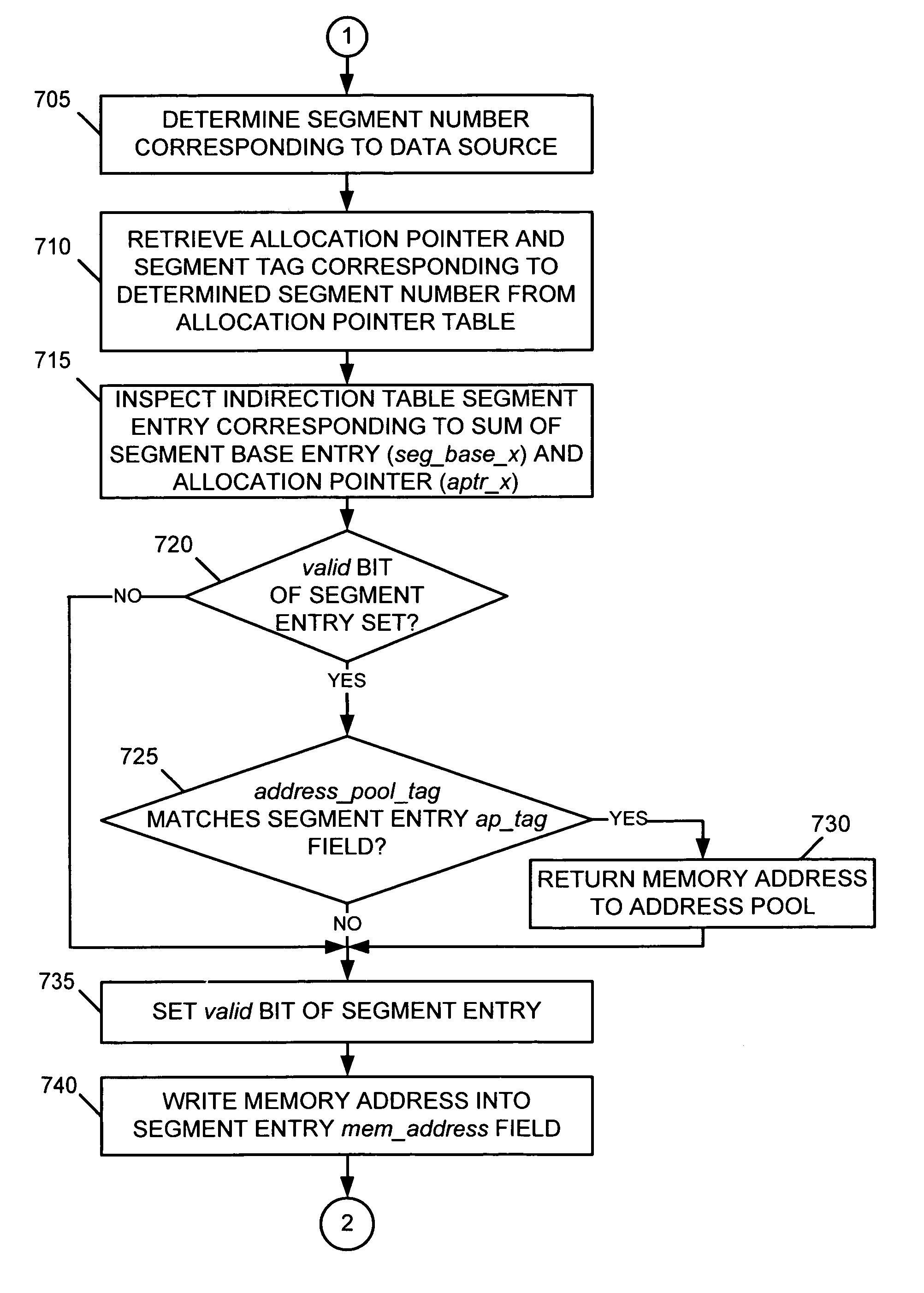
[0008]Consistent with the principles of the invention disclosed and claimed herein, these and other needs are addressed by providing tags, or counter values, that permit the aging of memory addresses extracted from a memory address pool. Implementations consistent with the principles of the invention “age” memory addresses extracted from the memory address pool through the provision of a tag, or counter value, which can be incremented when the pool is emptied of all addresses and then replenished. This tag can be passed to a data source requesting a memory write and then compared with a current address pool tag when the data source requests a data read. Implementations consistent with the principles of the invention may additionally “age” memory addresses through the provision of a buffer tag, or buffer counter value, which can be incremented when all memory addresses stored in a buffer have been written to. This buffer tag can also be passed to a data source requesting a memory write and then compared with a current tag when the data source requests a data read. Through the use of an address pool tag and a buffer tag, implementations consistent with the principles of the present invention can “age” memory blocks without incurring aliasing and address pool pollution.

Problems solved by technology

One problem that occurs with the use of a free address pool is when a memory “leak” occurs that causes a memory block to not be de-allocated.
When memory leaks occur, there is the possibility that the free address pool will become depleted.
This can create serious problems, since the system will be unable to allocate any further memory until blocks are de-allocated.
This, solution, however, also has its own attendant problems.
This problem is called “aliasing.” Aliasing has two detrimental effects.
First, the data integrity cannot be guaranteed, since data that is read might not be valid data.
Second, the free address pool may become “polluted” because a memory block might have multiple addresses in the address pool.

Method used

the structure of the environmentally friendly knitted fabric provided by the present invention; figure 2 Flow chart of the yarn wrapping machine for environmentally friendly knitted fabrics and storage devices; image 3 Is the parameter map of the yarn covering machine
View more

Image

Smart Image Click on the blue labels to locate them in the text.
Viewing Examples
Smart Image
  • Memory allocation using a memory address pool
  • Memory allocation using a memory address pool
  • Memory allocation using a memory address pool

Examples

Experimental program
Comparison scheme
Effect test

Embodiment Construction

[0022]The following detailed description of the invention refers to the accompanying drawings. The same reference numbers in different drawings may identify the same or similar elements. Also, the following detailed description does not limit the invention. Instead, the scope of the invention is defined by the appended claims and equivalents of the claim limitations.

[0023]Systems and methods consistent with the principles of the invention permit the implementation of free address pools without aliasing or address pool pollution. Aliasing and address pool pollution are avoided through the provision of address pool tags and segment tags that enable memory addresses extracted from an address pool to be “aged.” By comparing current address pool tags and segment tags with corresponding tags passed to a data source that has requested a memory write, implementations consistent with the principles of the invention prevent data from being read from memory that does not correspond to the requ...

the structure of the environmentally friendly knitted fabric provided by the present invention; figure 2 Flow chart of the yarn wrapping machine for environmentally friendly knitted fabrics and storage devices; image 3 Is the parameter map of the yarn covering machine
Login to View More

PUM

No PUM Login to View More

Abstract

A system maintains a first counter value that indicates a number of times memory addresses in a memory address pool have been replenished. The system further maintains a second counter value that indicates a number of times a circular buffer has been filled with memory addresses retrieved from the memory address pool. The system ages memory addresses allocated to memory write requests based on the first and second counter values.

Description

CROSS REFERENCE TO RELATED APPLICATIONS[0001]The present application is a continuation of U.S. Ser. No. 10 / 062,424 now U.S. Pat. No. 7,039,774, entitled “Memory Allocation Using a Memory Address Pool” and filed Feb. 5, 2002, the disclosure of which is incorporated by reference herein in its entirety.BACKGROUND OF THE INVENTION[0002]A. Field of the Invention[0003]The present invention relates generally to memory management systems and, more particularly, to systems and methods for allocating memory using a memory address pool.[0004]B. Description of Related Art[0005]Memory management systems conventionally use memory address pools, commonly called freelists, for managing memory. In many memory management systems, memory is divided into blocks with the addresses of these blocks stored in a secondary memory array to form a free memory address pool. This free address pool can be managed as a first-in-first-out (FIFO) queue. Addresses are removed from the free address pool when a block i...

Claims

the structure of the environmentally friendly knitted fabric provided by the present invention; figure 2 Flow chart of the yarn wrapping machine for environmentally friendly knitted fabrics and storage devices; image 3 Is the parameter map of the yarn covering machine
Login to View More

Application Information

Patent Timeline
no application Login to View More
Patent Type & Authority Patents(United States)
IPC IPC(8): G06F12/00
CPCG06F12/023
Inventor CRUZ-RIOS, JORGERAHIM, RAMITALAPANENI, VENKATESWARLUSINDHU, PRADEEP
Owner JUMIPER NETWORKS INC
Features
  • R&D
  • Intellectual Property
  • Life Sciences
  • Materials
  • Tech Scout
Why Patsnap Eureka
  • Unparalleled Data Quality
  • Higher Quality Content
  • 60% Fewer Hallucinations
Social media
Patsnap Eureka Blog
Learn More