[0009]Therefore, it is a main object of the present invention to prevent the receptacle fitting portion of a coaxial cable connector and, particularly a small-height and small-size coaxial cable connector, from degrading its fitting retaining force due to repeated fitting to a receptacle, resulting in occurrences of inconvenience such as accidental disengagement.
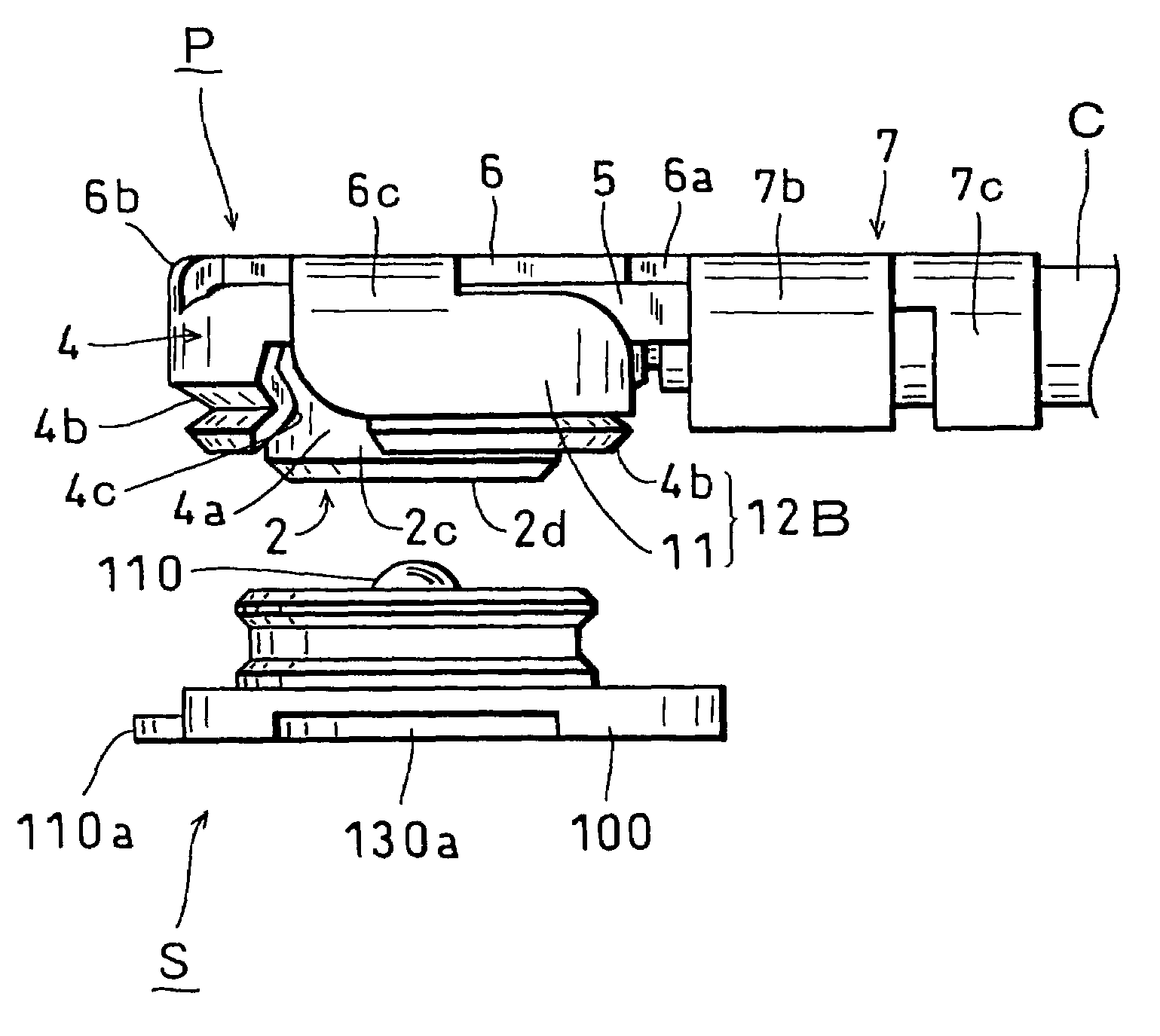
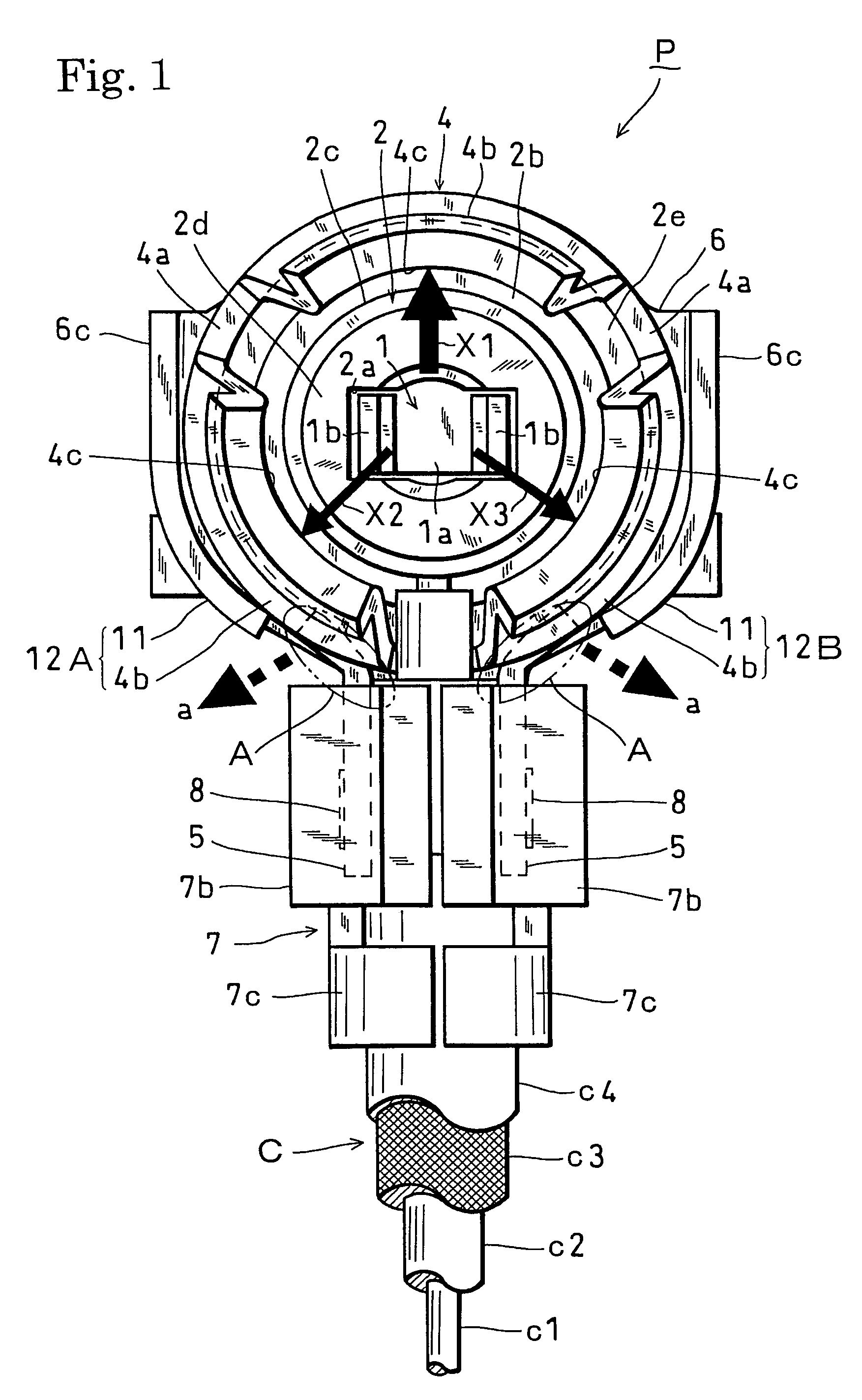
[0014]In the case of a coaxial cable connector including a contact which is connected to a central conductor of a coaxial cable, an insulation body internally equipped with said contact, and a cylindrical receptacle fitting portion including a plurality of arc-shaped elastic springs which are arranged outside said insulation body on a concentric circle and are connected to an outer conductor of said coaxial cable, when the connector is pulled out from the receptacle by pulling the coaxial cable, a largest stress is exerted on the cable drawing-out portion of the receptacle fitting portion (the A and B portions in FIG. 1), which forces the portions outwardly (the directions of the arrows a and b in FIG. 1) to expand them. However, in the present invention, since the receptacle fitting portion partially has the configurations of the double springs, it has an increased elastic force which disperses stresses therein to alleviate displacement and deformation of the same portions. Since the receptacle fitting portion has an increased elastic force and thus is less prone to deformation, it is possible to effectively prevent degradation of the fitting retaining force due to repeated insertion and pull and also it is possible to increase the initial retaining force, which improves the reliability of the fitting and contact. This can prevent the receptacle fitting portion from degrading its fitting retaining force resulting in inconvenience of accidental disengagement, etc., due to repeated fitting of a coaxial cable connector, particularly a small-height and small size L-shaped coaxial cable connector, into a receptacle.
[0015]The receptacle fitting portion has a lowest strength at the cable drawing-out portion (the A and B portions in FIG. 1). Therefore, by forming the adjacent arc-shaped elastic springs sandwiching the coaxial cable drawn out outwardly in the radial direction from the receptacle fitting portion to have the double-spring configuration, the lowest-strength portion of the receptacle fitting portion can be reinforced, thereby effectively alleviating degradation in the fitting retaining force due to repeated insertion and pull.
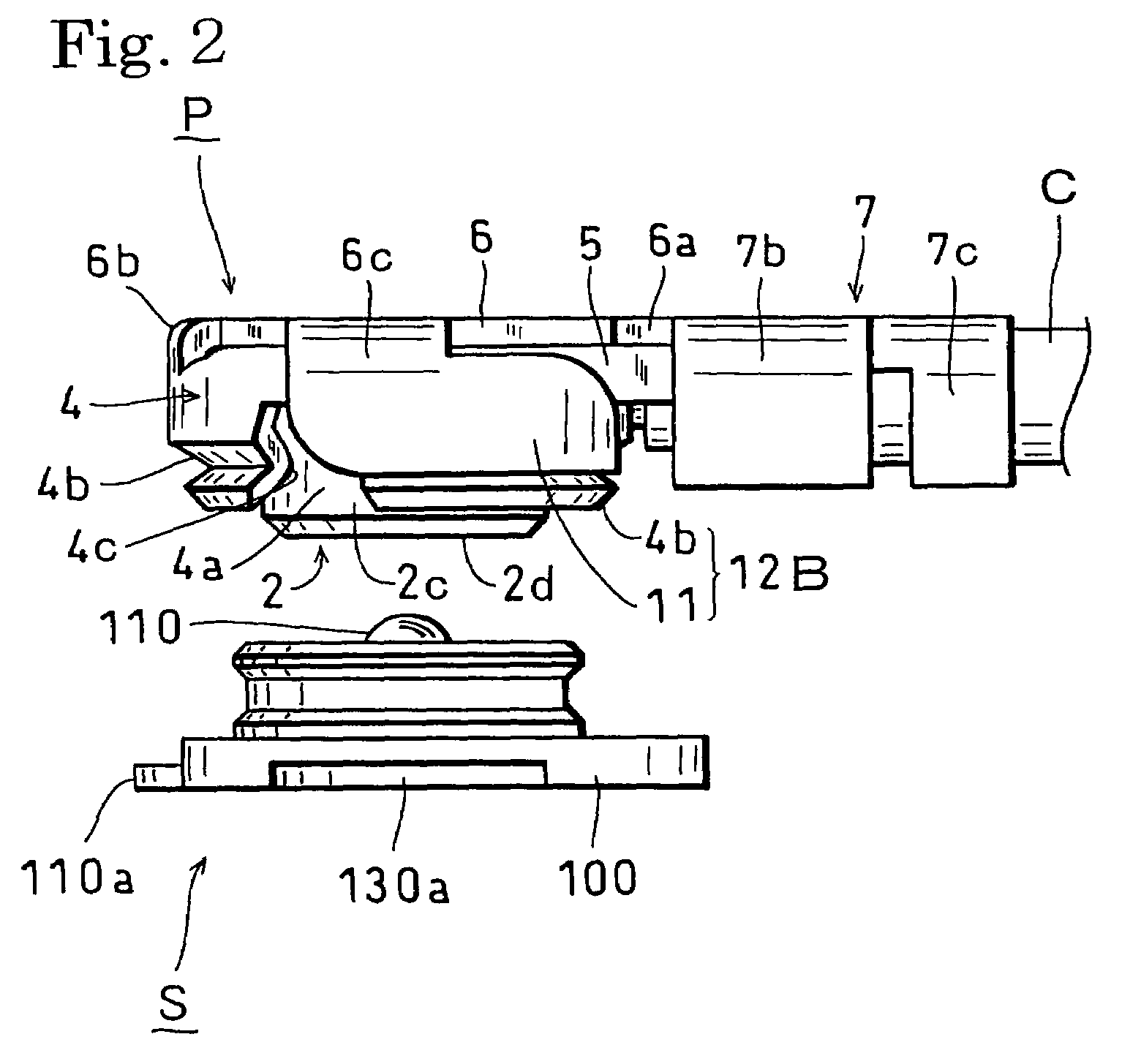
[0016]The outer elastic springs of the double springs are bent into an arc shape or a tangential straight shape such that their movable tip end portions are more inward than the outer diameter of the receptacle fitting portion, before being placed outside the receptacle fitting portion. Consequently, when the outer elastic springs of the double springs are placed outside the receptacle fitting portion, an initial displacement is generated, thus exerting a load to the double springs. Since the receptacle fitting portion has already had an increased elastic force before the coaxial cable is pulled at the state where the connector is fitted to the receptacle, it has greater resistance against deformation and exhibits reduced characteristic changes against repeated insertion and pull, in comparison with configurations which constitute double springs halfway through the displacement. Consequently, it is possible to effectively alleviate degradation of the fitting retaining force due to repeated insertion and pull. Also, the bending of the outer elastic springs of the double springs can be performed after they are placed outside the receptacle fitting portion, and in such a case, their movable tip end portions are bent into an arc shape or a tangential straight shape such that they are brought into contact with the outer peripheral surface of the receptacle fitting portion. In the case of bending the outer elastic springs of the double springs after placing them outside the receptacle fitting portion, the assembly of the connector will be easier.
[0017]Further, since the outer elastic springs of the double springs are formed, by bending, from portions of the outer conductor shell placed outside the receptacle fitting portion, the outer elastic springs are integral with the outer conductor shell, which can alleviate reduction of the fitting retaining force due to repeated insertion and pull without increasing the number of components and the number of assembly processes. In addition to forming the outer elastic springs of the double springs integrally with the outer conductor shell, they can also be constituted by U-shaped springs made from metal sheets or made by wire-forming or can be also constituted by resin springs formed concentrically with the body cylindrical shape by forming integrally with the insulation body.


 Login to View More
  Login to View More