Unlock instant, AI-driven research and patent intelligence for your innovation.

Method for preventing overload condition in a circuit switched arrangement

a circuit switched and overload condition technology, applied in the direction of interconnection arrangements, electrical equipment, telephonic communication, etc., can solve the problems of not having the capacity to service all terminals simultaneously, new callers cannot connect to the near-end office, and do not even get dial tone, etc., to achieve the effect of high probability

Inactive Publication Date: 2007-10-23
AMERICAN TELEPHONE & TELEGRAPH CO
View PDF1 Cites 6 Cited by
  • Summary
  • Abstract
  • Description
  • Claims
  • Application Information

AI Technical Summary

Benefits of technology

This approach effectively maintains a high probability of available channels, preventing network overload and ensuring that new callers can establish connections by strategically dropping calls, thereby alleviating congestion and maintaining network stability.

Problems solved by technology

By statistically multiplexing of terminals onto the transmission paths it is meant that the transmission paths do not have sufficient capacity to service all terminals simultaneously.
In this example, however, terminals that are connected to the PBX are not employing a shared transmission resource in order to reach the PBX.
The disadvantage of this arrangement, however, is that when circuits in the shared transmission path are congested, new callers cannot connect to the near-end office and, therefore, do not even get a dial tone.
Consequently, the client does not even dial out, or if dials, the dialed digits are not received, and that leads to difficulty in implementing intelligent admission controls.
This condition, unfortunately, has been observed more and more in practice because, with the increased popularity of the Internet, more computers utilize the network, and computers connected to the Internet often have holding times (the time intervals between off-hook and on-hook) that are much longer than those that were expected when the shared transmission path were originally engineered.
However, even in network arrangements that do not have a shared transmission path between client terminals and the switch at the near-end office (near-end switch, for short), congestion can occur, simply because of an extraordinary use of the near-end switch in response to some event, such a radio “call-in” contest.
That can occur of course, when components of that near-end switch that are shared, such as a concentrator or a digit collector, become overloaded.
It might also be caused by a large number of computer users whose computers automatically keep redialing a busy Internet Service Provider (ISP) modem bank in an effort to obtain a modem the moment one becomes free.
The end offices themselves are, however, not protected from rapid retries, except in the sense that a user is likely to give up after a few busy signals.

Method used

the structure of the environmentally friendly knitted fabric provided by the present invention; figure 2 Flow chart of the yarn wrapping machine for environmentally friendly knitted fabrics and storage devices; image 3 Is the parameter map of the yarn covering machine
View more

Image

Smart Image Click on the blue labels to locate them in the text.
Viewing Examples
Smart Image
  • Method for preventing overload condition in a circuit switched arrangement
  • Method for preventing overload condition in a circuit switched arrangement
  • Method for preventing overload condition in a circuit switched arrangement

Examples

Experimental program
Comparison scheme
Effect test

Embodiment Construction

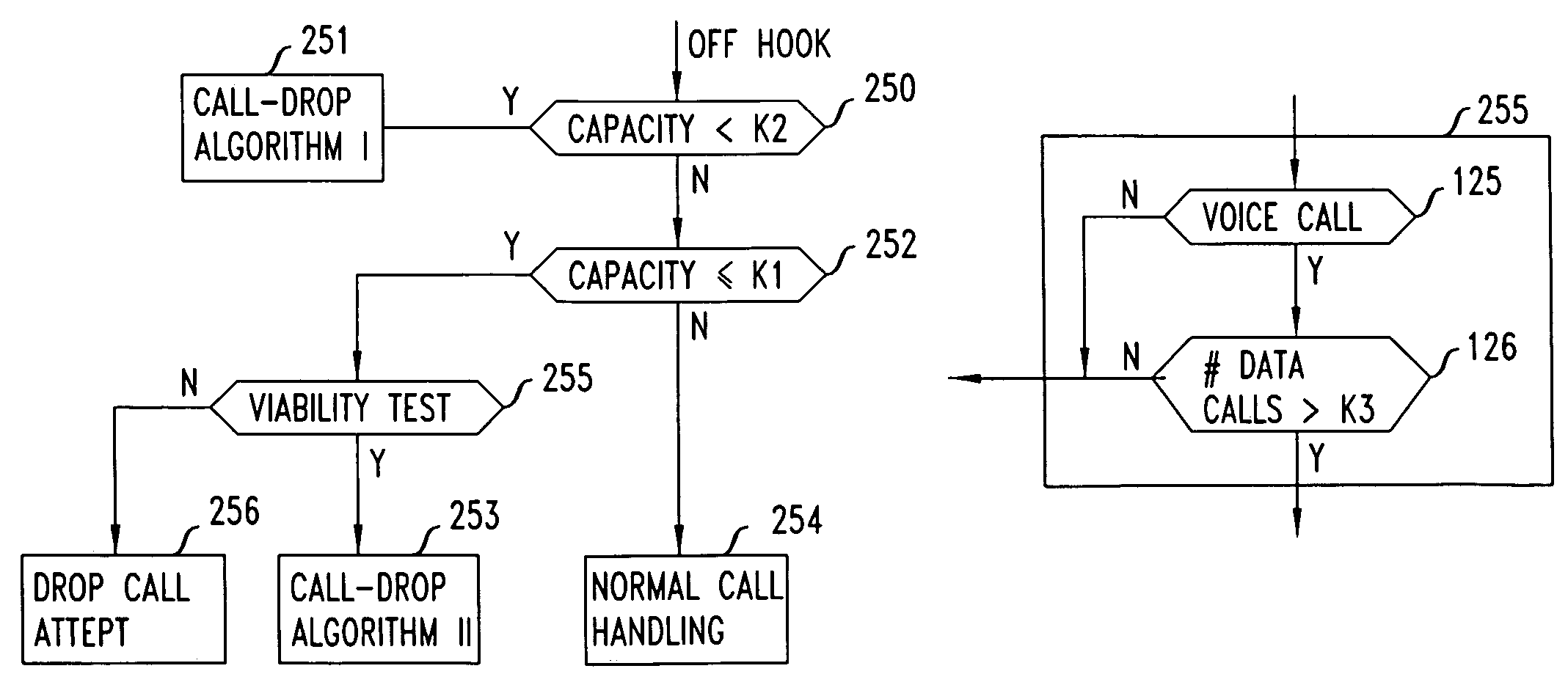
[0014]FIG. 1 presents a diagram of an illustrative arrangement where the principles disclosed herein can be practiced. In includes switch 10 (with processor 11), which is a near-end switch of a network that, on the trunk side, is connected to other switches of the network. Terminals 41 and 42 are connected directly to switch 10, as well as ISP 40. Additionally, shared path 30 connects HET 20 to switch 10. HET 20 includes a processor 21 that performs all of the processing needed in HET 20. Terminals 45-46 are connected to HET 20 via path 51, and terminals 43-44 are connected to HET 20 via path 52. Paths 51 and 52 may be, for example, hybrid-fiber coax systems, shared among the terminals. Henceforth, terminals 43-46 are termed “downstream” terminals, and paths 51 and 52 are termed “downstream” paths. Of course, an arrangement like the one shown in FIG. 1 can have more than two downstream paths. HET 20 concentrates the signals on each of the downstream paths (multiplexing action) and f...

the structure of the environmentally friendly knitted fabric provided by the present invention; figure 2 Flow chart of the yarn wrapping machine for environmentally friendly knitted fabrics and storage devices; image 3 Is the parameter map of the yarn covering machine
Login to View More

PUM

No PUM Login to View More

Abstract

Congestion problems in networks are alleviated with a method that works toward insuring that unused capacity will always exist in elements of a network that are resources which are shared by a plurality of users and which, consequently, can be overloaded. In response to each request to establish a connection over a path in the network, pursuant to a predetermined algorithm the method services the request, declines to service the request, or services the request after dropping an established connection. In one embodiment, when unused capacity on the path is above a first preselected level, all requests are serviced. When unused capacity falls below a second preselected threshold, no requests are serviced. When unused capacity is between the first and second thresholds, an existing data connection is dropped if a requested connection is a voice connection and the number of existing data connections exceeds a preselected threshold.

Description

RELATED APPLICATION[0001]The application is a Continuation of application Ser. No. 10 / 322,043 filed Dec. 17, 2002 now U.S. Pat. No. 7,068,766. This invention claims priority from Provisional application No. 60 / 410,538, filed Sep. 13, 2002. This invention is also related to U.S. patent application Ser. No. 10 / 026,083, filed Dec. 22, 2001, which is herein incorporated by reference.BACKGROUND OF THE INVENTION[0002]This invention relates to a method for preventing, or mitigating the effects of, an overload condition in a circuit switched telecommunication network. In some embodiments, such a network includes one or more arrangements where a group of client terminals are statistically multiplexed onto one or more transmission paths, the signals of active ones of the terminals are brought to a head end terminal (HET), and those signals are then communicated from the head end terminal to a central office switch of the network (henceforth, near-end office) over a shared transmission path. B...

Claims

the structure of the environmentally friendly knitted fabric provided by the present invention; figure 2 Flow chart of the yarn wrapping machine for environmentally friendly knitted fabrics and storage devices; image 3 Is the parameter map of the yarn covering machine
Login to View More

Application Information

Patent Timeline
no application Login to View More
Patent Type & Authority Patents(United States)
IPC IPC(8): H04M15/00H04M7/00
CPCH04M15/00H04Q3/0091H04M15/8016H04M2215/7414
Inventor AHN, SOOHANRAMASWAMI, VAIDYANATHAN
Owner AMERICAN TELEPHONE & TELEGRAPH CO