Exhaust after-treatment system with in-cylinder addition of unburnt hydrocarbons
a technology of exhaust after-treatment and hydrocarbons, which is applied in the direction of mechanical equipment, machines/engines, electric control, etc., can solve the problems of incompatibility of fuel injectors in typical engine cylinders, engine malfunctions, and increased cost and complexity of exhaust after-treatment systems
- Summary
- Abstract
- Description
- Claims
- Application Information
AI Technical Summary
Problems solved by technology
Method used
Image

Examples
first embodiment
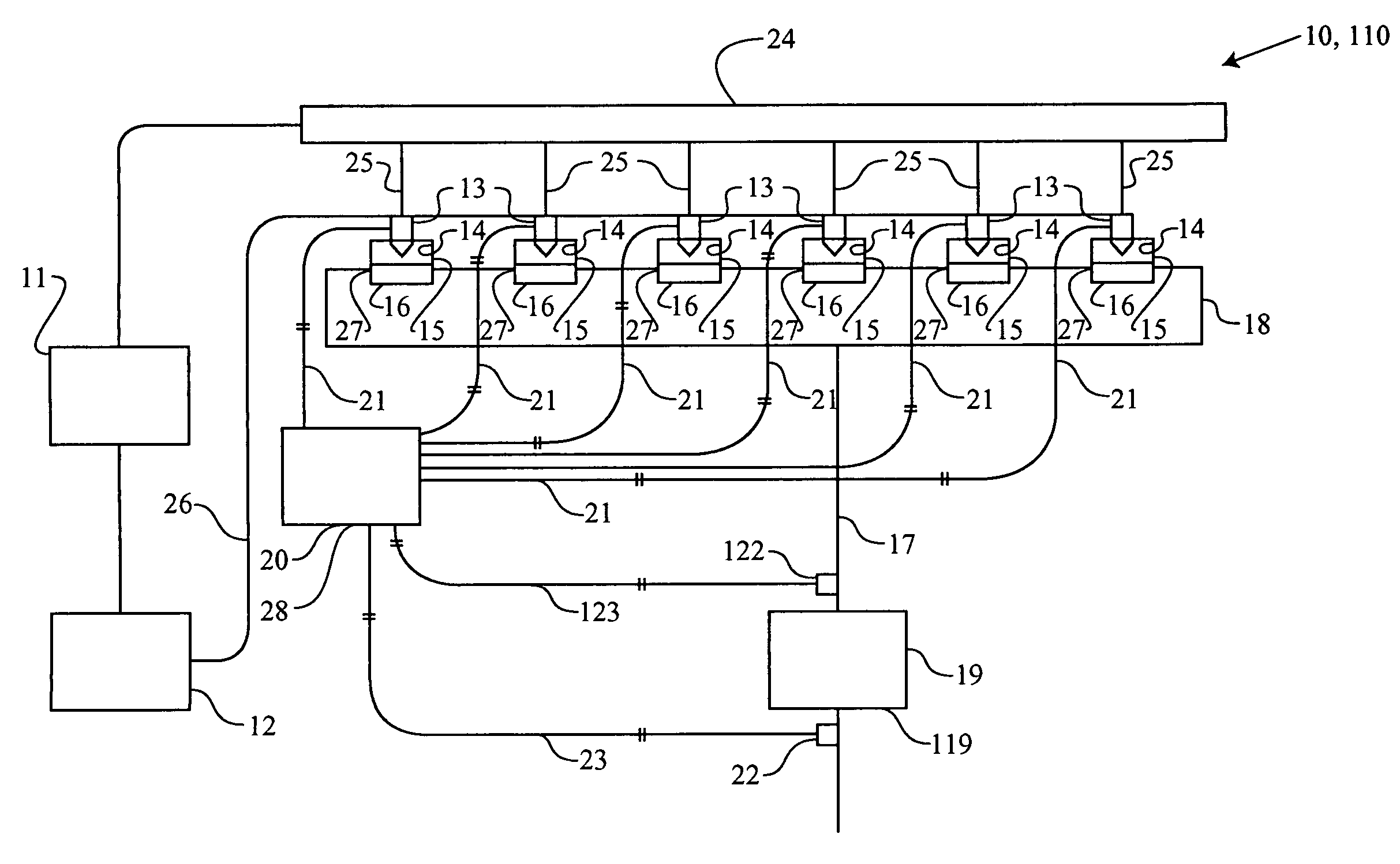
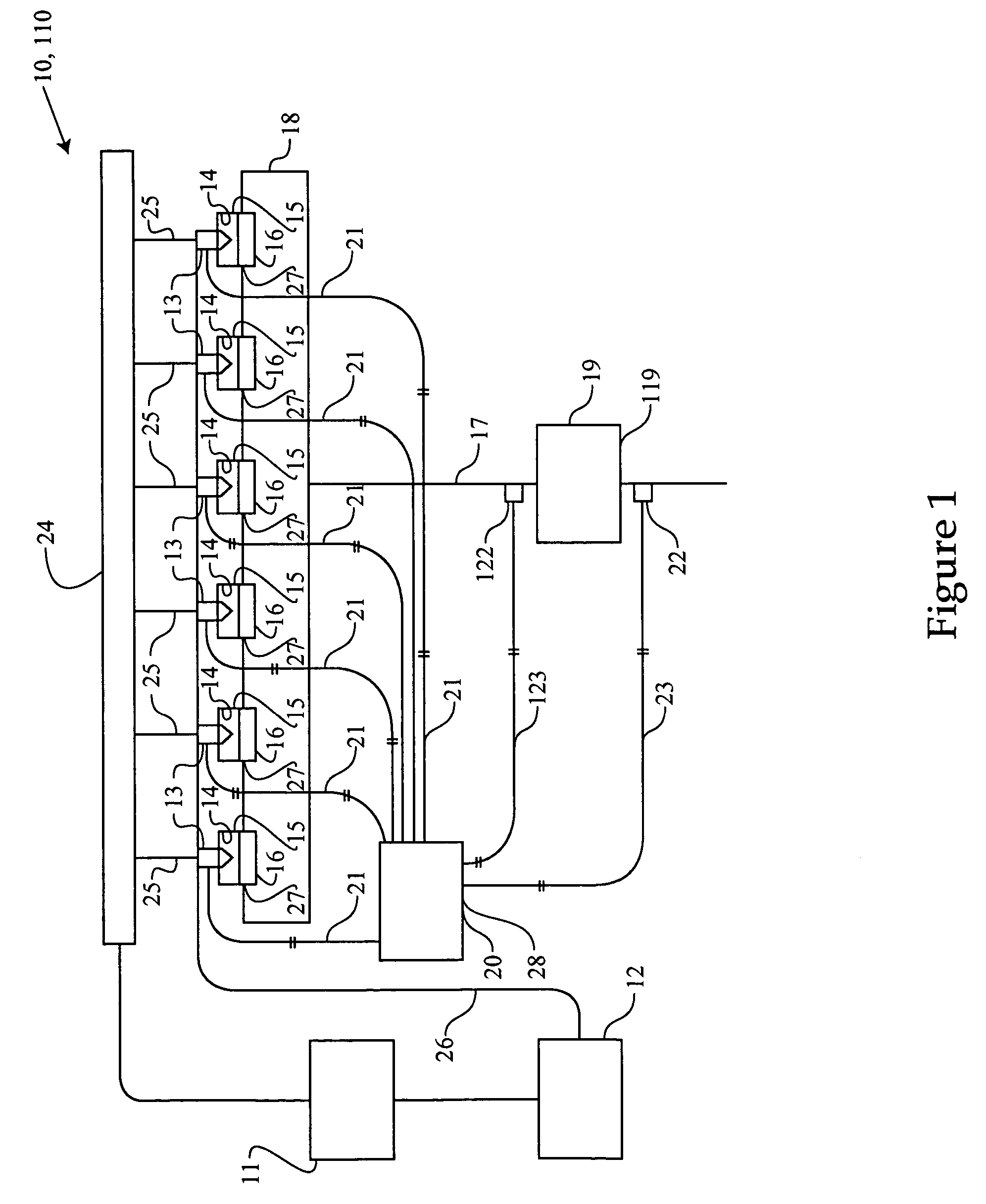
[0021] an article 28 includes a computer readable storage medium on which a regeneration algorithm is stored. The article 28 includes the electronic control module 20. The regeneration algorithm is operable to signal each fuel injector 13 to inject an additional amount of fuel in the first spray pattern 52 during at least one of the expansion stroke and the exhaust stroke of at least one engine cycle within the regeneration phase of the NOx adsorber 19. Because the additional amount of fuel is being injected during the exhaust or expansion stroke, the combustion chamber 14 is in a non-combustible environment and the additional amount of fuel will be unburnt when moved into the exhaust passage 17. The unburnt fuel will create the reductant-rich conditions needed for regeneration of the NOx adsorber 19. The regeneration algorithm includes a determining algorithm operable to determine when the regeneration phase of the NOx adsorber 19 begins and ends. Although the determining algorithm...
third embodiment
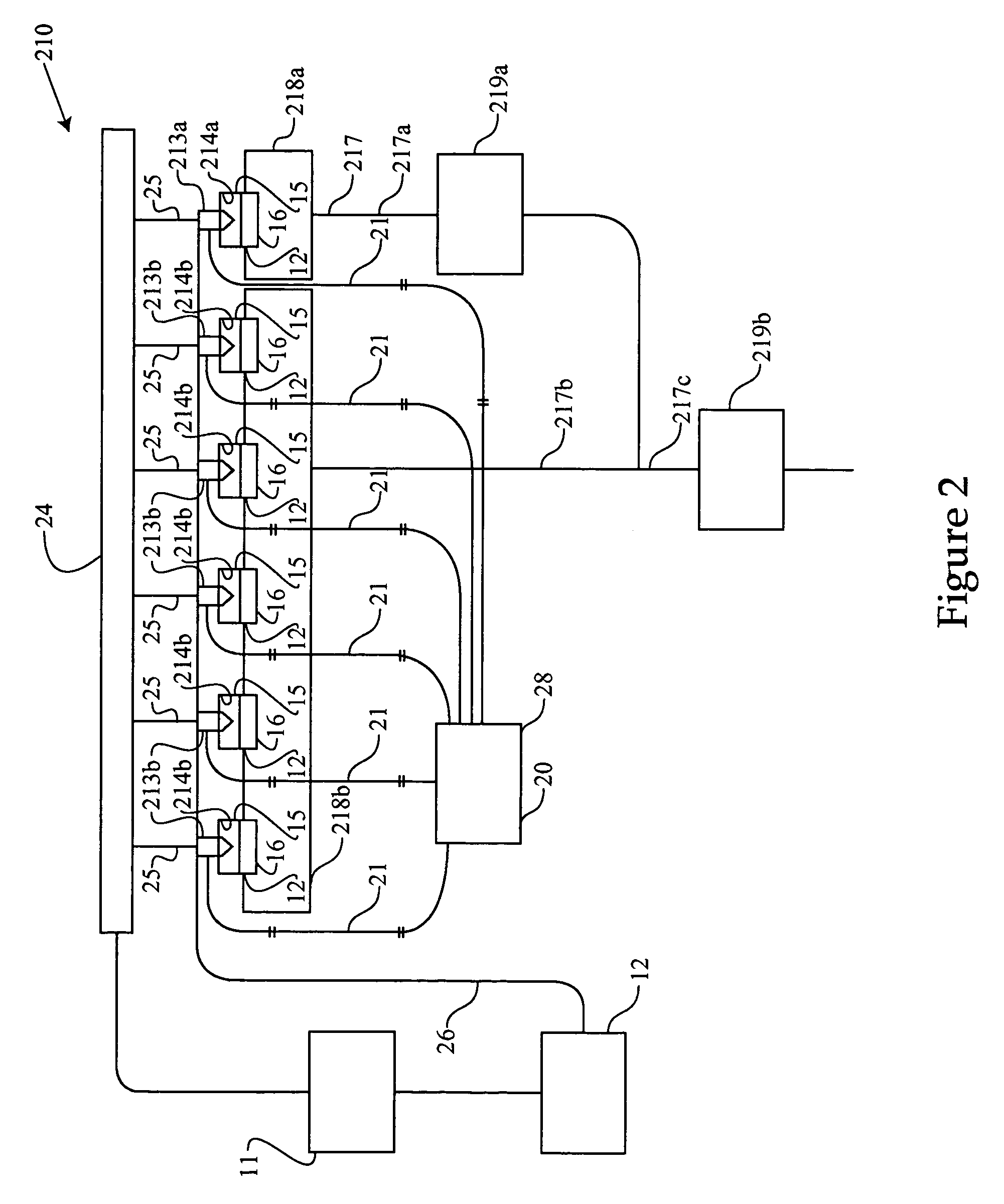
[0026]Referring to FIG. 2, there is shown a schematic representation of an exhaust after-treatment system 210, according to the present disclosure. A first exhaust manifold 218a fluidly connects one of the combustion chambers, referred to as a first combustion chamber 14a, with a first section 17a of the exhaust passage 17. A second exhaust manifold 218b fluidly connects a second portion of the combustion chambers 14b, illustrated as five combustion chambers, with a second section 17b of the exhaust passage 17. The first and second sections 17a and 17b of the exhaust passage 17 merge to form a merged section 17c of the exhaust passage 17. It should be appreciated that any number of combustion chambers could be fluidly connected to the first exhaust manifold and the second exhaust manifold depending on the desired power output and other known considerations. The plurality of fuel injectors 213 are divided into a first group, being a first fuel injector 213a operable to inject fuel in...
PUM
 Login to View More
 Abstract
Description
Claims
Application Information
 Login to View More
 - R&D
- Intellectual Property
- Life Sciences
- Materials
- Tech Scout
- Unparalleled Data Quality
- Higher Quality Content
- 60% Fewer Hallucinations
Browse by: Latest US Patents, China's latest patents, Technical Efficacy Thesaurus, Application Domain, Technology Topic, Popular Technical Reports.
© 2025 PatSnap. All rights reserved.Legal|Privacy policy|Modern Slavery Act Transparency Statement|Sitemap|About US| Contact US: help@patsnap.com