

Anti-CD30 stalk and anti-CD30 antibodies suitable for use in immunotoxins
an anti-cd30 and anti-cd30 technology, applied in the field of anti-cd30 stalk and anti-cd30 antibodies suitable for use in immunotoxins, can solve the problems of reducing the ability of cell killing or labeling, the state of the art does not yet permit predicting which antibodies, and the immunogenic activity of the immunotoxins is only moderate, so as to reduce the immunogenicity, inhibit the growth of cancer cells, and reduce the effect of immunogenicity
- Summary
- Abstract
- Description
- Claims
- Application Information
AI Technical Summary
Benefits of technology
Problems solved by technology
Method used
Image

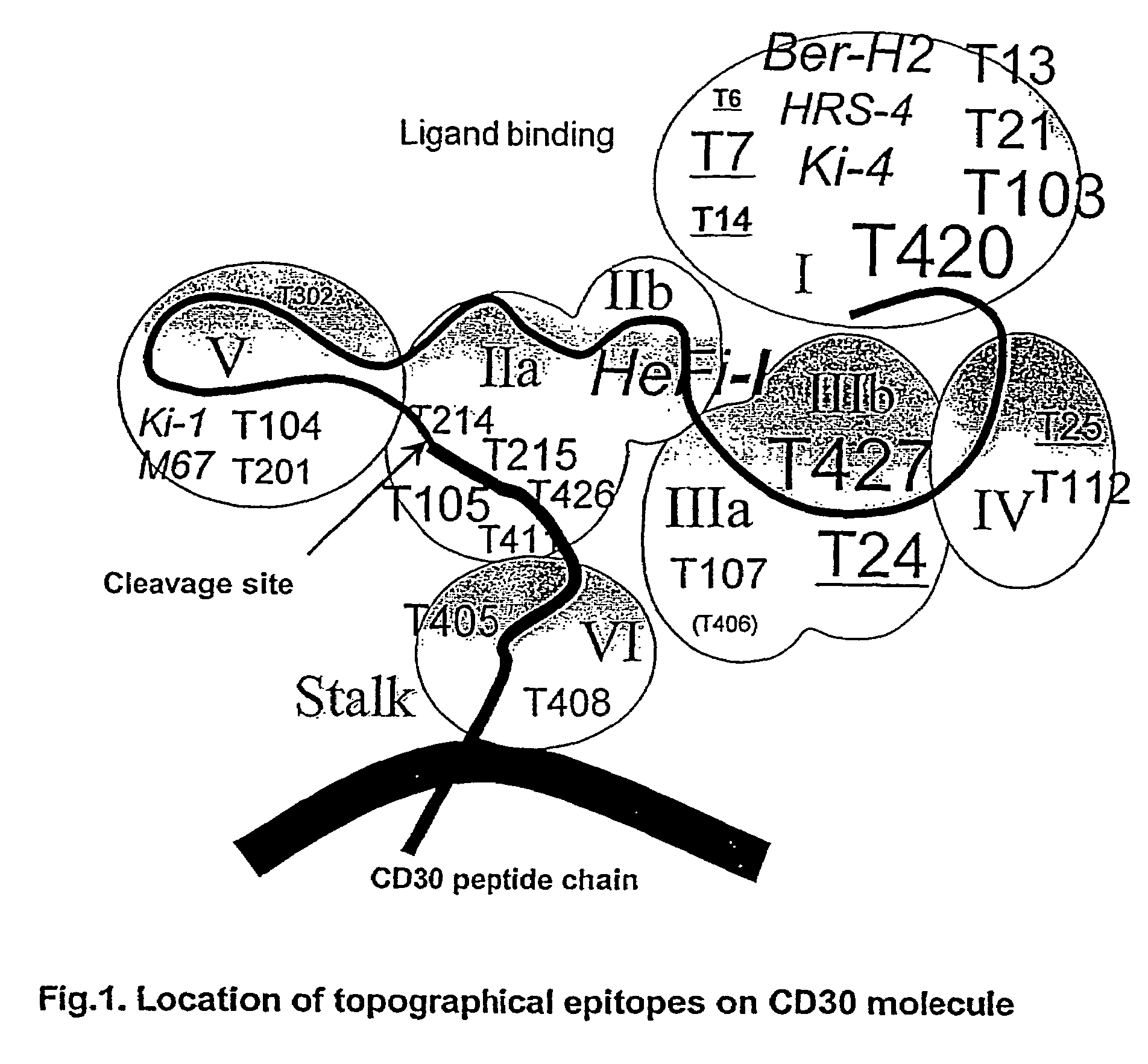
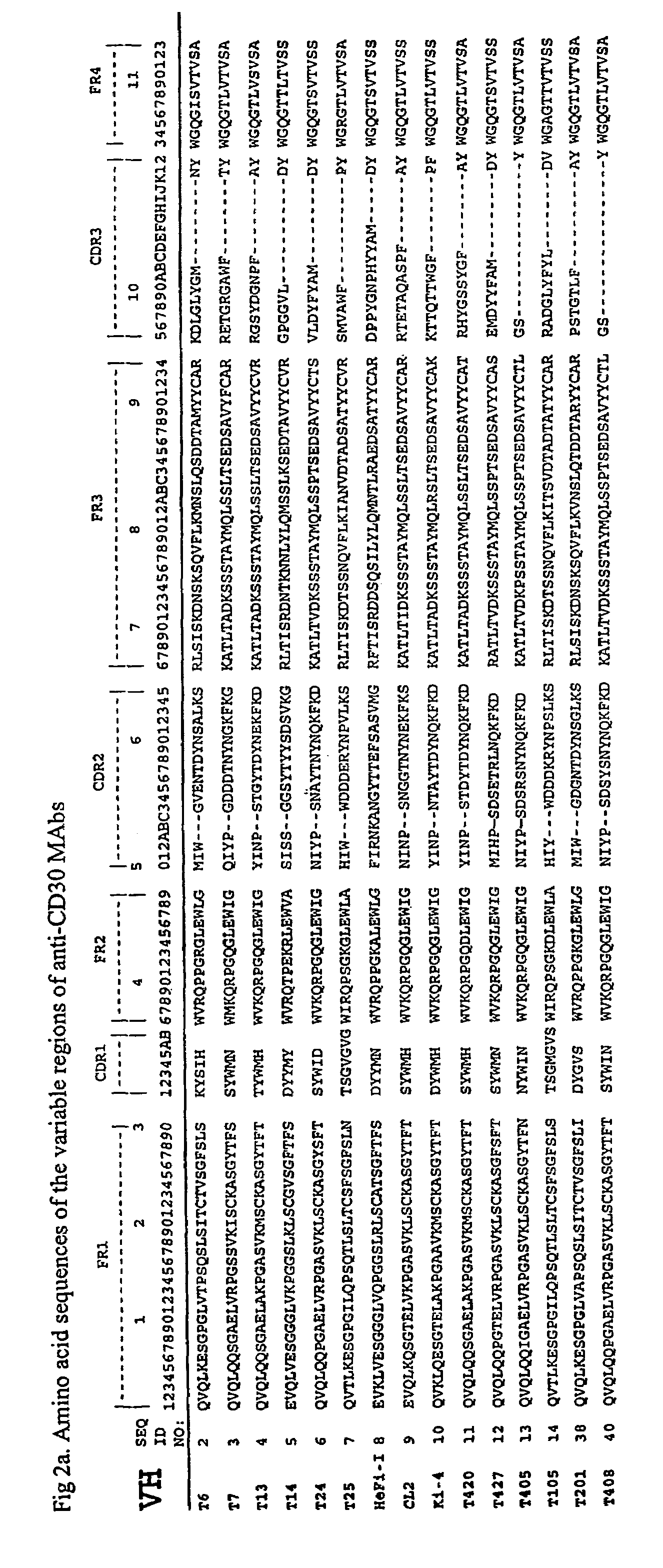
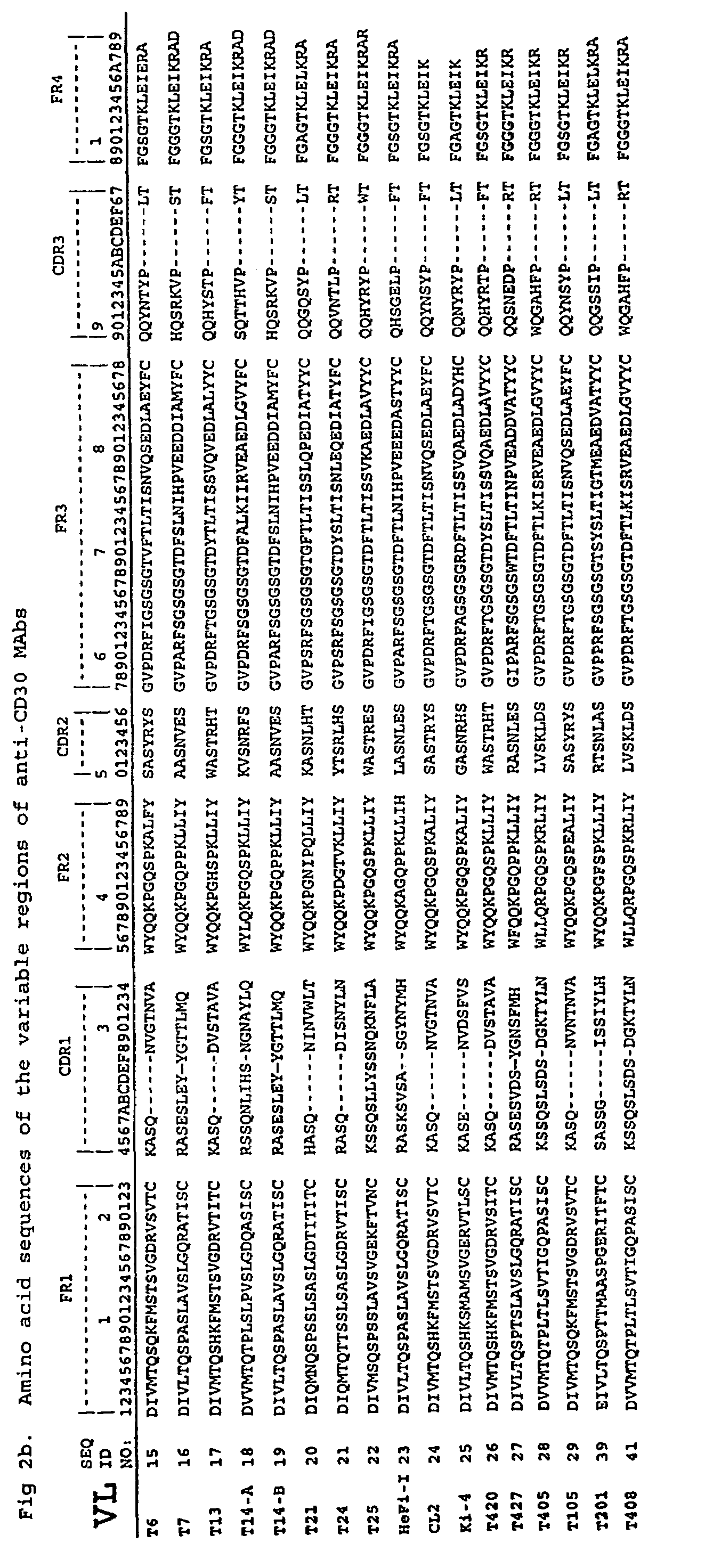
Examples
example 1
[0199]This Example sets forth the materials and methods used in the studies reported in the next Example.
[0200]Cells. All cells were cultured in Iscove's modified Dulbeccos' medium (GIBCO BRL, Gaithersburg, Md.) supplemented with 10% fetal bovine serum (FBS); 13 human cell lines were used in the studies reported in Example 2. A431-CD30 (Rozemuller et al., Int. J. Cancer, 92:861-870 (2001) (“Rozemuller 2001”)) and ATac-4 cells (Kreitman et al., Blood, 83:426-434 (1994)) are stable transformants of A431 cells that express CD30 and CD25 on the cell surface, respectively. L540, L428, L591 (from Dr. C. S. Duckett, NIH) and KM-H2 (from Dr. C. S. Duckett, NIH) were cell lines established from HL. KARPAS-299, SR-786, SUDHL-1, and SUP-M2 were ALCL-derived cell lines available from the German Collection of Microorganisms and Cell Cultures (DSMZ, Braunschweig, Germany). HUT102W and SIT are HTLV-1-positive adult T-cell leukemia cell lines (from Dr. N. Alima, Kagoshima University, Japan). DEL (f...
example 2
[0213]This Example reports the results of studies conducted using antibodies developed using the materials and methods of Example 1.
[0214]Production of Anti-CD30 MAbs. It has previously been reported that immunization of different strains of mice with a full-length human CD30 cDNA under the control of cytomegalovirus promoter induced extremely high anti-serum titers to the extracellular domain of CD30 (>106 by ELISA) (Rozemuller 2001). In this study, DNA-immunization was followed by 3-4 additional injections of recombinant sCD30 protein produced in E. coli (the extracellular domain of CD30 with His-tag on its C-terminus). Mice showing a good response to the protein boost reflected in the anti-CD30 serum titer were used for the production of MAbs. Three cell fusion experiments yielded a total or 6 specific hybridomas that secreted anti-CD30 MAbs in the culture medium. All of the MAbs reacted to sCD30 or CD30-Fc coated on plates by ELISA.
[0215]Characterization of Anti-CD30 MAbs. The c...
example 3
[0226]This Example discusses the results of the studies reported in Examples 1 and 2.
[0227]In this study, four anti-CD30 dsFv-based recombinant immunotoxins were produced whose Fvs originated from newly produced anti-CD30 MAbs. Two of the four immunotoxins showed particularly strong cytotoxic activity to CD30-positive cells. These two immunotoxins recognized two different epitopes on the CD30 molecule and both showed a relatively high affinity to CD30, suggesting that the affinity is an important factor in determining the efficacy of these anti-CD30 immunotoxins. Because these immunotoxins showed specific cytotoxicity against a wide range of CD30-positive cancer cell lines, they are expected to be useful agents for the treatment of CD30-positive hematologic malignancies.
[0228]Production and Characterization of Anti-CD30 MAbs. Various Fvs were isolated to test their suitability for making recombinant immunotoxins. In a previous study, specific scFvs for CD30 were isolated by panning ...
PUM
| Property | Measurement | Unit |
|---|---|---|
| average bond energy | aaaaa | aaaaa |
| temperature | aaaaa | aaaaa |
| temperature | aaaaa | aaaaa |
Abstract
Description
Claims
Application Information
 Login to View More