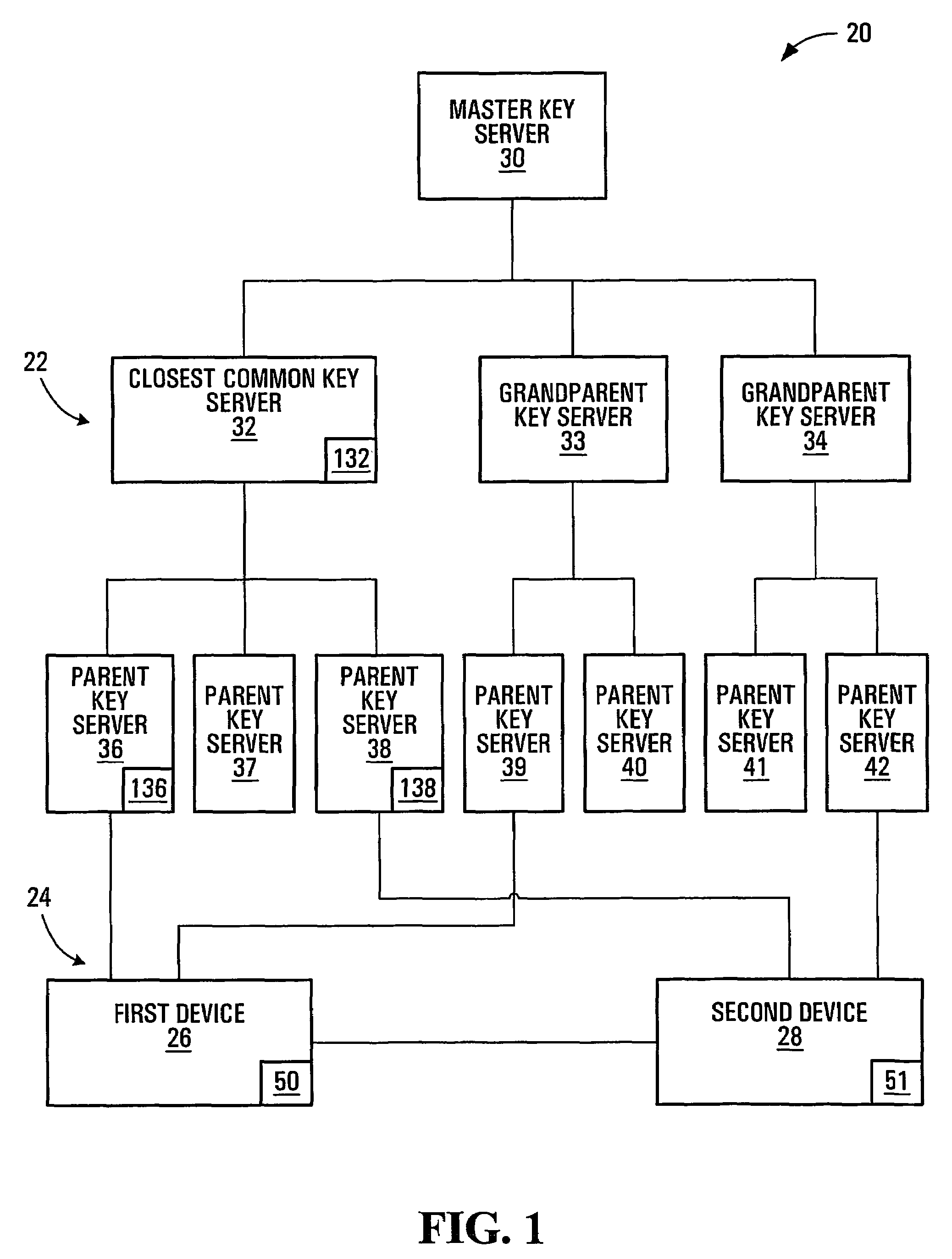
[0009]In accordance with another aspect of the invention, there is provided a method of facilitating secure communication between first and second devices. The method includes automatically identifying a common key server potentially accessible by both the first and second devices, and obtaining a secure private key from the common key server, for use in encrypting communications between the first and second devices.
[0010]Advantageously, as the method includes automatically identifying a common key server potentially accessible by both the first and second devices, it is not necessary for the first and second devices to know the identity of the common key server in advance, nor is it necessary for them to have previously exchanged mutual keys with the common key server. It is sufficient for the first and second devices to know that they wish to communicate securely with each other, and for each of the devices to have a parent key server (not necessarily the same key server). In addition, as a private key is obtained for encryption purposes, the method is not susceptible to potentially exploitable security weaknesses associated with asymmetric encryption.
[0016]Identifying may include identifying as the common key server, from among a group of key servers each of which is identified in both the first and second lists, the key server having the shortest communications paths to the first and second devices. Advantageously therefore, in such embodiments, the time required to obtain the private key is potentially reduced in comparison to systems that always rely on a single key server.
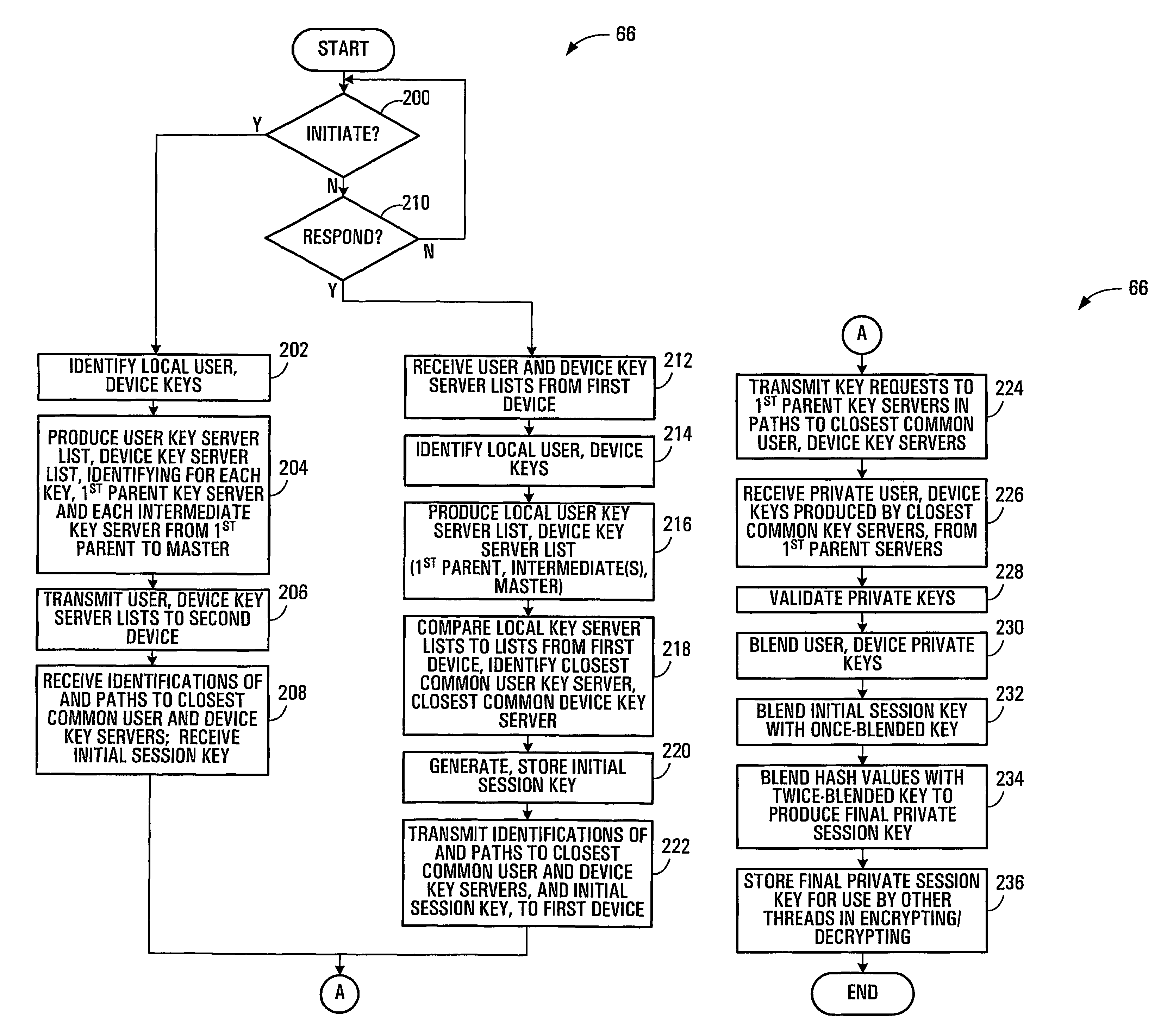
[0026]Blending may include encrypting at least one of the first and second private keys and the initial session key using at least one other of the first and second private keys and the initial session key. For example, blending may include encrypting the first private key using the second private key to produce a once-encrypted key. Similarly, blending may further include encrypting the once-encrypted key using the initial session key to produce a twice-encrypted key. Blending may further include generating a hash value in response to the twice-encrypted key, and appending the hash value to the twice-encrypted key. Blending may further include deleting a portion of the twice-encrypted key other than the hash value appended thereto, the deleted portion having a length equal to the hash value appended thereto. Blending may further include repeating the steps of generating and appending a hash value to the twice-encrypted key and deleting a portion of the twice-encrypted key until the twice-encrypted key has been entirely replaced with appended hash values. Advantageously, in such embodiments, the final private session key so generated is a truly private key, with no corresponding root keys stored in a software program or on the device or on a publicly accessible key server. As the final private session key has not been directly transmitted over the Internet (or other network) at all, and no devices other than the first and second devices have all the data necessary to create the final private session key, security is considerably enhanced as compared to conventional secure communications systems.
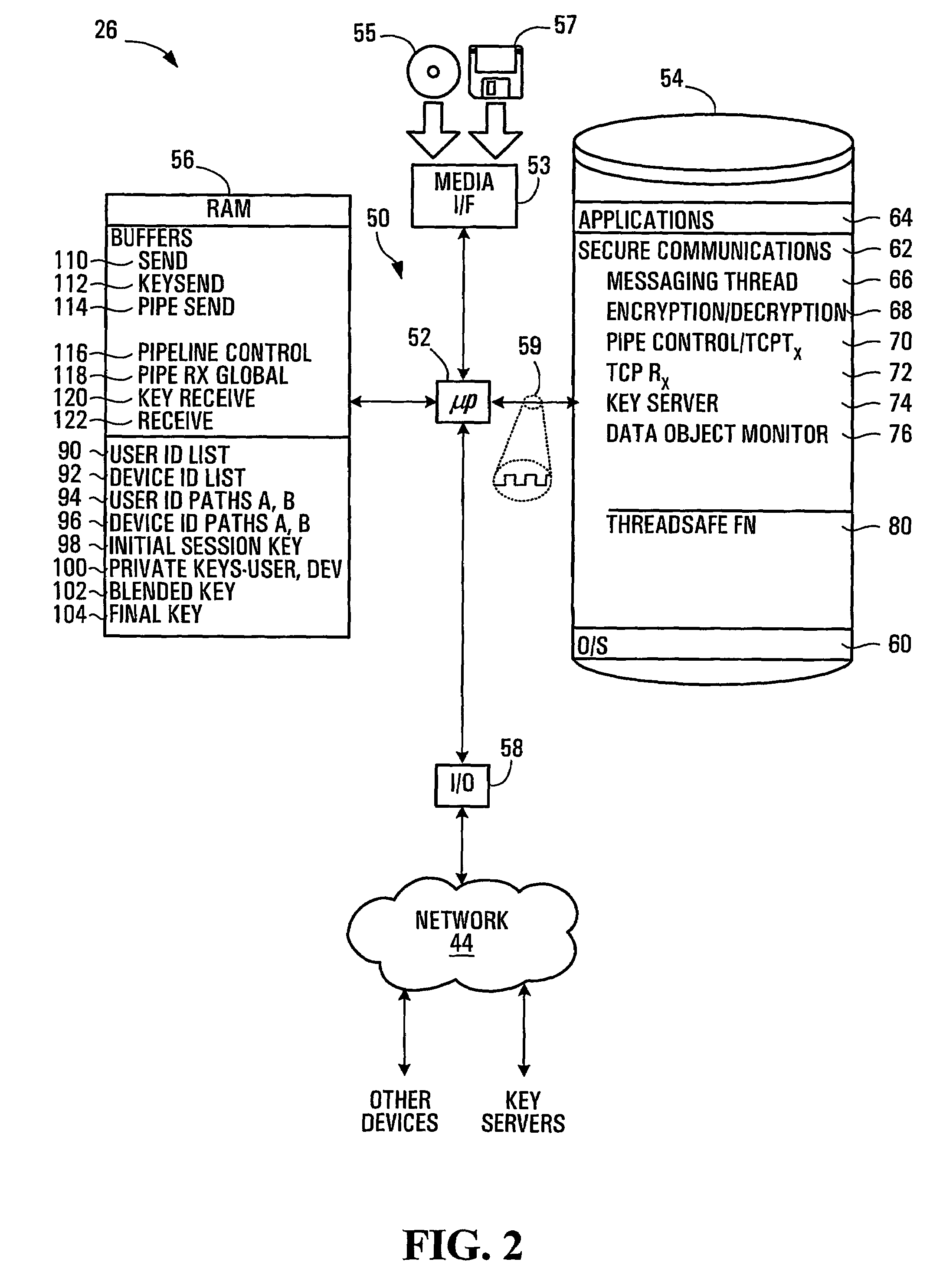
[0029]In accordance with another aspect of the invention, there is provided an apparatus for facilitating secure communication between first and second devices. The apparatus includes a processor circuit capable of communication with a network. The processor circuit is configured to identify a common key server potentially accessible by both the first and second devices. The processor circuit is also configured to obtain a secure private key from the common key server, for use in encrypting communications between the first and second devices.
[0031]In accordance with another aspect of the invention, there is provided an apparatus for facilitating secure communication between first and second devices. The apparatus includes means for identifying a common key server potentially accessible by both the first and second devices. The apparatus further includes means for obtaining a secure private key from the common key server, for use in encrypting communications between the first and second devices.


 Login to View More
  Login to View More